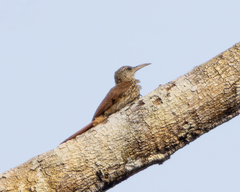
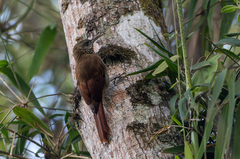
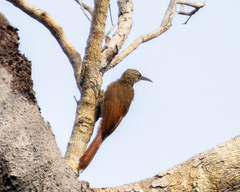

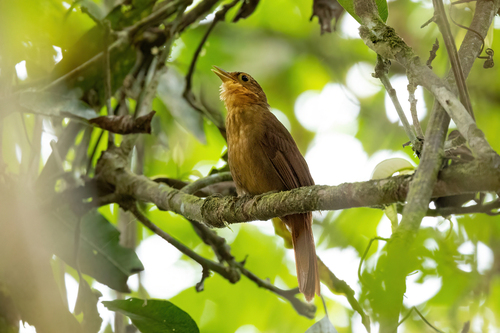
Inambari Woodcreeper

Inambari Woodcreeper

Lepidocolaptes fatimalimae

Silhouette: Sheatherius · PhyloPic

LCLeast ConcernNTVUENCR
Daily sighting probability <5% · Rare
at Manu National Park

In 3 days ~10% in a week ~20%

107 Verified sightings at Manu National Park From 2019 to 2026
298 In all 2 parks
July Best month
☀️ Diurnal When it's spotted

About the Inambari Woodcreeper

The Inambari woodcreeper (Lepidocolaptes fatimalimae) is a species of bird in the subfamily Dendrocolaptinae of the ovenbird family Furnariidae. It is found in Bolivia, Brazil, and Peru. The Inambari woodcreeper was described in 2013 as part of the reevaluation of Lepidocolaptes albolineatus, which was then called the lineated woodcreeper. Starting in the early 2010s, all but the lineated's nominate subspecies were split from it, eventually resulting in recognition of the Inambari woodcreeper (which had not been known as a subspecies), the Duida woodcreeper (L. duidae), the dusky-capped woodcreeper (L. fuscicapillus), and a monotypic L. albolineatus which was renamed the Guianan woodcreeper.

The Inambari woodcreeper's specific epithet honors Fátima Lima, manager of bird collections at the Museu Paraense Emílio Goeldi. The Inambari woodcreeper is monotypic. The Inambari woodcreeper is 17 to 19 cm (6.7 to 7.5 in) long and weighs about 31 to 35 g (1.1 to 1.2 oz). It is a smallish, slim, woodcreeper with a slim decurved bill. The sexes have the same plumage. Adults' face, crown, and nape are dark russet-brown with few or no spots on the... Wikipedia →

Sounds

Song0:17

Bolivia · 2021

© Jacob Wijpkema · XC688332 · CC BY-NC-SA 4.0

Vesper song0:35

Bolivia · 2023

© Richard E. Webster · XC864465 · CC BY-NC-SA 4.0

Canto0:15

Brazil · 2018

© Caio Brito · XC556387 · CC BY-NC-SA 4.0

Global Distribution

Parks Where Found

# Park Country Daily sighting probability
1 Tambopata National Reserve 🇵🇪 Peru
~10%
2 Manu National Park 🇵🇪 Peru
<5%

Before you go

What are the chances of seeing an Inambari Woodcreeper in Manu National Park?

Rare

Under 5% of wildlife watchers report an Inambari Woodcreeper sighting in Manu National Park on a given day, based on 107 verified sightings from GBIF citizen-science data from 2019 to 2026. It is the 373rd most-seen of the 641 birds we can rate there. Over three days the chance rises to about 10%, and over a week to about 20%, if each day is a fresh chance.

When is the best time to see an Inambari Woodcreeper in Manu National Park?

July

In that month about 10% of wildlife watchers report an Inambari Woodcreeper in Manu National Park on a given day, against under 5% in August to June, the lowest months. That is one of Manu National Park's driest months, with about 70 mm of rain against 290 mm in February.

What time of day is best to see an Inambari Woodcreeper?

Between 9 am and noon

Across all the parks we cover, that three-hour window holds the most Inambari Woodcreeper sightings with a recorded time, and about 8 in 10 of them come between 6 am and 6 pm: it is a daytime animal.

Is Manu National Park the best place to see an Inambari Woodcreeper?

2nd of 2

Of the 2 parks where we can rate Inambari Woodcreeper sightings, Manu National Park ranks 2nd at under 5%. The best odds are in Tambopata National Reserve (Peru, about 10%).

Which relatives of the Inambari Woodcreeper live in Manu National Park?

Same family: Furnariidae

The closest relatives of the Inambari Woodcreeper that you can see in Manu National Park (family Furnariidae, Ovenbirds and Woodcreepers) are Buff-throated Woodcreeper (about 30%), Pale-legged Hornero (about 20%) and Plain-crowned Spinetail (about 20%), with each one's daily chance of a sighting.

Where does the Inambari Woodcreeper sighting chance come from?

GBIF citizen-science records

It is estimated from how often the Inambari Woodcreeper is recorded against all the birds logged in Manu National Park (107 verified sightings from 2019 to 2026), calibrated against known sighting rates. Figures are rounded to the nearest 10% because citizen-science data supports honest approximations, not decimals, and months with records from fewer than five people show "—". How it works.

← Back to Manu National Park