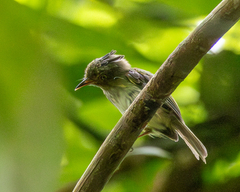
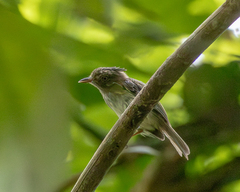

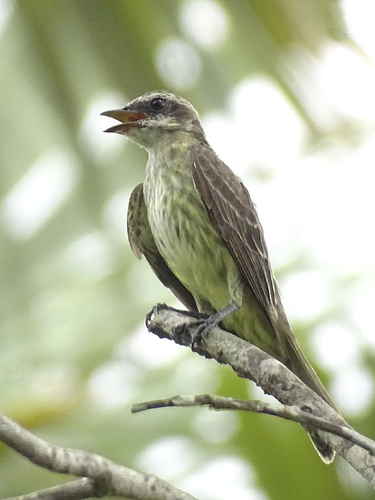
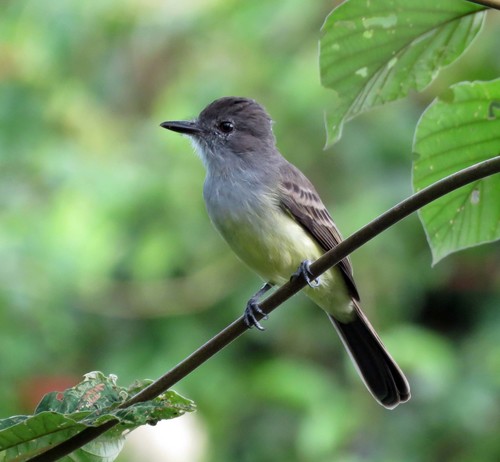
Long-crested Pygmy-Tyrant

Long-crested Pygmy-Tyrant

Lophotriccus eulophotes

Silhouette: Emily Willoughby · PhyloPic

LCLeast ConcernNTVUENCR
Daily sighting probability <5% · Rare
at Manu National Park

In 3 days <5% in a week ~10%

46 Verified sightings at Manu National Park From 2019 to 2026
46 In 1 park
August Best month
☀️ Diurnal When it's spotted

About the Long-crested Pygmy-Tyrant

The long-crested pygmy tyrant (Lophotriccus eulophotes) is a species of bird in the family Tyrannidae, the tyrant flycatchers. It is found in the western Amazon Basin of Bolivia, Brazil and Peru. The long-crested pygmy tyrant has had the binomial Lophotriccus eulophotes since it was originally described in 1925. It is monotypic. However, several early twentieth century authors treated it and what is now the double-banded pygmy tyrant (L. vitiosus) as conspecific. In addition, several authors have suggested that genus Lophotriccus should be merged into genus Hemitriccus.

The long-crested pygmy tyrant is 10 to 10.5 cm (3.9 to 4.1 in) long and weighs 6.5 to 8 g (0.23 to 0.28 oz). The sexes have the same plumage. Adults have long black crown feathers with gray edges. They form the eponymous crest that it sometimes erects and fans; they extend beyond the rear of the head when folded. Adults have whitish lores on an otherwise olive face. Their back, rump, and uppertail coverts are olive. Their wings are dusky with olive tips on the coverts; the latter show very weakly as two wing bars. Their tail is dusky. Their throat and underparts are whitish... Wikipedia →

Sounds

Canto1:15

Brazil · 2018

© Caio Brito · XC556395 · CC BY-NC-SA 4.0

Song1:02

Brazil · 2019

© Felipe Arantes · XC475748 · CC BY-NC-SA 4.0

Call0:33

Bolivia · 2021

© Jacob Wijpkema · XC686802 · CC BY-NC-SA 4.0

Global Distribution

Parks Where Found

# Park Country Daily sighting probability
1 Manu National Park 🇵🇪 Peru
<5%

More parks will be added in future updates.

Before you go

What are the chances of seeing a Long-crested Pygmy-Tyrant in Manu National Park?

Rare

Under 5% of wildlife watchers report a Long-crested Pygmy-Tyrant sighting in Manu National Park on a given day, based on 46 verified sightings from GBIF citizen-science data from 2019 to 2026. It is the 443rd most-seen of the 641 birds we can rate there. Over three days the chance rises to under 5%, and over a week to about 10%, if each day is a fresh chance.

When is the best time to see a Long-crested Pygmy-Tyrant in Manu National Park?

Any time of year

In every month with enough records, under 5% of wildlife watchers report a Long-crested Pygmy-Tyrant in Manu National Park on a given day, so our monthly data shows no clear season.

What time of day is best to see a Long-crested Pygmy-Tyrant?

Between 10 am and 1 pm

Across all the parks we cover, that three-hour window holds the most Long-crested Pygmy-Tyrant sightings with a recorded time, and about 8 in 10 of them come between 6 am and 6 pm: it is a daytime animal.

Where else can you see a Long-crested Pygmy-Tyrant?

Only Manu National Park, in our data

Manu National Park is the only park on Wallace's Line with enough records to rate Long-crested Pygmy-Tyrant sightings: under 5% of wildlife watchers there report one on a given day.

Which relatives of the Long-crested Pygmy-Tyrant live in Manu National Park?

Same family: Tyrannidae

The closest relatives of the Long-crested Pygmy-Tyrant that you can see in Manu National Park (family Tyrannidae, Tyrant Flycatchers) are Social Flycatcher (about 40%), Tropical Kingbird (about 40%) and Great Kiskadee (about 30%), with each one's daily chance of a sighting.

Where does the Long-crested Pygmy-Tyrant sighting chance come from?

GBIF citizen-science records

It is estimated from how often the Long-crested Pygmy-Tyrant is recorded against all the birds logged in Manu National Park (46 verified sightings from 2019 to 2026), calibrated against known sighting rates. Figures are rounded to the nearest 10% because citizen-science data supports honest approximations, not decimals, and months with records from fewer than five people show "—". How it works.

← Back to Manu National Park