American Snail-eater

American Snail-eater

Dipsas articulata

Silhouette: Alex Slavenko · PhyloPic

LCLeast ConcernNTVUENCR
Daily sighting probability ~10% · With luck
at Gandoca-Manzanillo Wildlife Refuge

In 3 days ~30% in a week ~50%

5 Verified sightings at Gandoca-Manzanillo Wildlife Refuge From 2019 to 2026
22 In all 3 parks
November Best month
🌙 Nocturnal When it's spotted

About the American Snail-eater

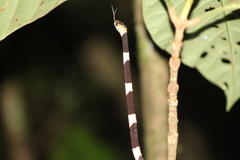
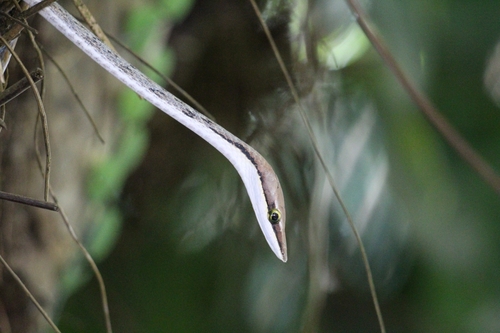
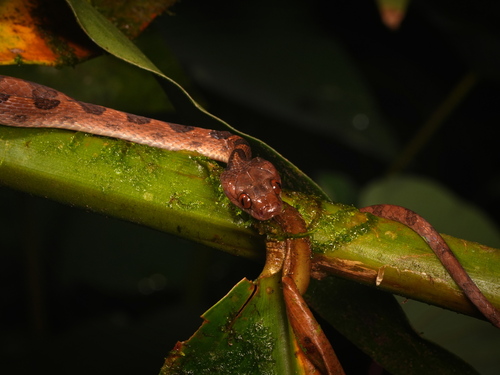
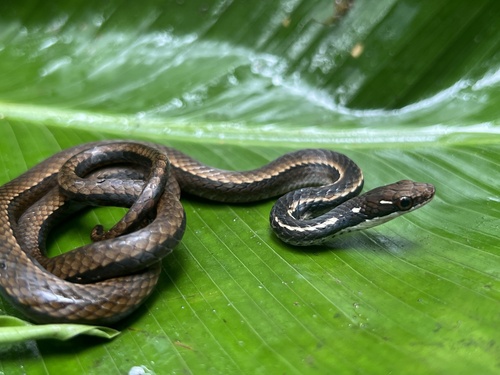
Dipsas articulata, commonly known as the American snail-eater, is a non-venomous species of snake found in Nicaragua, Costa Rica and Panama. D. articulata is known by a few names including the American snail-eater, but also the red-striped thirst snake and the Central American snail-eater.

The distribution of this species extends from the lowlands of southeastern Nicaragua to northwestern Panama. It has been identified mostly in parks, reserves, and other natural areas, like the Tirimbina Biological Reserve in Costa Rica and Portobelo National Park in Panama. The first record in Nicaragua was in 2002 during a herpetofaunal survey in Refugio Bartola when a male individual was found coiled up partially obscured by a vine on a tree trunk. A new record in Coclé, Panama in 2014 in a mid-elevation cloud forest extended its known geographic range slightly.

This arboreal species of snake has been found in lowland tropical wet forests. It is commonly found perched on trees or in vegetation low to the ground, likely searching for its main diet of terrestrial snails. There is a record of an individual found in a bromeliad attached to a fallen tree... Wikipedia →

Global Distribution

Parks Where Found

# Park Country Daily sighting probability
1 Gandoca-Manzanillo Wildlife Refuge 🇨🇷 Costa Rica
~10%
2 Cahuita National Park 🇨🇷 Costa Rica
~10%
3 Arenal Volcano National Park 🇨🇷 Costa Rica
~10%

Before you go

What are the chances of seeing an American Snail-eater in Gandoca-Manzanillo Wildlife Refuge?

With luck

About 10% of wildlife watchers report an American Snail-eater sighting in Gandoca-Manzanillo Wildlife Refuge on a given day, based on 5 verified sightings from GBIF citizen-science data from 2019 to 2026. It is the 31st most-seen of the 33 reptiles we can rate there. Over three days the chance rises to about 30%, and over a week to about 50%, if each day is a fresh chance.

When is the best time to see an American Snail-eater in Gandoca-Manzanillo Wildlife Refuge?

November

In that month about 40% of wildlife watchers report an American Snail-eater in Gandoca-Manzanillo Wildlife Refuge on a given day, against under 5% in October and December–August, the lowest months.

What time of day is best to see an American Snail-eater?

Between 7 and 10 pm

Across all the parks we cover, that three-hour window holds the most American Snail-eater sightings with a recorded time, and about 8 in 10 of them come between 6 pm and 6 am: it is mostly seen at night.

Is Gandoca-Manzanillo Wildlife Refuge the best place to see an American Snail-eater?

Yes

Of the 3 parks where we can rate American Snail-eater sightings, Gandoca-Manzanillo Wildlife Refuge has the highest daily chance: about 10%. Next come Cahuita National Park (Costa Rica, about 10%) and Arenal Volcano National Park (Costa Rica, about 10%).

Which relatives of the American Snail-eater live in Gandoca-Manzanillo Wildlife Refuge?

Same family: Colubridae

The closest relatives of the American Snail-eater that you can see in Gandoca-Manzanillo Wildlife Refuge (family Colubridae, Colubrid Snakes) are Köhler’s Vine Snake (about 30%), Blunthead Tree Snake (about 20%) and Cloudy Snail-eating Snake (about 20%), with each one's daily chance of a sighting.

Where does the American Snail-eater sighting chance come from?

GBIF citizen-science records

It is estimated from how often the American Snail-eater is recorded against all the reptiles logged in Gandoca-Manzanillo Wildlife Refuge (5 verified sightings from 2019 to 2026), calibrated against known sighting rates. Figures are rounded to the nearest 10% because citizen-science data supports honest approximations, not decimals, and months with records from fewer than five people show "—". How it works.

← Back to Gandoca-Manzanillo Wildlife Refuge