Blunthead Tree Snake

Blunthead Tree Snake

Imantodes cenchoa

Silhouette: PhyloPic

LCLeast ConcernNTVUENCR
Daily sighting probability ~20% · Possible
at Gandoca-Manzanillo Wildlife Refuge

In 3 days ~60% in a week ~90%

20 Verified sightings at Gandoca-Manzanillo Wildlife Refuge From 2019 to 2026
756 In all 29 parks
December Best month
🌙 Nocturnal When it's spotted

About the Blunthead Tree Snake

Imantodes cenchoa, also known commonly as the blunthead tree snake, the neotropical blunt-headed tree snake, and the fiddle-string snake, is a species of mildly venomous, rear-fanged snake in the family Colubridae. The species is native to Mexico, Central America, and South America.

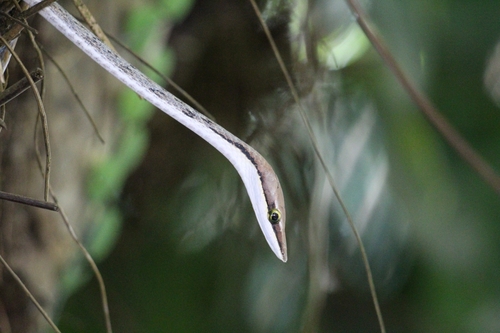
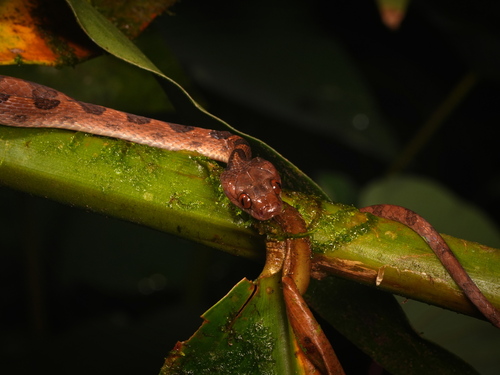
The blunthead tree snake averages about 800 mm (31 in) in total length (including tail). Maximum total length is about 1.5 m (4 ft 11 in). I. cenchoa is known for its long, slender body and very large head. The pupil of its eye is very distinct from other snakes. Most snakes found around the world are known to have very poor vision and rely mostly on smell and vibrations to detect signs of prey and predators. Arboreal snakes have much better vision than other snakes. The blunthead tree snake has a vertical slit for a pupil which allows the snake to look downward. This trait gives the blunthead tree snake an advantage over other snakes. The large eyes make up approximately 26% of its head.

The ventral surface, or stomach, of the blunthead tree snake is mostly white, while the dorsal surface, or top, is a light or pale brown with lateral dark brown patches that begin at the head and continue... Wikipedia →

Global Distribution

Parks Where Found

# Park Country Daily sighting probability
1 Pico Bonito National Park 🇭🇳 Honduras
~50%
2 Cusuco National Park 🇭🇳 Honduras
~40%
3 Tortuguero National Park 🇨🇷 Costa Rica
~40%
4 Braulio Carrillo National Park 🇨🇷 Costa Rica
~40%
5 Yasuní National Park 🇪🇨 Ecuador
~30%
6 Brownsberg Nature Park 🇸🇷 Suriname
~30%
7 Tambopata National Reserve 🇵🇪 Peru
~30%
8 Piedras Blancas National Park 🇨🇷 Costa Rica
~30%
9 Bastimentos Island National Marine Park 🇵🇦 Panama
~30%
10 Cockscomb Basin Wildlife Sanctuary 🇧🇿 Belize
~30%
11 Manu National Park 🇵🇪 Peru
~30%
12 Main Ridge Forest Reserve 🇹🇹 Trinidad and Tobago
~30%
13 Tenorio Volcano National Park 🇨🇷 Costa Rica
~30%
14 Gandoca-Manzanillo Wildlife Refuge 🇨🇷 Costa Rica
~20%
15 Cuyabeno Wildlife Reserve 🇪🇨 Ecuador
~20%
16 Tayrona National Natural Park 🇨🇴 Colombia
~20%
17 Lago de Yojoa 🇭🇳 Honduras
~20%
18 Arenal Volcano National Park 🇨🇷 Costa Rica
~20%
19 Amacayacu National Natural Park 🇨🇴 Colombia
~20%
20 Montes Azules Biosphere Reserve 🇲🇽 Mexico
~20%
21 Santa Rosa National Park 🇨🇷 Costa Rica
~20%
22 Cahuita National Park 🇨🇷 Costa Rica
~20%
23 Corcovado National Park 🇨🇷 Costa Rica
~20%
24 Manuel Antonio National Park 🇨🇷 Costa Rica
~10%
25 Chirripó National Park 🇨🇷 Costa Rica
~10%
26 La Amistad International Park (Panama) 🇵🇦 Panama
~10%
27 Soberanía National Park 🇵🇦 Panama
~10%
28 Monteverde Cloud Forest Reserve 🇨🇷 Costa Rica
~10%
29 Calakmul Biosphere Reserve 🇲🇽 Mexico
~10%

Zoos & Centres Where Found

# Zoo / Centre Country
1 Yumka' 🇲🇽 Mexico In captivity

Before you go

What are the chances of seeing a Blunthead Tree Snake in Gandoca-Manzanillo Wildlife Refuge?

Possible

About 20% of wildlife watchers report a Blunthead Tree Snake sighting in Gandoca-Manzanillo Wildlife Refuge on a given day, based on 20 verified sightings from GBIF citizen-science data from 2019 to 2026. It is the 17th most-seen of the 33 reptiles we can rate there. Over three days the chance rises to about 60%, and over a week to about 90%, if each day is a fresh chance.

When is the best time to see a Blunthead Tree Snake in Gandoca-Manzanillo Wildlife Refuge?

April, August and November–February

In those months about 30% of wildlife watchers report a Blunthead Tree Snake in Gandoca-Manzanillo Wildlife Refuge on a given day, against under 5% in March, June–July and September–October, the lowest months.

What time of day is best to see a Blunthead Tree Snake?

Between 7 and 10 pm

Across all the parks we cover, that three-hour window holds the most Blunthead Tree Snake sightings with a recorded time, and about 8 in 10 of them come between 6 pm and 6 am: it is mostly seen at night.

Where does the Blunthead Tree Snake sighting chance come from?

GBIF citizen-science records

It is estimated from how often the Blunthead Tree Snake is recorded against all the reptiles logged in Gandoca-Manzanillo Wildlife Refuge (20 verified sightings from 2019 to 2026), calibrated against known sighting rates. Figures are rounded to the nearest 10% because citizen-science data supports honest approximations, not decimals, and months with records from fewer than five people show "—". How it works.

← Back to Gandoca-Manzanillo Wildlife Refuge