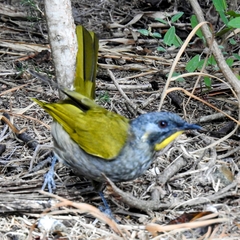
Yellow-throated Honeyeater

Yellow-throated Honeyeater

Nesoptilotis flavicollis

Silhouette: Rachael Joakim · PhyloPic

LCLeast ConcernNTVUENCR Endemic
Daily sighting probability ~30% · Possible
at Maria Island National Park

In 3 days ~60% in a week ~90%

86 Verified sightings at Maria Island National Park From 2019 to 2026
589 In all 3 parks
June Best month
🌅 Crepuscular When it's spotted

About the Yellow-throated Honeyeater

The yellow-throated honeyeater (Nesoptilotis flavicollis) is a species of passerine bird in the honeyeater family Meliphagidae. It is similar in behaviour and appearance to the white-eared honeyeater and is endemic to Australia's island state of Tasmania. It was formerly considered a pest of orchards.

The species was originally described by French ornithologist Louis Pierre Vieillot in 1817, who placed it in the genus Melithreptus. Its specific epithet is derived from the Latin words flavus 'yellow', and collis 'neck'. Other vernacular names are the green cherry-picker, green dick or green linnet.

The yellow-throated honeyeater was previously placed in the genus Lichenostomus, but was moved to Nesoptilotis after a molecular phylogenetic analysis, published in 2011, showed that the original genus was polyphyletic. It is a sister taxon to the white-eared honeyeater (N. leucotis), which occurs on mainland Australia but not in Tasmania, and they belong to a clade that contains the genera Entomyzon, Melithreptus and Foulehaio.

The yellow-throated honeyeater is a medium-sized honeyeater with a relatively long tail. Typical weight is 31 g (1.1 oz) and the... Wikipedia →

Sounds

Song0:04

Australia · 2026

© JJSUN · XC1088462 · CC BY-NC-SA 4.0

Uncertain0:15

Australia · 2022

© nick talbot · XC715554 · CC BY-NC-SA 4.0

Call1:19

Australia · 2020

© Marc Anderson · XC673999 · CC BY-NC-ND 4.0

Global Distribution

Parks Where Found

# Park Country Daily sighting probability
1 Cradle Mountain-Lake St Clair National Park 🇦🇺 Australia
~60%
2 Freycinet National Park 🇦🇺 Australia
~40%
3 Maria Island National Park 🇦🇺 Australia
~30%

Cities Where Found

# City Country Daily sighting probability
1 Hobart 🇦🇺 Australia
~20%

Before you go

What are the chances of seeing a Yellow-throated Honeyeater in Maria Island National Park?

Possible

About 30% of wildlife watchers report a Yellow-throated Honeyeater sighting in Maria Island National Park on a given day, based on 86 verified sightings from GBIF citizen-science data from 2019 to 2026. It is the 40th most-seen of the 81 birds we can rate there. Over three days the chance rises to about 60%, and over a week to about 90%, if each day is a fresh chance.

When is the best time to see a Yellow-throated Honeyeater in Maria Island National Park?

February and May–June

In those months about 40% of wildlife watchers report a Yellow-throated Honeyeater in Maria Island National Park on a given day, against about 10% in December, the lowest month.

What time of day is best to see a Yellow-throated Honeyeater?

Between 5 and 8 am

Across all the parks we cover, that three-hour window holds the most Yellow-throated Honeyeater sightings with a recorded time, and about 7 in 10 of them come between 6 pm and 6 am: it is most active around dawn and dusk.

Is Maria Island National Park the best place to see a Yellow-throated Honeyeater?

3rd of 3

Of the 3 parks where we can rate Yellow-throated Honeyeater sightings, Maria Island National Park ranks 3rd at about 30%. The best odds are in Cradle Mountain-Lake St Clair National Park (Australia, about 60%) and Freycinet National Park (Australia, about 40%).

Which relatives of the Yellow-throated Honeyeater live in Maria Island National Park?

Same family: Meliphagidae

The closest relatives of the Yellow-throated Honeyeater that you can see in Maria Island National Park (family Meliphagidae, Honeyeaters) are Yellow Wattlebird (about 80%), Black-headed Honeyeater (about 60%) and New Holland Honeyeater (about 50%), with each one's daily chance of a sighting.

Where does the Yellow-throated Honeyeater sighting chance come from?

GBIF citizen-science records

It is estimated from how often the Yellow-throated Honeyeater is recorded against all the birds logged in Maria Island National Park (86 verified sightings from 2019 to 2026), calibrated against known sighting rates. Figures are rounded to the nearest 10% because citizen-science data supports honest approximations, not decimals, and months with records from fewer than five people show "—". How it works.

← Back to Maria Island National Park