African Savanna Hare

African Savanna Hare

Lepus victoriae

Silhouette: Jan A. Venter, Herbert H. T. Prins, David A. Balfour & Rob Slotow (vectorized by T. Michael Keesey) · PhyloPic

LCLeast ConcernNTVUENCR
Daily sighting probability ~10% · With luck
at Masai Mara National Reserve

In 3 days ~20% in a week ~40%

6 Verified sightings at Masai Mara National Reserve From 2019 to 2026
66 In all 8 parks
November Best month
🌅 Crepuscular When it's spotted

About the African Savanna Hare

The African savanna hare (Lepus victoriae) is a mammal species in the family Leporidae, native to Africa. It is listed as "least concern" on the IUCN Red List. It is native to diverse regions and habitats of Africa, including savannas and the Sahel. It is found in Algeria, Botswana, Burundi, Chad, the Democratic Republic of the Congo, Côte d'Ivoire, Ethiopia, the Gambia, Ghana, Guinea, Guinea-Bissau, Kenya, Libya, Mali, Mauritania, Morocco, Mozambique, Namibia, Niger, Nigeria, Rwanda, Senegal, Sierra Leone, Somalia, South Africa, Sudan, Tanzania, Tunisia, Uganda, and Zambia.

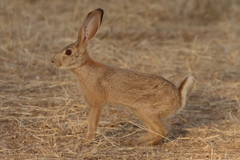
The African savanna hare is a medium-sized species growing to a length of between 41 and 58 cm (16 and 23 in) with a weight of between 1.5 and 3 kilograms (3.3 and 6.6 lb). The ears have black tips, the dorsal surface of head and body is greyish-brown, the flanks and limbs are reddish-brown and the underparts are white. The general colouring is richer in tone than other hares, especially in mountain regions where the hares are a rather darker shade. The tail is black above and white below. This hare looks very similar to the Cape hare in appearance but can be told... Wikipedia →

Global Distribution

Parks Where Found

# Park Country Daily sighting probability
1 Aberdare National Park 🇰🇪 Kenya
~30%
2 Samburu National Reserve 🇰🇪 Kenya
~30%
3 Queen Elizabeth National Park 🇺🇬 Uganda
~20%
4 Amboseli National Park 🇰🇪 Kenya
~10%
5 Serengeti National Park 🇹🇿 Tanzania
~10%
6 Ngorongoro Conservation Area 🇹🇿 Tanzania
~10%
7 Masai Mara National Reserve 🇰🇪 Kenya
~10%
8 Kruger National Park 🇿🇦 South Africa
<5%

Before you go

What are the chances of seeing an African Savanna Hare in Masai Mara National Reserve?

With luck

About 10% of wildlife watchers report an African Savanna Hare sighting in Masai Mara National Reserve on a given day, based on 6 verified sightings from GBIF citizen-science data from 2019 to 2026. It is the 39th most-seen of the 40 mammals we can rate there. Over three days the chance rises to about 20%, and over a week to about 40%, if each day is a fresh chance.

When is the best time to see an African Savanna Hare in Masai Mara National Reserve?

November

In that month about 20% of wildlife watchers report an African Savanna Hare in Masai Mara National Reserve on a given day, against under 5% in January–June and September–October, the lowest months. That is one of Masai Mara National Reserve's wettest months, with about 120 mm of rain against 15 mm in July.

What time of day is best to see an African Savanna Hare?

Between 6 and 9 pm

Across all the parks we cover, that three-hour window holds the most African Savanna Hare sightings with a recorded time, and about half of them come between 6 pm and 6 am: it is most active around dawn and dusk.

Where does the African Savanna Hare sighting chance come from?

GBIF citizen-science records

It is estimated from how often the African Savanna Hare is recorded against all the mammals logged in Masai Mara National Reserve (6 verified sightings from 2019 to 2026), calibrated against known sighting rates. Figures are rounded to the nearest 10% because citizen-science data supports honest approximations, not decimals, and months with records from fewer than five people show "—". How it works.

← Back to Masai Mara National Reserve