Black-necked Spitting Cobra

Black-necked Spitting Cobra

Naja nigricollis

Silhouette: V. Deepak · PhyloPic

LCLeast ConcernNTVUENCR
Daily sighting probability ~10% · With luck
at Masai Mara National Reserve

In 3 days ~30% in a week ~50%

10 Verified sightings at Masai Mara National Reserve From 2019 to 2026
21 In all 3 parks
September Best month
☀️🌙 Day & Night When it's spotted

About the Black-necked Spitting Cobra

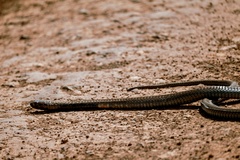
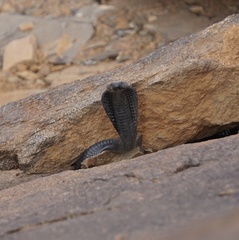
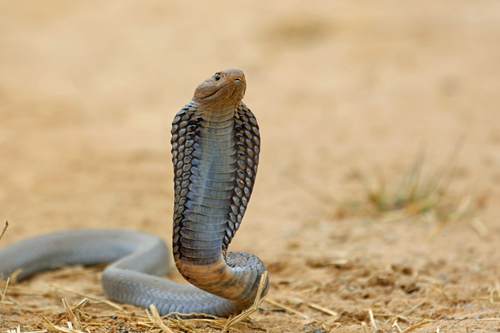
The black-necked spitting cobra (Naja nigricollis) is a species of spitting cobra found mostly in sub-Saharan Africa. They are moderately sized snakes that can grow to a length of 1.2 to 2.2 m (3.9 to 7.2 ft) in length. Their coloration and markings can vary considerably. They prey primarily on small rodents. They possess medically significant venom, although the mortality rate for untreated bites on humans is relatively low (~ 5–10%, in endemic regions under 1%). Like other spitting cobras, they can eject venom from their fangs when threatened (one drop over 7 metres (23 ft) and more in perfect accuracy). The cytotoxic venom irritates the skin, causing blisters and inflammation, and can cause permanent blindness if the venom makes contact with the eyes and is not washed off.

Naja nigricollis belongs to the cobra genus Naja under the family Elapidae. It previously included two subspecies that have been moved to the species Naja nigricincta – the zebra spitting cobra (Naja nigricincta nigricincta) and the black spitting cobra (Naja nigricincta woodi).

Naja nigricollis is classified under the genus Naja of the family Elapidae. It was first described by Norwegian zoologist... Wikipedia →

Global Distribution

Parks Where Found

# Park Country Daily sighting probability
1 Nairobi National Park 🇰🇪 Kenya
~10%
2 Queen Elizabeth National Park 🇺🇬 Uganda
~10%
3 Masai Mara National Reserve 🇰🇪 Kenya
~10%

Zoos & Centres Where Found

# Zoo / Centre Country
1 Cabarceno Natural Park 🇪🇸 Spain In captivity
2 Johannesburg Zoo 🇿🇦 South Africa In captivity
3 Chapultepec Zoo 🇲🇽 Mexico In captivity
4 Gambia Reptile Farm 🇬🇲 Gambia In captivity

Closest Relatives at Masai Mara National Reserve

No species of the same family or order lives in Masai Mara National Reserve, so these are its closest relatives here: other reptiles.

Before you go

What are the chances of seeing a Black-necked Spitting Cobra in Masai Mara National Reserve?

With luck

About 10% of wildlife watchers report a Black-necked Spitting Cobra sighting in Masai Mara National Reserve on a given day, based on 10 verified sightings from GBIF citizen-science data from 2019 to 2026. It is the 9th most-seen of the 13 reptiles we can rate there. Over three days the chance rises to about 30%, and over a week to about 50%, if each day is a fresh chance.

When is the best time to see a Black-necked Spitting Cobra in Masai Mara National Reserve?

September

In that month about 20% of wildlife watchers report a Black-necked Spitting Cobra in Masai Mara National Reserve on a given day, against under 5% in February, April, June and October–December, the lowest months. That is one of Masai Mara National Reserve's driest months, with about 35 mm of rain against 140 mm in April.

What time of day is best to see a Black-necked Spitting Cobra?

Between 9 am and noon

Across all the parks we cover, that three-hour window holds the most Black-necked Spitting Cobra sightings with a recorded time, and about 7 in 10 of them come between 6 am and 6 pm: it is seen both by day and at night.

Is Masai Mara National Reserve the best place to see a Black-necked Spitting Cobra?

Among the best

Of the 3 parks where we can rate Black-necked Spitting Cobra sightings, Masai Mara National Reserve ranks 3rd at about 10%, level with the leaders once rounded. The best odds are in Nairobi National Park (Kenya, about 10%) and Queen Elizabeth National Park (Uganda, about 10%).

Where does the Black-necked Spitting Cobra sighting chance come from?

GBIF citizen-science records

It is estimated from how often the Black-necked Spitting Cobra is recorded against all the reptiles logged in Masai Mara National Reserve (10 verified sightings from 2019 to 2026), calibrated against known sighting rates. Figures are rounded to the nearest 10% because citizen-science data supports honest approximations, not decimals, and months with records from fewer than five people show "—". How it works.
← Back to Masai Mara National Reserve