




Completed

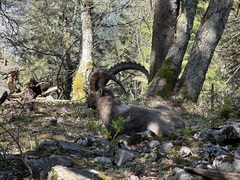


Alpine Ibex
Capra ibex
Silhouette: Steven Traver · PhyloPic
- KingdomAnimalia (Animals)
- PhylumChordata (Chordates)
- ClassMammalia (Mammals)
- OrderArtiodactyla (Even-toed Ungulates and Cetaceans)
- FamilyBovidae (Bovids)
- GenusCapra (Goats)
- SpeciesCapra ibex (Alpine Ibex)
In 3 days >90%
346 Verified sightings at Mercantour National Park From 2019 to 2026
737 In all 5 parks
August Best month
☀️ Diurnal When it's spotted

Completed
About the Alpine Ibex
The Alpine ibex (Capra ibex), also known as the steinbock, is a European species of goat which lives in the Alps. It is one of ten species in the genus Capra, and its closest living relative is the Iberian ibex. The Alpine ibex is a sexually dimorphic species; males are much larger and carry much larger, longer horns than females. Its coat is brownish-grey. Alpine ibexes tend to live in steep, rough terrain and open alpine meadows. They can be found at elevations as high as 3,300 m (10,800 ft) and their sharp hooves allow them to scale the steep slopes and cliffs of their mountainous habitat.
Alpine ibexes primarily feed on grass and are active throughout the year. Although they are social animals, adult males and females segregate for most of the year, coming together only to mate. During the breeding season, males use their long horns to fight for access to females. Ibexes have few predators but may succumb to parasites and diseases.
By the 19th century, human hunters extirpated the Alpine ibex from most of its range, driving it near to extinction. It went through a population bottleneck of fewer than 100 individuals, all living in Gran Paradiso National Park, Italy. Despite its ensuing very low genetic diversity across populations, the species has been successfully reintroduced to parts of its historical range. As of 2020, the IUCN lists the species as being of least concern. Wikipedia →
Recent sightings of Alpine Ibex in Mercantour National Park
LIVEiNaturalistGlobal Distribution
Parks Where Found
| # | Park | Country | Daily sighting probability |
|---|---|---|---|
| 1 | Mercantour National Park | 🇫🇷 France | |
| 2 | Vanoise National Park | 🇫🇷 France | |
| 3 | Triglav National Park | 🇸🇮 Slovenia | |
| 4 | Hohe Tauern National Park | 🇦🇹 Austria | |
| 5 | Ecrins National Park | 🇫🇷 France |
Zoos & Centres Where Found
Closest Relatives at Mercantour National Park




Before you go
What are the chances of seeing an Alpine Ibex in Mercantour National Park?
Very likely
About 80% of wildlife watchers report an Alpine Ibex sighting in Mercantour National Park on a given day, based on 346 verified sightings from GBIF citizen-science data from 2019 to 2026. It is the 3rd most-seen of the 12 mammals we can rate there. Over three days the chance rises to over 90%, if each day is a fresh chance.
When is the best time to see an Alpine Ibex in Mercantour National Park?
August and September
In those months about 90% of wildlife watchers report an Alpine Ibex in Mercantour National Park on a given day, against about 40% in January, the lowest month.
What time of day is best to see an Alpine Ibex?
Between 11 am and 2 pm
Across all the parks we cover, that three-hour window holds the most Alpine Ibex sightings with a recorded time, and about 9 in 10 of them come between 6 am and 6 pm: it is a daytime animal.
Is Mercantour National Park the best place to see an Alpine Ibex?
Yes
Of the 5 parks where we can rate Alpine Ibex sightings, Mercantour National Park has the highest daily chance: about 80%. Next come Vanoise National Park (France, about 80%) and Triglav National Park (Slovenia, about 50%). All parks ranked.
Where does the Alpine Ibex sighting chance come from?
GBIF citizen-science records
It is estimated from how often the Alpine Ibex is recorded against all the mammals logged in Mercantour National Park (346 verified sightings from 2019 to 2026), calibrated against known sighting rates. Figures are rounded to the nearest 10% because citizen-science data supports honest approximations, not decimals, and months with records from fewer than five people show "—". How it works.
