Greater Horseshoe Bat

Greater Horseshoe Bat

Rhinolophus ferrumequinum

Silhouette: Margot Michaud · PhyloPic

LCLeast ConcernNTVUENCR
Daily sighting probability ~10% · With luck
at Mercantour National Park

In 3 days ~30% in a week ~60%

26 Verified sightings at Mercantour National Park From 2019 to 2026
78 In all 3 parks
January Best month
☀️ Diurnal When it's spotted

About the Greater Horseshoe Bat

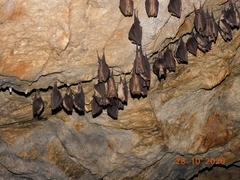
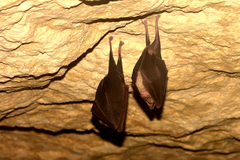
The greater horseshoe bat (Rhinolophus ferrumequinum) is an insectivorous bat of the genus Rhinolophus. Its distribution covers Europe, Northern Africa, Central Asia and Eastern Asia. It is the largest of the horseshoe bats in Europe and is thus easily distinguished from other species. The species is sedentary, typically travelling up to 30 kilometres (19 mi) between the winter and summer roosts, with the longest recorded movement being 180 km (110 mi). The frequencies used by this bat species for echolocation lie between 69–83 kHz, have most energy at 81 kHz and have an average duration of 37.4 ms.

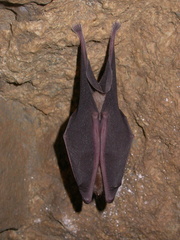
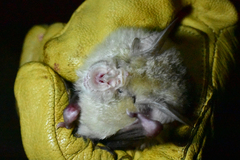
The greater horseshoe bat is the largest horseshoe bat in Europe. It has a distinctive noseleaf, which has a pointed upper part and a horseshoe-shaped lower part. Its horseshoe noseleaf helps to focus the ultrasound it uses to 'see'. The greater horseshoe bat also has tooth and bone structures that are distinct from that of other rhinolophids. Its first premolar on the upper jaw protrudes from the row of teeth. For other horseshoe bats, this premolar is very small or non-existent. Also in comparison to its relatives, the greater horseshoe bat has relatively short... Wikipedia →

Sounds

Recording0:03

Portugal · 2021

© neilfletcher · iNaturalist · CC BY-NC 4.0

Recording0:26

Germany · 2023

© Stefan Gey · iNaturalist · CC BY-NC 4.0

Recording0:11

Italy · 2020

© Giacomo Gola · iNaturalist · CC BY-NC 4.0

Global Distribution

Parks Where Found

# Park Country Daily sighting probability
1 Mercantour National Park 🇫🇷 France
~10%
2 Cévennes National Park 🇫🇷 France
~10%
3 Pyrénées National Park 🇫🇷 France
~10%

Before you go

What are the chances of seeing a Greater Horseshoe Bat in Mercantour National Park?

With luck

About 10% of wildlife watchers report a Greater Horseshoe Bat sighting in Mercantour National Park on a given day, based on 26 verified sightings from GBIF citizen-science data from 2019 to 2026. It is the 12th most-seen of the 12 mammals we can rate there. Over three days the chance rises to about 30%, and over a week to about 60%, if each day is a fresh chance.

When is the best time to see a Greater Horseshoe Bat in Mercantour National Park?

March, May and December–January

In those months about 20% of wildlife watchers report a Greater Horseshoe Bat in Mercantour National Park on a given day, against under 5% in August, the lowest month.

What time of day is best to see a Greater Horseshoe Bat?

Between 3 and 6 pm

Across all the parks we cover, that three-hour window holds the most Greater Horseshoe Bat sightings with a recorded time, and about 8 in 10 of them come between 6 am and 6 pm: it is a daytime animal.

Is Mercantour National Park the best place to see a Greater Horseshoe Bat?

Yes

Of the 3 parks where we can rate Greater Horseshoe Bat sightings, Mercantour National Park has the highest daily chance: about 10%. Next come Cévennes National Park (France, about 10%) and Pyrénées National Park (France, about 10%).

Where does the Greater Horseshoe Bat sighting chance come from?

GBIF citizen-science records

It is estimated from how often the Greater Horseshoe Bat is recorded against all the mammals logged in Mercantour National Park (26 verified sightings from 2019 to 2026), calibrated against known sighting rates. Figures are rounded to the nearest 10% because citizen-science data supports honest approximations, not decimals, and months with records from fewer than five people show "—". How it works.

← Back to Mercantour National Park