Brown-headed Nuthatch

Brown-headed Nuthatch

Sitta pusilla

Silhouette: Alan and Elaine Wilson (Modified) · PhyloPic

LCLeast ConcernNTVUENCR Endemic
Daily sighting probability <5% · Rare
at Merritt Island National Wildlife Refuge

In 3 days <5%

10 Verified sightings at Merritt Island National Wildlife Refuge From 2019 to 2026
944 In all 6 parks
October Best month
☀️ Diurnal When it's spotted

About the Brown-headed Nuthatch

The brown-headed nuthatch (Sitta pusilla) is a small songbird endemic to pine forests throughout the Southeastern United States. Genetic analyses indicated low differentiation between northern and southern populations in Florida, but the study also found lower genetic diversity among south Florida populations that may be a result of the increased habitat fragmentation that was documented. The Bahama nuthatch was formerly considered a subspecies (S. p. insularis), but has since been reclassified as its own separate species. Two recent studies assessing vocalizations in Bahama and continental nuthatch populations found important differences. One of the studies also demonstrated that continental and Bahama populations did not respond aggressively to calls of the other population. This type of call-response study is often used to help define cryptic species.

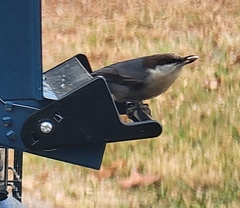
The bird, like other nuthatches, possesses a sharp black nail-like beak, which it uses to pound open seeds. It is a frequent visitor to feeding stations and is highly fond of sunflower seeds and suet cakes. Bold and inquisitive, this bird is readily approachable by humans.

The bird is regularly observed using a small chips of bark, small twigs, and pine needles held in its beak as tools to dig for insects. The nuthatch exhibits other curious behaviors such as cooperative groups where groups of 3–5 adults provide care at a single nest. Recent genetic assessments suggest some of the putatively non-breeding adults associated with these groups may actually breed with individuals in neighboring territories. This nuthatch also exhibits a wide range of other social behaviors that include social grooming and male-female duets similar to those observed for the pygmy nuthatch.

The brown-headed nuthatch has been found to prefer making their nests at the top of short snags. Despite the other species' common name, the brown-headed nuthatch is about the same size as the pygmy nuthatch and the two species are the world's smallest nuthatches. In the brown-headed nuthatch, the total length is 9–11 cm (3.5–4.3 in), wingspan is 16–18 cm (6.3–7.1 in) and body mass is 10–12 g (0.35–0.42 oz). This species sports a brown cap with narrow black eyeline and buff white cheeks, chin, and belly. Its wings are bluish-gray in color. A small white spot is found at the nape of the neck. The bird's call is a sharp whee-hyah that sounds very similar to a "rubber duck" toy and is notably loud for a bird of its size. They also make softer "pit pit pit" calls while in flight as well as other squeaking noises. Wikipedia →

Sounds

Call0:21

United States · 2024

© Valerie Heemstra · XC860797 · CC BY-NC-SA 4.0

Song0:21

United States · 2021

© Paul Driver · XC651187 · CC BY-NC-SA 4.0

Alarm call0:24

United States · 2019

© Russ Wigh · XC481983 · CC BY-NC-SA 4.0

Global Distribution

Parks Where Found

# Park Country Daily sighting probability
1 Congaree National Park 🇺🇸 United States
~30%
2 Everglades National Park 🇺🇸 United States
~10%
3 Big Cypress National Preserve 🇺🇸 United States
<5%
4 Great Smoky Mountains National Park 🇺🇸 United States
<5%
5 Shenandoah National Park 🇺🇸 United States
<5%
6 Merritt Island National Wildlife Refuge 🇺🇸 United States
<5%

Cities Where Found

# City Country Daily sighting probability
1 Houston 🇺🇸 United States
<5%
2 Orlando 🇺🇸 United States
<5%

Before you go

What are the chances of seeing a Brown-headed Nuthatch in Merritt Island National Wildlife Refuge?

Rare

Under 5% of wildlife watchers report a Brown-headed Nuthatch sighting in Merritt Island National Wildlife Refuge on a given day, based on 10 verified sightings from GBIF citizen-science data from 2019 to 2026. It is the 253rd most-seen of the 279 birds we can rate there. Over three days the chance rises to under 5%, if each day is a fresh chance.

When is the best time to see a Brown-headed Nuthatch in Merritt Island National Wildlife Refuge?

Any time of year

In every month with enough records, under 5% of wildlife watchers report a Brown-headed Nuthatch in Merritt Island National Wildlife Refuge on a given day, so our monthly data shows no clear season.

What time of day is best to see a Brown-headed Nuthatch?

Between 8 and 11 am

Across all the parks we cover, that three-hour window holds the most Brown-headed Nuthatch sightings with a recorded time, and about 9 in 10 of them come between 6 am and 6 pm: it is a daytime animal.

Is Merritt Island National Wildlife Refuge the best place to see a Brown-headed Nuthatch?

6th of 6

Of the 6 parks where we can rate Brown-headed Nuthatch sightings, Merritt Island National Wildlife Refuge ranks 6th at under 5%. The best odds are in Congaree National Park (United States, about 30%), Everglades National Park (United States, about 10%) and Big Cypress National Preserve (United States, under 5%).

Which relatives of the Brown-headed Nuthatch live in Merritt Island National Wildlife Refuge?

Same order: Passeriformes

The closest relatives of the Brown-headed Nuthatch that you can see in Merritt Island National Wildlife Refuge (order Passeriformes, Perching Birds) are Boat-tailed Grackle (about 70%), Northern Cardinal (about 50%) and Yellow-rumped Warbler (about 40%), with each one's daily chance of a sighting.

Where does the Brown-headed Nuthatch sighting chance come from?

GBIF citizen-science records

It is estimated from how often the Brown-headed Nuthatch is recorded against all the birds logged in Merritt Island National Wildlife Refuge (10 verified sightings from 2019 to 2026), calibrated against known sighting rates. Figures are rounded to the nearest 10% because citizen-science data supports honest approximations, not decimals, and months with records from fewer than five people show "—". How it works.

← Back to Merritt Island National Wildlife Refuge