Southeastern Five-lined Skink

Southeastern Five-lined Skink

Plestiodon inexpectatus

Silhouette: David Orr · PhyloPic

LCLeast ConcernNTVUENCR Endemic
Daily sighting probability ~10% · With luck
at Merritt Island National Wildlife Refuge

In 3 days ~40% in a week ~60%

30 Verified sightings at Merritt Island National Wildlife Refuge From 2019 to 2026
122 In all 3 parks
August Best month
☀️ Diurnal When it's spotted

About the Southeastern Five-lined Skink

Plestiodon inexpectatus, the southeastern five-lined skink is a common skink in the southeastern United States. The specific name, inexpectatus ("the unexpected"), is possibly a reference to the unexpected discovery of this species in 1932, almost 175 years after Linnaeus described Plestiodon fasciatus, commonly known as the American five-lined skink.

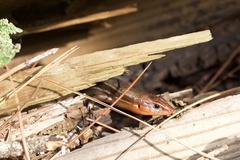
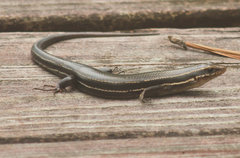
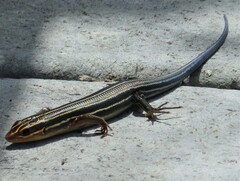
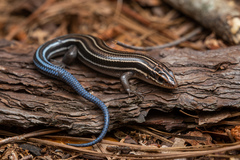
As their common name suggests, southeastern five-lined skinks have five characteristic narrow stripes along their bodies that become lighter with age. The middle stripe tends to be narrower than the others, and the dark areas between stripes are black in young skinks but become brown with age. A similar lizard, the common five-lined skink (Plestiodon fasciatus), is slightly smaller than the southeastern five-lined skink and has broader stripes. However, it is difficult to discriminate between these two species on the basis of physical appearance.

Young southeastern five-lined skinks have a bright blue or purplish tail, especially towards the tip. Also, stripes become a bright reddish orange towards the head. Juvenile coloration may persist into adulthood, giving the head of the animal an altogether orange... Wikipedia →

Global Distribution

Parks Where Found

# Park Country Daily sighting probability
1 Everglades National Park 🇺🇸 United States
~20%
2 Merritt Island National Wildlife Refuge 🇺🇸 United States
~10%
3 Big Cypress National Preserve 🇺🇸 United States
~10%

Cities Where Found

# City Country Daily sighting probability
1 Orlando 🇺🇸 United States
~10%
2 Miami 🇺🇸 United States
<5%

Zoos & Centres Where Found

# Zoo / Centre Country
1 Montgomery Zoo 🇺🇸 United States In captivity

Closest Relatives at Merritt Island National Wildlife Refuge

No species of the same family or order lives in Merritt Island National Wildlife Refuge, so these are its closest relatives here: other reptiles.

Before you go

What are the chances of seeing a Southeastern Five-lined Skink in Merritt Island National Wildlife Refuge?

With luck

About 10% of wildlife watchers report a Southeastern Five-lined Skink sighting in Merritt Island National Wildlife Refuge on a given day, based on 30 verified sightings from GBIF citizen-science data from 2019 to 2026. It is the 12th most-seen of the 35 reptiles we can rate there. Over three days the chance rises to about 40%, and over a week to about 60%, if each day is a fresh chance.

When is the best time to see a Southeastern Five-lined Skink in Merritt Island National Wildlife Refuge?

August

In that month about 30% of wildlife watchers report a Southeastern Five-lined Skink in Merritt Island National Wildlife Refuge on a given day, against under 5% in November to January, the lowest months. That is one of Merritt Island National Wildlife Refuge's wettest months, with about 170 mm of rain against 50 mm in March.

What time of day is best to see a Southeastern Five-lined Skink?

Between 9 am and noon

Across all the parks we cover, that three-hour window holds the most Southeastern Five-lined Skink sightings with a recorded time, and about 9 in 10 of them come between 6 am and 6 pm: it is a daytime animal.

Is Merritt Island National Wildlife Refuge the best place to see a Southeastern Five-lined Skink?

2nd of 3

Of the 3 parks where we can rate Southeastern Five-lined Skink sightings, Merritt Island National Wildlife Refuge ranks 2nd at about 10%. The best odds are in Everglades National Park (United States, about 20%).

Where does the Southeastern Five-lined Skink sighting chance come from?

GBIF citizen-science records

It is estimated from how often the Southeastern Five-lined Skink is recorded against all the reptiles logged in Merritt Island National Wildlife Refuge (30 verified sightings from 2019 to 2026), calibrated against known sighting rates. Figures are rounded to the nearest 10% because citizen-science data supports honest approximations, not decimals, and months with records from fewer than five people show "—". How it works.

← Back to Merritt Island National Wildlife Refuge