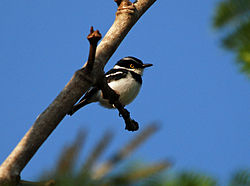
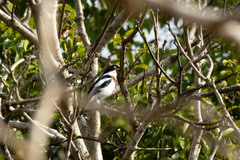
Eastern Black-headed Batis

Eastern Black-headed Batis

Batis minor

Silhouette: Mathieu Pélissié · PhyloPic

LCLeast ConcernNTVUENCR
Daily sighting probability ~10% · With luck
at Meru National Park

In 3 days ~30% in a week ~60%

20 Verified sightings at Meru National Park From 2019 to 2026
116 In all 5 parks
November Best month
☀️ Diurnal When it's spotted

About the Eastern Black-headed Batis

The eastern black-headed batis (Batis minor) is a passerine bird in the family Platysteiridae from eastern Africa. It was formerly treated as conspecific with the western black-headed batis. The eastern black-headed batis was described by the German ornithologist Carlo von Erlanger in 1901 who considered the taxon as a subspecies of the grey-headed batis (Batis orientalis) and introduced the trinomial name Batis orientalis minor.

Two subspecies are recognised: It is a small, stocky, rather restless, flycatcher like bird with a white, black and grey plumage. The forehead, crown and nape are blackish grey with a white supercilium and loral spot, the mask is glossy bluish black and there is a white spot on the nape. The mantle and back are dark grey with a paler rump, females have a greyer mantle. The underparts are white with a glossy black breast band, which is dark reddish brown in the females. The tail is black with white outer tail feathers... Wikipedia →

Sounds

Call0:34

Tanzania · 2021

© paulo kivuyo · XC690048 · CC BY-SA 4.0

Song0:54

Tanzania · 2019

© Peter Boesman · XC509907 · CC BY-NC-ND 4.0

Call0:16

Kenya · 2018

© Frank Lambert · XC466959 · CC BY-NC-ND 4.0

Global Distribution

Parks Where Found

# Park Country Daily sighting probability
1 Mkomazi National Park 🇹🇿 Tanzania
~40%
2 Meru National Park 🇰🇪 Kenya
~10%
3 Mikumi National Park 🇹🇿 Tanzania
~10%
4 Tsavo East National Park 🇰🇪 Kenya
<5%
5 Tsavo West National Park 🇰🇪 Kenya
<5%

Cities Where Found

# City Country Daily sighting probability
1 Mombasa 🇰🇪 Kenya
~30%
2 Dar es-Salaam 🇹🇿 Tanzania
~10%

Before you go

What are the chances of seeing an Eastern Black-headed Batis in Meru National Park?

With luck

About 10% of wildlife watchers report an Eastern Black-headed Batis sighting in Meru National Park on a given day, based on 20 verified sightings from GBIF citizen-science data from 2019 to 2026. It is the 151st most-seen of the 243 birds we can rate there. Over three days the chance rises to about 30%, and over a week to about 60%, if each day is a fresh chance.

When is the best time to see an Eastern Black-headed Batis in Meru National Park?

October and November

In those months about 20% of wildlife watchers report an Eastern Black-headed Batis in Meru National Park on a given day, against about 10% in June, September and December–April, the lowest months. Those are among Meru National Park's wettest months, with about 140 mm of rain a month against almost none in July. May and July–August have too few records to rate.

What time of day is best to see an Eastern Black-headed Batis?

Between 10 am and 1 pm

Across all the parks we cover, that three-hour window holds the most Eastern Black-headed Batis sightings with a recorded time, and about 9 in 10 of them come between 6 am and 6 pm: it is a daytime animal.

Is Meru National Park the best place to see an Eastern Black-headed Batis?

2nd of 5

Of the 5 parks where we can rate Eastern Black-headed Batis sightings, Meru National Park ranks 2nd at about 10%. The best odds are in Mkomazi National Park (Tanzania, about 40%).

Where does the Eastern Black-headed Batis sighting chance come from?

GBIF citizen-science records

It is estimated from how often the Eastern Black-headed Batis is recorded against all the birds logged in Meru National Park (20 verified sightings from 2019 to 2026), calibrated against known sighting rates. Figures are rounded to the nearest 10% because citizen-science data supports honest approximations, not decimals, and months with records from fewer than five people show "—". How it works.

← Back to Meru National Park