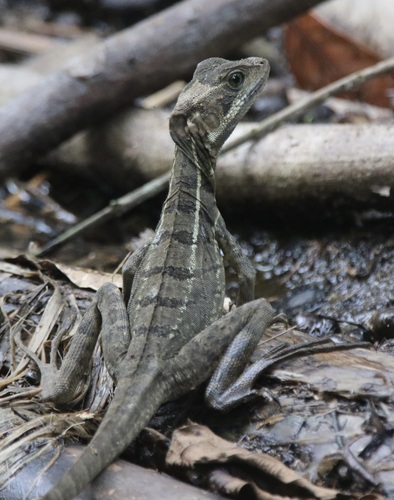
Panama City Anole

Panama City Anole

Anolis apletophallus

Silhouette: Beth Reinke · PhyloPic

LCLeast ConcernNTVUENCR Endemic
Daily sighting probability ~10% · With luck
at Parque Natural Metropolitano

In 3 days ~20% in a week ~40%

13 Verified sightings at Parque Natural Metropolitano From 2019 to 2026
119 In all 2 parks
February Best month
☀️ Diurnal When it's spotted

About the Panama City Anole

Anolis apletophallus is a species of anoles, iguanian lizards in the family Dactyloidae native to Panama. The species was split from Anolis limifrons in Köhler and Sunyer (2008). It has been reported in Panama, Honduras and Colombia. A decline in its population in Panama over a 40-year timespan has been attributed to changes in local climate, with years following El Niño negatively affecting the species.

Only fairly recently recognized as its own species, the specific epithet of this species translates to "immense penis", due to its large bi-lobed hemipenis as an identifying feature described by Köhler and Sunyer (2008).

A. apletophallus is a relatively small mainland anole getting to about 40–45 mm (snout-to-vent), but have a large dewlap relative to their body size. The species displays dewlap polymorphism, where some populations' dewlaps are orange, while others are white with a basal orange dot, and others still display both dewlap morphs. No genetic differences were found between individuals with different dewlap morphs. They are rather short-lived with a 9 month generation time making them an annual species, with the adults reaching... Wikipedia →

Global Distribution

Parks Where Found

# Park Country Daily sighting probability
1 Soberanía National Park 🇵🇦 Panama
~30%
2 Parque Natural Metropolitano 🇵🇦 Panama
~10%

Before you go

What are the chances of seeing a Panama City Anole in Parque Natural Metropolitano?

With luck

About 10% of wildlife watchers report a Panama City Anole sighting in Parque Natural Metropolitano on a given day, based on 13 verified sightings from GBIF citizen-science data from 2019 to 2026. It is the 14th most-seen of the 29 reptiles we can rate there. Over three days the chance rises to about 20%, and over a week to about 40%, if each day is a fresh chance.

When is the best time to see a Panama City Anole in Parque Natural Metropolitano?

August–September and December–May

In those months about 10% of wildlife watchers report a Panama City Anole in Parque Natural Metropolitano on a given day, against under 5% in June–July and October–November, the lowest months.

What time of day is best to see a Panama City Anole?

Between 9 am and noon

Across all the parks we cover, that three-hour window holds the most Panama City Anole sightings with a recorded time, and about 8 in 10 of them come between 6 am and 6 pm: it is a daytime animal.

Is Parque Natural Metropolitano the best place to see a Panama City Anole?

2nd of 2

Of the 2 parks where we can rate Panama City Anole sightings, Parque Natural Metropolitano ranks 2nd at about 10%. The best odds are in Soberanía National Park (Panama, about 30%).

Which relatives of the Panama City Anole live in Parque Natural Metropolitano?

Same genus: Anolis

The closest relatives of the Panama City Anole that you can see in Parque Natural Metropolitano (genus Anolis, Anoles) are Brown Anole (about 20%), Gaige's Anole (about 10%) and Grass Anole (about 10%), with each one's daily chance of a sighting.

Where does the Panama City Anole sighting chance come from?

GBIF citizen-science records

It is estimated from how often the Panama City Anole is recorded against all the reptiles logged in Parque Natural Metropolitano (13 verified sightings from 2019 to 2026), calibrated against known sighting rates. Figures are rounded to the nearest 10% because citizen-science data supports honest approximations, not decimals, and months with records from fewer than five people show "—". How it works.

← Back to Parque Natural Metropolitano