Speckle-throated Woodpecker

Speckle-throated Woodpecker

Campethera scriptoricauda

Silhouette: Pepe Reigada · PhyloPic

LCLeast ConcernNTVUENCR
Daily sighting probability ~20% · Possible
at Mikumi National Park

In 3 days ~50% in a week ~80%

55 Verified sightings at Mikumi National Park From 2019 to 2026
101 In all 2 parks
July Best month
☀️ Diurnal When it's spotted

About the Speckle-throated Woodpecker

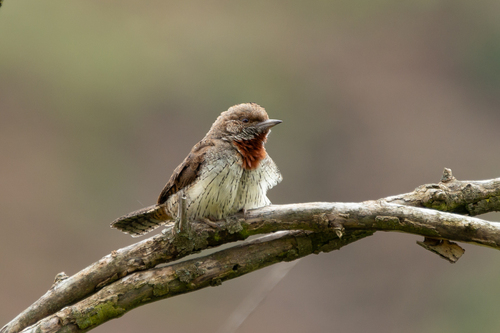
The speckle-throated woodpecker (Campethera scriptoricauda), also known as Reichenow's woodpecker, is an East African woodpecker often considered a subspecies of Bennett's woodpecker. The bird is named after the German ornithologist Anton Reichenow.

It is greenish above with yellowish barring (giving a slightly yellower appearance than the similar Nubian woodpecker) and pale yellowish below with black speckles. The speckles continue forward through the throat, the main point of distinction from both the Nubian and Bennett's woodpeckers. The bill is pale, depicted as yellow or off-white.

Among its calls in Tanzania are "wi-wi-wi-wi-wi and a short churr." At least in Mozambique, it is probably vocally indistinguishable from Bennett's woodpecker. It lives in open woodland in Mozambique between Beira and the lower Zambezi river, in central and southeastern Malawi, and in eastern and central Tanzania north to Handeni as well as in the North Pare Mountains and around Mount Kilimanjaro. Formerly it was also found around Mombasa, Kenya. It inhabits open woodlands. At least in Mozambique, it prefers broad-leaved woodland with an understory... Wikipedia →

Sounds

Call0:28

Tanzania · 2012

© David C. Moyer · XC96363 · CC BY-NC-ND 2.5

Global Distribution

Parks Where Found

# Park Country Daily sighting probability
1 Mikumi National Park 🇹🇿 Tanzania
~20%
2 Liwonde National Park 🇲🇼 Malawi
~20%

Before you go

What are the chances of seeing a Speckle-throated Woodpecker in Mikumi National Park?

Possible

About 20% of wildlife watchers report a Speckle-throated Woodpecker sighting in Mikumi National Park on a given day, based on 55 verified sightings from GBIF citizen-science data from 2019 to 2026. It is the 66th most-seen of the 261 birds we can rate there. Over three days the chance rises to about 50%, and over a week to about 80%, if each day is a fresh chance.

When is the best time to see a Speckle-throated Woodpecker in Mikumi National Park?

July

In that month about 40% of wildlife watchers report a Speckle-throated Woodpecker in Mikumi National Park on a given day, against about 10% in January to May, the lowest months. That is one of Mikumi National Park's driest months, with about 25 mm of rain against 200 mm in April.

What time of day is best to see a Speckle-throated Woodpecker?

Between 7 and 10 am

Across all the parks we cover, that three-hour window holds the most Speckle-throated Woodpecker sightings with a recorded time, and about 7 in 10 of them come between 6 am and 6 pm: it is a daytime animal.

Is Mikumi National Park the best place to see a Speckle-throated Woodpecker?

Yes

Of the 2 parks where we can rate Speckle-throated Woodpecker sightings, Mikumi National Park has the highest daily chance: about 20%. Next come Liwonde National Park (Malawi, about 20%).

Which relatives of the Speckle-throated Woodpecker live in Mikumi National Park?

Same genus: Campethera

The closest relatives of the Speckle-throated Woodpecker that you can see in Mikumi National Park (genus Campethera, African Green Woodpeckers) are Little Green Woodpecker (about 10%) and Golden-tailed Woodpecker (about 10%), with each one's daily chance of a sighting.

Where does the Speckle-throated Woodpecker sighting chance come from?

GBIF citizen-science records

It is estimated from how often the Speckle-throated Woodpecker is recorded against all the birds logged in Mikumi National Park (55 verified sightings from 2019 to 2026), calibrated against known sighting rates. Figures are rounded to the nearest 10% because citizen-science data supports honest approximations, not decimals, and months with records from fewer than five people show "—". How it works.

← Back to Mikumi National Park