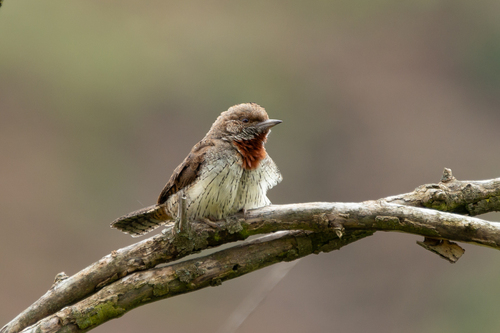
Yellow-fronted Tinkerbird

Yellow-fronted Tinkerbird

Pogoniulus chrysoconus

Silhouette: PhyloPic

LCLeast ConcernNTVUENCR
Daily sighting probability ~10% · With luck
at Mikumi National Park

In 3 days ~30% in a week ~60%

28 Verified sightings at Mikumi National Park From 2019 to 2026
1,016 In all 21 parks
July Best month
☀️ Diurnal When it's spotted

About the Yellow-fronted Tinkerbird

The yellow-fronted tinkerbird (Pogoniulus chrysoconus) is a small bird in the family Lybiidae formerly known as yellow-fronted tinker barbet. It is sometimes considered conspecific with its southern counterpart, the red-fronted tinkerbird, Pogoniulus pusillus. Barbets are near passerine birds with bristles around the base of the bill and a world-wide tropical distribution.

The subspecies vary with respect to size and colour tone of the plumage streaks. If P. c. extoni is restricted to the southernmost population occurring in southeastern Botswana, northern South Africa and Eswatini, the following two subspecies are also recognized:

It is associated with mesic, open to closed broadleaved or mixed woodlands and... Wikipedia →

Sounds

Song0:15

Gambia · 2024

© Zsombor Károlyi · XC1163412 · CC BY-NC-SA 4.0

Call0:13

South Africa · 2025

© Marna Buys · XC1103080 · CC BY-NC-SA 4.0

Song0:36

Senegal · 2026

© Peter Boesman · XC1081351 · CC BY-NC-ND 4.0

Global Distribution

Parks Where Found

# Park Country Daily sighting probability
1 Niokolo-Koba National Park 🇸🇳 Senegal
~20%
2 Murchison Falls National Park 🇺🇬 Uganda
~20%
3 Kafue National Park 🇿🇲 Zambia
~10%
4 Mikumi National Park 🇹🇿 Tanzania
~10%
5 Pilanesberg National Park 🇿🇦 South Africa
~10%
6 Queen Elizabeth National Park 🇺🇬 Uganda
~10%
7 Lake Mburo National Park 🇺🇬 Uganda
~10%
8 Gonarezhou National Park 🇿🇼 Zimbabwe
~10%
9 Akagera National Park 🇷🇼 Rwanda
<5%
10 Virunga National Park 🇨🇩 Democratic Republic of the Congo
<5%
11 Bale Mountains National Park 🇪🇹 Ethiopia
<5%
12 Moremi Game Reserve 🇧🇼 Botswana
<5%
13 Semuliki National Park 🇺🇬 Uganda
<5%
14 Mana Pools National Park 🇿🇼 Zimbabwe
<5%
15 Hwange National Park 🇿🇼 Zimbabwe
<5%
16 Kruger National Park 🇿🇦 South Africa
<5%
17 Nyungwe National Park 🇷🇼 Rwanda
<5%
18 Kidepo Valley National Park 🇺🇬 Uganda
<5%
19 South Luangwa National Park 🇿🇲 Zambia
<5%
20 Kibale National Park 🇺🇬 Uganda
<5%
21 Bwindi Impenetrable National Park 🇺🇬 Uganda
<5%

Cities Where Found

# City Country Daily sighting probability
1 Maiduguri 🇳🇬 Nigeria
~60%
2 Ouagadougou 🇧🇫 Burkina Faso
~40%
3 Abuja 🇳🇬 Nigeria
~40%
4 Serrekunda 🇬🇲 Gambia
~30%
5 Kampala 🇺🇬 Uganda
~30%
6 Lusaka 🇿🇲 Zambia
~30%
7 Harare 🇿🇼 Zimbabwe
~20%
8 Lomé 🇹🇬 Togo
~10%
9 N'Djamena 🇹🇩 Chad
~10%
10 Accra 🇬🇭 Ghana
~10%

Before you go

What are the chances of seeing a Yellow-fronted Tinkerbird in Mikumi National Park?

With luck

About 10% of wildlife watchers report a Yellow-fronted Tinkerbird sighting in Mikumi National Park on a given day, based on 28 verified sightings from GBIF citizen-science data from 2019 to 2026. It is the 106th most-seen of the 261 birds we can rate there. Over three days the chance rises to about 30%, and over a week to about 60%, if each day is a fresh chance.

When is the best time to see a Yellow-fronted Tinkerbird in Mikumi National Park?

July to September

In those months about 20% of wildlife watchers report a Yellow-fronted Tinkerbird in Mikumi National Park on a given day, against under 5% in January, the lowest month. Those are among Mikumi National Park's driest months, with about 20 mm of rain a month against 200 mm in April.

What time of day is best to see a Yellow-fronted Tinkerbird?

Between 8 and 11 am

Across all the parks we cover, that three-hour window holds the most Yellow-fronted Tinkerbird sightings with a recorded time, and about 9 in 10 of them come between 6 am and 6 pm: it is a daytime animal.

Where does the Yellow-fronted Tinkerbird sighting chance come from?

GBIF citizen-science records

It is estimated from how often the Yellow-fronted Tinkerbird is recorded against all the birds logged in Mikumi National Park (28 verified sightings from 2019 to 2026), calibrated against known sighting rates. Figures are rounded to the nearest 10% because citizen-science data supports honest approximations, not decimals, and months with records from fewer than five people show "—". How it works.

← Back to Mikumi National Park