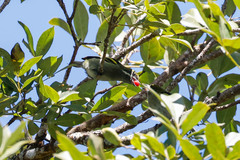
Moustached Tinkerbird

Moustached Tinkerbird

Pogoniulus leucomystax

Silhouette: PhyloPic

LCLeast ConcernNTVUENCR
Daily sighting probability ~20% · Possible
at Mkomazi National Park

In 3 days ~40% in a week ~70%

25 Verified sightings at Mkomazi National Park From 2019 to 2026
193 In all 4 parks
February Best month
☀️ Diurnal When it's spotted

About the Moustached Tinkerbird

The moustached tinkerbird (Pogoniulus leucomystax) is a species of bird in the large Piciformes order in the Lybiidae family. It occurs in high-altitude forests in central Africa. It is greenish with little sexual dimorphism. The tinkerbird eats berries and insects.

Older literature often separate the moustached tinkerbird and its close relative, the green tinkerbird, (Pogoniulus simplex) from the rest of Pogoniulus into a separate now-defunct genus, Viridibucco (Oberholser, 1905). "Viridibucco leucomystax" is a commonly encountered taxonomical synonym of the current valid name Pogoniulus leucomystax. The split was supported by their shared overall green coloration and similar lifestyle. In the early 20th century, the two were even considered conspecific.

Some also speculate that the moustached tinkerbird, the green tinkerbird and the western tinkerbird (Pogoniulus coryphaea) are allospecies. On basis of morphological differences, Ripley and Heinrich described a tentative subspecies of Pogoniulus leucomystax. The type specimen of Pogoniulus leucomystax meridionalis (Ripley and Heinrich, 1969) originated... Wikipedia →

Sounds

Song0:20

Zambia · 2023

© Dries Van de Loock · XC860436 · CC BY-NC-ND 4.0

Call0:11

Tanzania · 2019

© Meena Haribal · XC609995 · CC BY-NC-SA 4.0

Song0:14

Tanzania · 2019

© Peter Boesman · XC510360 · CC BY-NC-ND 4.0

Global Distribution

Parks Where Found

# Park Country Daily sighting probability
1 Mkomazi National Park 🇹🇿 Tanzania
~20%
2 Aberdare National Park 🇰🇪 Kenya
~10%
3 Arusha National Park 🇹🇿 Tanzania
~10%
4 Ngorongoro Conservation Area 🇹🇿 Tanzania
<5%

Before you go

What are the chances of seeing a Moustached Tinkerbird in Mkomazi National Park?

Possible

About 20% of wildlife watchers report a Moustached Tinkerbird sighting in Mkomazi National Park on a given day, based on 25 verified sightings from GBIF citizen-science data from 2019 to 2026. It is the 124th most-seen of the 272 birds we can rate there. Over three days the chance rises to about 40%, and over a week to about 70%, if each day is a fresh chance.

When is the best time to see a Moustached Tinkerbird in Mkomazi National Park?

February

In that month about 30% of wildlife watchers report a Moustached Tinkerbird in Mkomazi National Park on a given day, against about 10% in January, March–April, July–August and October, the lowest months. May has too few records to rate.

What time of day is best to see a Moustached Tinkerbird?

Between 9 am and noon

Across all the parks we cover, that three-hour window holds the most Moustached Tinkerbird sightings with a recorded time, and about 9 in 10 of them come between 6 am and 6 pm: it is a daytime animal.

Is Mkomazi National Park the best place to see a Moustached Tinkerbird?

Yes

Of the 4 parks where we can rate Moustached Tinkerbird sightings, Mkomazi National Park has the highest daily chance: about 20%. Next come Aberdare National Park (Kenya, about 10%) and Arusha National Park (Tanzania, about 10%).

Which relatives of the Moustached Tinkerbird live in Mkomazi National Park?

Same family: Lybiidae

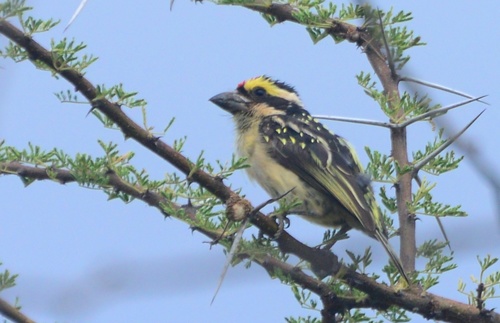
The closest relatives of the Moustached Tinkerbird that you can see in Mkomazi National Park (family Lybiidae, African Barbets) are D'Arnaud's Barbet (about 60%), Red-and-yellow Barbet (about 50%) and Black-throated Barbet (about 40%), with each one's daily chance of a sighting.

Where does the Moustached Tinkerbird sighting chance come from?

GBIF citizen-science records

It is estimated from how often the Moustached Tinkerbird is recorded against all the birds logged in Mkomazi National Park (25 verified sightings from 2019 to 2026), calibrated against known sighting rates. Figures are rounded to the nearest 10% because citizen-science data supports honest approximations, not decimals, and months with records from fewer than five people show "—". How it works.

← Back to Mkomazi National Park