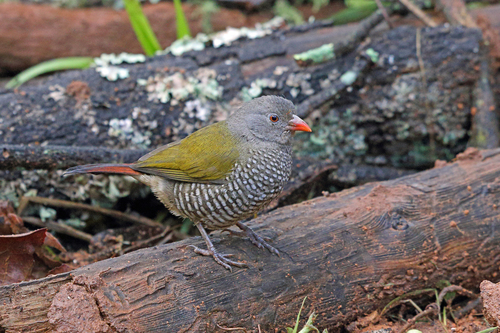
Pearl-headed Mannikin

Pearl-headed Mannikin

Odontospiza caniceps

LCLeast ConcernNTVUENCR
Daily sighting probability <5% · Rare
at Mkomazi National Park

In 3 days ~10% in a week ~20%

6 Verified sightings at Mkomazi National Park From 2019 to 2026
375 In all 9 parks
January Best month
☀️ Diurnal When it's spotted

About the Pearl-headed Mannikin

The grey-headed silverbill (Spermestes griseicapilla), also known as pearl-headed mannikin, is a species of estrildid finch found in eastern Africa, Ethiopia, Kenya, South Sudan, and Tanzania. It has an estimated global extent of occurrence of 400,000 km2 (150,000 sq mi). It was formerly usually placed in the monotypic genus Odontospiza as Odontospiza caniceps and sometimes placed in the genus Lonchura.

The grey-headed silverbill is a stocky bird with a grey head studded with white dots. Its body is greyish-brown with partly black wings and tail and a white rump. The juvenile can be told by its white rump. Adult male is approximately 11.5 cm (4.5 in) in length with wing length 6.5 cm (2.6 in).

The grey-headed silverbill is commonly found in dry savanna habitat but never too far away from water. It wanders widely, influenced by weather and shifting availability of sources of water. The grey-headed silverbill is gregarious, moving in small flocks and often mixing with African silverbill.

The grey-headed silverbill feeds mostly on grass seeds. But it has been suggested that the species also feed on insects... Wikipedia →

Sounds

Call0:09

Tanzania · 2019

© Peter Boesman · XC510281 · CC BY-NC-ND 4.0

Call0:12

Ethiopia · 2015

© Hans Matheve · XC306027 · CC BY-NC-ND 4.0

Global Distribution

Parks Where Found

# Park Country Daily sighting probability
1 Serengeti National Park 🇹🇿 Tanzania
~10%
2 Ngorongoro Conservation Area 🇹🇿 Tanzania
<5%
3 Tsavo West National Park 🇰🇪 Kenya
<5%
4 Mkomazi National Park 🇹🇿 Tanzania
<5%
5 Samburu National Reserve 🇰🇪 Kenya
<5%
6 Amboseli National Park 🇰🇪 Kenya
<5%
7 Tarangire National Park 🇹🇿 Tanzania
<5%
8 Masai Mara National Reserve 🇰🇪 Kenya
<5%
9 Nairobi National Park 🇰🇪 Kenya
<5%

Zoos & Centres Where Found

# Zoo / Centre Country
1 San Diego Zoo 🇺🇸 United States In captivity

Before you go

What are the chances of seeing a Pearl-headed Mannikin in Mkomazi National Park?

Rare

Under 5% of wildlife watchers report a Pearl-headed Mannikin sighting in Mkomazi National Park on a given day, based on 6 verified sightings from GBIF citizen-science data from 2019 to 2026. It is the 244th most-seen of the 272 birds we can rate there. Over three days the chance rises to about 10%, and over a week to about 20%, if each day is a fresh chance.

When is the best time to see a Pearl-headed Mannikin in Mkomazi National Park?

January and March–April

In those months about 10% of wildlife watchers report a Pearl-headed Mannikin in Mkomazi National Park on a given day, against under 5% in February and June–December, the lowest months. Those are among Mkomazi National Park's wettest months, with about 95 mm of rain a month against 5 mm in July. May has too few records to rate.

What time of day is best to see a Pearl-headed Mannikin?

Between 2 and 5 pm

Across all the parks we cover, that three-hour window holds the most Pearl-headed Mannikin sightings with a recorded time, and about 8 in 10 of them come between 6 am and 6 pm: it is a daytime animal.

Which relatives of the Pearl-headed Mannikin live in Mkomazi National Park?

Same family: Estrildidae

The closest relatives of the Pearl-headed Mannikin that you can see in Mkomazi National Park (family Estrildidae, Waxbills and Allies) are Red-cheeked Cordon-bleu (about 40%), Green-winged Pytilia (about 40%) and Purple Grenadier (about 30%), with each one's daily chance of a sighting.

Where does the Pearl-headed Mannikin sighting chance come from?

GBIF citizen-science records

It is estimated from how often the Pearl-headed Mannikin is recorded against all the birds logged in Mkomazi National Park (6 verified sightings from 2019 to 2026), calibrated against known sighting rates. Figures are rounded to the nearest 10% because citizen-science data supports honest approximations, not decimals, and months with records from fewer than five people show "—". How it works.

← Back to Mkomazi National Park