Four-banded Sandgrouse

Four-banded Sandgrouse

Pterocles quadricinctus

Silhouette: PhyloPic

LCLeast ConcernNTVUENCR
Daily sighting probability ~20% · Possible
at Mole National Park

In 3 days ~50% in a week ~80%

85 Verified sightings at Mole National Park From 2019 to 2026
143 In all 3 parks
November Best month
🌅 Crepuscular When it's spotted

About the Four-banded Sandgrouse

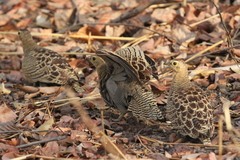
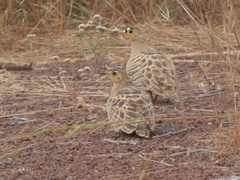
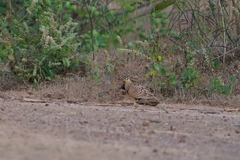
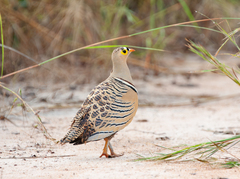
The four-banded sandgrouse (Pterocles quadricinctus) is a medium-sized bird in the sandgrouse family. The four-banded sandgrouse is 25–28 cm (9.8–11 in) long. Its head, neck and upperparts are yellowish-green, with the back heavily marked with brown. The male has black and white bands on its forehead as well as black and white bands separating the breast from the heavily barred belly. The female lacks the head and breast bands and is heavily barred on the back and flanks. It has a small, pigeon-like head and neck, but a sturdy compact body. It has long pointed wings, which are grey underneath, a short tail and a fast direct flight.

This gregarious species occurs in a belt across Africa from Mauritania and Cameroon east to Sudan and Uganda. It is much more common in the west of its range. It is a partial seasonal migrant, with some birds moving further north in the rainy season. It breeds on open areas with some trees, including savanna, scrubland and similar habitats.

Flocks fly to watering holes in the evening to drink and are largely nocturnal. The call is a loud wulli-wulli, and there is much twittering at the drinking...

Wikipedia →

Sounds

Song0:12

Gambia · 2023

© Albert Vrielink · XC857077 · CC BY-NC-SA 4.0

Flight call0:10

Ghana · 2021

© Brendan Sloan · XC690867 · CC BY-NC-ND 4.0

Call0:06

Ethiopia · 2015

© Andrew Spencer · XC277092 · CC BY-NC-ND 4.0

Global Distribution

Parks Where Found

# Park Country Daily sighting probability
1 Mole National Park 🇬🇭 Ghana
~20%
2 Niokolo-Koba National Park 🇸🇳 Senegal
~10%
3 Kidepo Valley National Park 🇺🇬 Uganda
<5%

Before you go

What are the chances of seeing a Four-banded Sandgrouse in Mole National Park?

Possible

About 20% of wildlife watchers report a Four-banded Sandgrouse sighting in Mole National Park on a given day, based on 85 verified sightings from GBIF citizen-science data from 2019 to 2026. It is the 105th most-seen of the 266 birds we can rate there. Over three days the chance rises to about 50%, and over a week to about 80%, if each day is a fresh chance.

When is the best time to see a Four-banded Sandgrouse in Mole National Park?

November

In that month about 40% of wildlife watchers report a Four-banded Sandgrouse in Mole National Park on a given day, against about 10% in May–June and August–October, the lowest months. That is one of Mole National Park's driest months, with about 5 mm of rain against 220 mm in August. July has too few records to rate.

What time of day is best to see a Four-banded Sandgrouse?

Between 4 and 7 pm

Across all the parks we cover, that three-hour window holds the most Four-banded Sandgrouse sightings with a recorded time, and about 6 in 10 of them come between 6 am and 6 pm: it is most active around dawn and dusk.

Is Mole National Park the best place to see a Four-banded Sandgrouse?

Yes

Of the 3 parks where we can rate Four-banded Sandgrouse sightings, Mole National Park has the highest daily chance: about 20%. Next come Niokolo-Koba National Park (Senegal, about 10%) and Kidepo Valley National Park (Uganda, under 5%).

Where does the Four-banded Sandgrouse sighting chance come from?

GBIF citizen-science records

It is estimated from how often the Four-banded Sandgrouse is recorded against all the birds logged in Mole National Park (85 verified sightings from 2019 to 2026), calibrated against known sighting rates. Figures are rounded to the nearest 10% because citizen-science data supports honest approximations, not decimals, and months with records from fewer than five people show "—". How it works.

← Back to Mole National Park