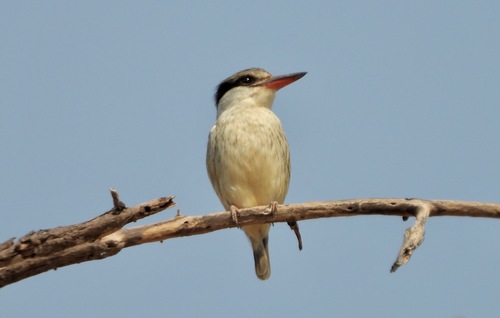
Red-throated Bee-eater

Red-throated Bee-eater

Merops bulocki

Silhouette: Sheatherius · PhyloPic

LCLeast ConcernNTVUENCR
Daily sighting probability ~80% · Very likely
at Mole National Park

In 3 days >90%

497 Verified sightings at Mole National Park From 2019 to 2026
1,929 In all 4 parks
September Best month
☀️ Diurnal When it's spotted

About the Red-throated Bee-eater

The red-throated bee-eater (Merops bulocki) is a species of bird in the family Meropidae. This species is native to the Sudan (region). It has a wide range and large total population, and the International Union for Conservation of Nature has assessed its conservation status as being of "least concern".

The adult red-throated bee eater grows to about 20 to 22 cm (8 to 9 in) in length with a moderately long tail, but no streamers. The upper parts are green and the red chin and throat are distinctive, though about 1% of individuals have a yellow throat. The hind neck, breast and underparts are buff, and the under-tail coverts and thighs are bright blue. To the east of the Central African Republic, the birds have blue facial features while to the west these features are green.

The red-throated bee-eater has a wide distribution across tropical Africa, its range extending from Senegal and Gambia in the west to Uganda, southern Sudan, and Ethiopia in the east. Its typical habitat is savannah with scattered trees, farmland with trees, the edges of marshes, bushy pastures and gardens, but the birds are rarely to be found far from the erosion...

Wikipedia →

Sounds

Flight call0:28

Gambia · 2024

© Zsombor Károlyi · XC1163403 · CC BY-NC-SA 4.0

Call0:55

Senegal · 2024

© Frank Lambert · XC1041428 · CC BY-NC-ND 4.0

Alarm call1:20

Gambia · 2020

© Joost van Bruggen · XC533848 · CC BY-NC-ND 4.0

Global Distribution

Parks Where Found

# Park Country Daily sighting probability
1 Niokolo-Koba National Park 🇸🇳 Senegal
~90%
2 Mole National Park 🇬🇭 Ghana
~80%
3 Murchison Falls National Park 🇺🇬 Uganda
~60%
4 Queen Elizabeth National Park 🇺🇬 Uganda
~20%

Zoos & Centres Where Found

# Zoo / Centre Country
1 Wilhelma 🇩🇪 Germany In captivity

Before you go

What are the chances of seeing a Red-throated Bee-eater in Mole National Park?

Very likely

About 80% of wildlife watchers report a Red-throated Bee-eater sighting in Mole National Park on a given day, based on 497 verified sightings from GBIF citizen-science data from 2019 to 2026. It is the most-seen of the 266 birds we can rate there. Over three days the chance rises to over 90%, if each day is a fresh chance.

When is the best time to see a Red-throated Bee-eater in Mole National Park?

September

In that month about 90% of wildlife watchers report a Red-throated Bee-eater in Mole National Park on a given day, against about 70% in May and June, the lowest months. That is one of Mole National Park's wettest months, with about 190 mm of rain against almost none in January. July has too few records to rate.

What time of day is best to see a Red-throated Bee-eater?

Between 2 and 5 pm

Across all the parks we cover, that three-hour window holds the most Red-throated Bee-eater sightings with a recorded time, and about 9 in 10 of them come between 6 am and 6 pm: it is a daytime animal.

Is Mole National Park the best place to see a Red-throated Bee-eater?

2nd of 4

Of the 4 parks where we can rate Red-throated Bee-eater sightings, Mole National Park ranks 2nd at about 80%. The best odds are in Niokolo-Koba National Park (Senegal, about 90%). All parks ranked.

Which relatives of the Red-throated Bee-eater live in Mole National Park?

Same genus: Merops

The closest relatives of the Red-throated Bee-eater that you can see in Mole National Park (genus Merops, Typical Bee-eaters) are Northern Carmine Bee-eater (about 10%) and Swallow-tailed Bee-eater (about 10%), with each one's daily chance of a sighting.

Where does the Red-throated Bee-eater sighting chance come from?

GBIF citizen-science records

It is estimated from how often the Red-throated Bee-eater is recorded against all the birds logged in Mole National Park (497 verified sightings from 2019 to 2026), calibrated against known sighting rates. Figures are rounded to the nearest 10% because citizen-science data supports honest approximations, not decimals, and months with records from fewer than five people show "—". How it works.

← Back to Mole National Park