Stone Partridge

Stone Partridge

Ptilopachus petrosus

Silhouette: Sheatherius · PhyloPic

LCLeast ConcernNTVUENCR
Daily sighting probability ~50% · Likely
at Mole National Park

In 3 days ~90% in a week >90%

256 Verified sightings at Mole National Park From 2019 to 2026
408 In all 3 parks
April Best month
🌅 Crepuscular When it's spotted

About the Stone Partridge

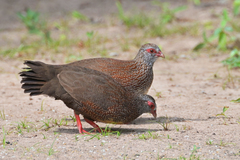
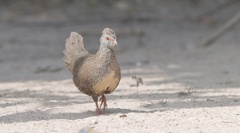
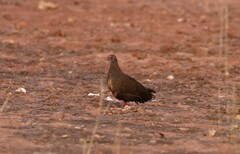
The stone partridge (Ptilopachus petrosus) is a bird of the New World quail family. This largely brown bird, which commonly holds its tail raised, is found in scrubland and lightly wooded habitats, often near rocks, from Kenya and Ethiopia to Gambia (a large part of its range is in the Sudanian Savanna).

The stone partridge was formally described in 1789 by the German naturalist Johann Friedrich Gmelin in his revised and expanded edition of Carl Linnaeus's Systema Naturae. He placed it with all the other partridge like birds in the genus Tetrao and coined the binomial name Tetrao petrosus. Gmelin's description was based on the Comte de Buffon's "Le perdrix de roche ou de la Gambia" and John Latham's "Rufous-breasted partridge". The stone partridge is now placed with Nahan's partridge in the genus Ptilopachus that was introduced in 1837 by the English naturalist William Swainson. The genus name is from the Ancient Greek ptilon meaning "feather" with pakhus meaning "thick" or "dense". The specific epithet petrosus is Latin meaning "rocky".

Four subspecies are recognised:

Wikipedia →

Sounds

Duet1:11

Burkina Faso · 2026

© Marc Languy · XC1186952 · CC BY-NC-SA 4.0

Song0:27

Ghana · 2022

© Alain Verneau · XC775647 · CC BY-NC-SA 4.0

Call0:12

Ghana · 2022

© Peter Boesman · XC719462 · CC BY-NC-ND 4.0

Global Distribution

Parks Where Found

# Park Country Daily sighting probability
1 Mole National Park 🇬🇭 Ghana
~50%
2 Niokolo-Koba National Park 🇸🇳 Senegal
~30%
3 Kidepo Valley National Park 🇺🇬 Uganda
~20%

Zoos & Centres Where Found

# Zoo / Centre Country
1 San Diego Zoo 🇺🇸 United States In captivity
2 Walsrode World Bird Park 🇩🇪 Germany In captivity
3 Valencia Bioparc 🇪🇸 Spain In captivity
4 Avifauna 🇪🇸 Spain In captivity

Before you go

What are the chances of seeing a Stone Partridge in Mole National Park?

Likely

About 50% of wildlife watchers report a Stone Partridge sighting in Mole National Park on a given day, based on 256 verified sightings from GBIF citizen-science data from 2019 to 2026. It is the 23rd most-seen of the 266 birds we can rate there. Over three days the chance rises to about 90%, and over a week to over 90%, if each day is a fresh chance.

When is the best time to see a Stone Partridge in Mole National Park?

January and April

In those months about 70% of wildlife watchers report a Stone Partridge in Mole National Park on a given day, against about 40% in March and June, the lowest months. Those are among Mole National Park's driest months, with about 25 mm of rain a month against 220 mm in August. July has too few records to rate.

What time of day is best to see a Stone Partridge?

Between 5 and 8 pm

Across all the parks we cover, that three-hour window holds the most Stone Partridge sightings with a recorded time, and about 7 in 10 of them come between 6 am and 6 pm: it is most active around dawn and dusk.

Is Mole National Park the best place to see a Stone Partridge?

Yes

Of the 3 parks where we can rate Stone Partridge sightings, Mole National Park has the highest daily chance: about 50%. Next come Niokolo-Koba National Park (Senegal, about 30%) and Kidepo Valley National Park (Uganda, about 20%).

Where does the Stone Partridge sighting chance come from?

GBIF citizen-science records

It is estimated from how often the Stone Partridge is recorded against all the birds logged in Mole National Park (256 verified sightings from 2019 to 2026), calibrated against known sighting rates. Figures are rounded to the nearest 10% because citizen-science data supports honest approximations, not decimals, and months with records from fewer than five people show "—". How it works.

← Back to Mole National Park