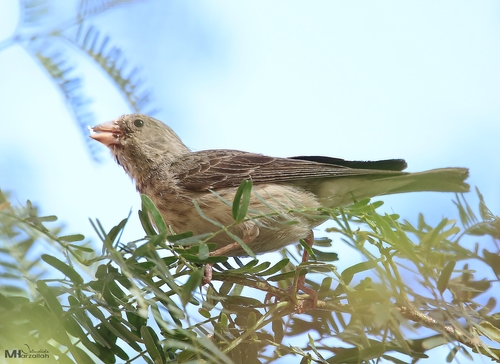

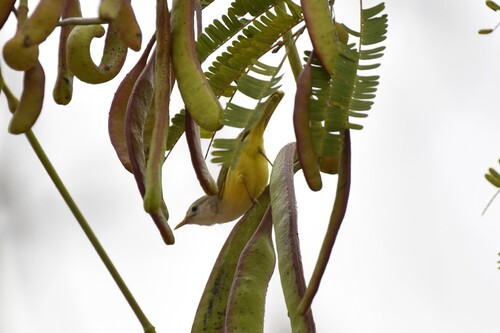
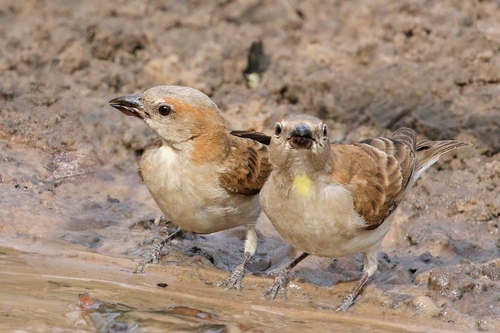
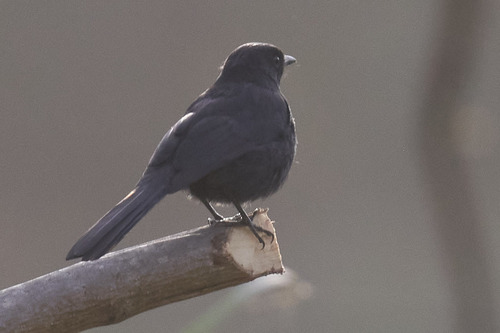
White-rumped Seedeater

White-rumped Seedeater

Crithagra leucopygia

Silhouette: Sheatherius · PhyloPic

LCLeast ConcernNTVUENCR
Daily sighting probability <5% · Rare
at Mole National Park

In 3 days <5% in a week ~10%

6 Verified sightings at Mole National Park From 2019 to 2026
46 In all 3 parks
November Best month
☀️ Diurnal When it's spotted

About the White-rumped Seedeater

The white-rumped seedeater (Crithagra leucopygia) is a species of finch in the family Fringillidae. It is found throughout the Sahel and the eastern part of the Sudan region. Its natural habitat is dry savanna. It is known elsewhere and in aviculture as the grey singing finch.

The white-rumped seedeater was formerly placed in the genus Serinus but phylogenetic analysis using mitochondrial and nuclear DNA sequences found that the genus was polyphyletic. The genus was therefore split and a number of species including the white-rumped seedeater were moved to the resurrected genus Crithagra Swainson 1827.

Wikipedia →

Sounds

Song0:27

Senegal · 2019

© Bram Piot · XC469496 · CC BY-NC-SA 4.0

Call0:28

Ghana · 2022

© Peter Boesman · XC719072 · CC BY-NC-ND 4.0

Song0:21

Algeria · 2022

© Karim Haddad · XC700707 · CC BY-NC-SA 4.0

Global Distribution

Parks Where Found

# Park Country Daily sighting probability
1 Djoudj National Bird Sanctuary 🇸🇳 Senegal
~10%
2 Murchison Falls National Park 🇺🇬 Uganda
<5%
3 Mole National Park 🇬🇭 Ghana
<5%

Cities Where Found

# City Country Daily sighting probability
1 Maiduguri 🇳🇬 Nigeria
~50%
2 Ouagadougou 🇧🇫 Burkina Faso
~30%
3 N'Djamena 🇹🇩 Chad
~10%
4 Dakar 🇸🇳 Senegal
~10%

Zoos & Centres Where Found

# Zoo / Centre Country
1 Bloedel Conservatory 🇨🇦 Canada In captivity

Before you go

What are the chances of seeing a White-rumped Seedeater in Mole National Park?

Rare

Under 5% of wildlife watchers report a White-rumped Seedeater sighting in Mole National Park on a given day, based on 6 verified sightings from GBIF citizen-science data from 2019 to 2026. It is the 255th most-seen of the 266 birds we can rate there. Over three days the chance rises to under 5%, and over a week to about 10%, if each day is a fresh chance.

When is the best time to see a White-rumped Seedeater in Mole National Park?

November

In that month about 10% of wildlife watchers report a White-rumped Seedeater in Mole National Park on a given day, against under 5% in August–October and December–June, the lowest months. That is one of Mole National Park's driest months, with about 5 mm of rain against 220 mm in August. July has too few records to rate.

What time of day is best to see a White-rumped Seedeater?

Between 8 and 11 am

Across all the parks we cover, that three-hour window holds the most White-rumped Seedeater sightings with a recorded time, and about 9 in 10 of them come between 6 am and 6 pm: it is a daytime animal.

Is Mole National Park the best place to see a White-rumped Seedeater?

3rd of 3

Of the 3 parks where we can rate White-rumped Seedeater sightings, Mole National Park ranks 3rd at under 5%. The best odds are in Djoudj National Bird Sanctuary (Senegal, about 10%) and Murchison Falls National Park (Uganda, under 5%).

Where does the White-rumped Seedeater sighting chance come from?

GBIF citizen-science records

It is estimated from how often the White-rumped Seedeater is recorded against all the birds logged in Mole National Park (6 verified sightings from 2019 to 2026), calibrated against known sighting rates. Figures are rounded to the nearest 10% because citizen-science data supports honest approximations, not decimals, and months with records from fewer than five people show "—". How it works.

← Back to Mole National Park