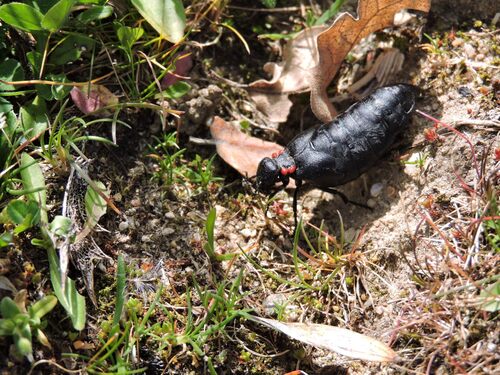
Physomeloe corallifer

Physomeloe corallifer

Physomeloe corallifer

Daily sighting probability ~10% · With luck
at Monfragüe National Park

In 3 days ~30% in a week ~50%

6 Verified sightings at Monfragüe National Park From 2019 to 2026
109 In all 2 parks
April Best month
☀️ Diurnal When it's spotted

About the Physomeloe corallifer

Physomeloe corallifer is a species of blister beetle native to the Iberian Peninsula, it is the only recognised species in the genus Physomeloe. As larvae, Physomeloe corallifer have long hairy bodies, with thin legs, large powerful mandibles and short antennae. Larvae are very rarely observed in the wild as they spend their time underground.

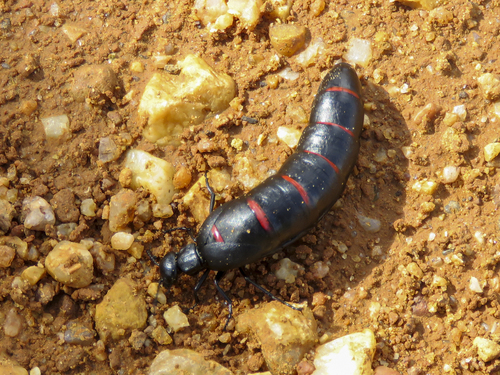
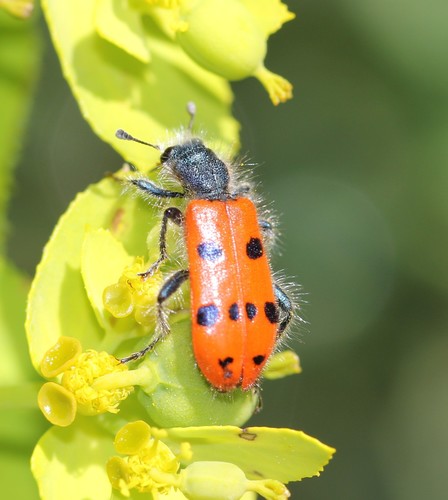
As adults they possess short elytra, barely covering a third of their massive abdomens. Their pronotum are adorned by four coral red spots, this is where the species derives its name from,corallifer, meaning "carrying or possessing coral"; these marks have an aposematic function, warning predators of the danger posed by trying to eat them, as like other blister beetles they can secrete hemolymph containing cantharidin, a highly irritating substance that can cause lesions to the skin and conjunctivitis in the eyes; this does not seem to deter great bustards, who eat them in small doses as a measure to self-medicate and expunge parasites. As it is the case with many insects, females are larger than males, measuring up to four centimetres.

Much like other blister beetles, Physomeloe corallifer can parasitize other... Wikipedia →
Global Distribution

Parks Where Found

# Park Country Daily sighting probability
1 Sierra de Guadarrama National Park 🇪🇸 Spain
~20%
2 Monfragüe National Park 🇪🇸 Spain
~10%

Before you go

What are the chances of seeing a Physomeloe corallifer in Monfragüe National Park?

With luck

About 10% of wildlife watchers report a Physomeloe corallifer sighting in Monfragüe National Park on a given day, based on 6 verified sightings from GBIF citizen-science data from 2019 to 2026. It is the 70th most-seen of the 84 insects we can rate there. Over three days the chance rises to about 30%, and over a week to about 50%, if each day is a fresh chance.

When is the best time to see a Physomeloe corallifer in Monfragüe National Park?

April

In that month about 20% of wildlife watchers report a Physomeloe corallifer in Monfragüe National Park on a given day, against under 5% in May to February, the lowest months. That is one of Monfragüe National Park's wettest months, with about 70 mm of rain against almost none in July.

What time of day is best to see a Physomeloe corallifer?

Between noon and 3 pm

Across all the parks we cover, that three-hour window holds the most Physomeloe corallifer sightings with a recorded time, and about 9 in 10 of them come between 6 am and 6 pm: it is a daytime animal.

Is Monfragüe National Park the best place to see a Physomeloe corallifer?

2nd of 2

Of the 2 parks where we can rate Physomeloe corallifer sightings, Monfragüe National Park ranks 2nd at about 10%. The best odds are in Sierra de Guadarrama National Park (Spain, about 20%).

Where does the Physomeloe corallifer sighting chance come from?

GBIF citizen-science records

It is estimated from how often the Physomeloe corallifer is recorded against all the insects logged in Monfragüe National Park (6 verified sightings from 2019 to 2026), calibrated against known sighting rates. Figures are rounded to the nearest 10% because citizen-science data supports honest approximations, not decimals, and months with records from fewer than five people show "—". How it works.

← Back to Monfragüe National Park