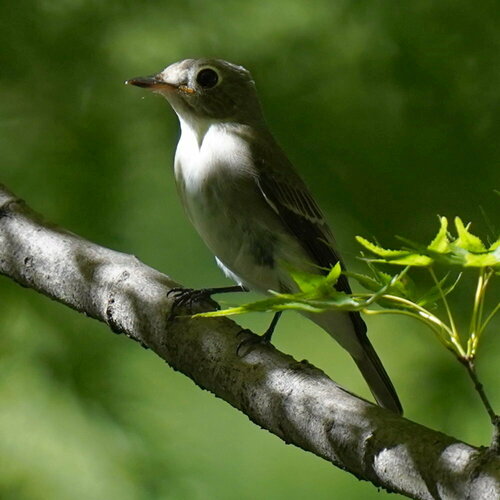
Black-and-orange Flycatcher

Black-and-orange Flycatcher

Ficedula nigrorufa

Silhouette: Rachael Joakim · PhyloPic

LCLeast ConcernNTVUENCR Endemic
Daily sighting probability <5% · Rare
at Mudumalai National Park

In 3 days <5%

5 Verified sightings at Mudumalai National Park From 2019 to 2026
219 In all 3 parks
April Best month
🌅 Crepuscular When it's spotted

About the Black-and-orange Flycatcher

The black-and-orange flycatcher (Ficedula nigrorufa) or black-and-rufous flycatcher is a species of flycatcher endemic to the central and southern Western Ghats, the Nilgiris and Palni hill ranges in southern India. It is unique among the Ficedula flycatchers in having rufous coloration on its back and prior to molecular studies was suggested to be related to the chats and thrushes.

A distinctly coloured bird found mainly in the high-elevation areas of the Western Ghats, the Nilgiris, the Palnis and associated hill ranges. The male is distinctly black headed with black wings. The female has the black replaced by dark brown and has a light eye-ring. They are usually seen singly or in pairs.

The young bird at around two weeks of age is brownish orange with a whitish vent and abdomen. The head has dark streaks and the wings appear bluish with a trace of brown. There is a pale ring around the eye and the orange tail appears stumpy. Eight weeks after fledging they appear almost like adults except for patches of brown feathers in the crown.

The main population of this bird is found in the high elevation plateaus above 1,500 m (4,900 ft) areas... Wikipedia →

Sounds

Call0:14

India · 2002

© David Farrow · XC19576 · CC BY-NC-SA 3.0

Song0:51

India · 2018

© Bird lab - IISER Tirupati (C P Harikrishnan, Viral Joshi, V V Robin) · XC856387 · CC BY-NC-SA 4.0

Call0:11

India · 2016

© Frank Lambert · XC474094 · CC BY-NC-ND 4.0

Global Distribution

Parks Where Found

# Park Country Daily sighting probability
1 Eravikulam National Park 🇮🇳 India
~40%
2 Periyar National Park 🇮🇳 India
<5%
3 Mudumalai National Park 🇮🇳 India
<5%

Before you go

What are the chances of seeing a Black-and-orange Flycatcher in Mudumalai National Park?

Rare

Under 5% of wildlife watchers report a Black-and-orange Flycatcher sighting in Mudumalai National Park on a given day, based on 5 verified sightings from GBIF citizen-science data from 2019 to 2026. It is the 230th most-seen of the 233 birds we can rate there. Over three days the chance rises to under 5%, if each day is a fresh chance.

When is the best time to see a Black-and-orange Flycatcher in Mudumalai National Park?

Any time of year

In every month with enough records, under 5% of wildlife watchers report a Black-and-orange Flycatcher in Mudumalai National Park on a given day, so our monthly data shows no clear season.

What time of day is best to see a Black-and-orange Flycatcher?

Between 3 and 6 am

Across all the parks we cover, that three-hour window holds the most Black-and-orange Flycatcher sightings with a recorded time, and about 6 in 10 of them come between 6 am and 6 pm: it is most active around dawn and dusk.

Is Mudumalai National Park the best place to see a Black-and-orange Flycatcher?

3rd of 3

Of the 3 parks where we can rate Black-and-orange Flycatcher sightings, Mudumalai National Park ranks 3rd at under 5%. The best odds are in Eravikulam National Park (India, about 40%) and Periyar National Park (India, under 5%).

Where does the Black-and-orange Flycatcher sighting chance come from?

GBIF citizen-science records

It is estimated from how often the Black-and-orange Flycatcher is recorded against all the birds logged in Mudumalai National Park (5 verified sightings from 2019 to 2026), calibrated against known sighting rates. Figures are rounded to the nearest 10% because citizen-science data supports honest approximations, not decimals, and months with records from fewer than five people show "—". How it works.

← Back to Mudumalai National Park