Malabar Whistling-Thrush

Malabar Whistling-Thrush

Myophonus horsfieldii

Silhouette: Martin Bulla, based on François Desbordes' illustration · PhyloPic

LCLeast ConcernNTVUENCR Endemic
Daily sighting probability ~10% · With luck
at Mudumalai National Park

In 3 days ~30% in a week ~60%

104 Verified sightings at Mudumalai National Park From 2019 to 2026
3,298 In all 8 parks
January Best month
🌅 Crepuscular When it's spotted

About the Malabar Whistling-Thrush

The Malabar whistling thrush (Myophonus horsfieldii) is a whistling thrush in the family Muscicapidae. The bird has been called whistling schoolboy for the whistling calls that they make at dawn that have a very human quality. The species is a resident in the Western Ghats and associated hills of peninsular India including central India and parts of the Eastern Ghats.

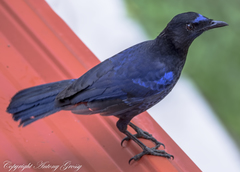
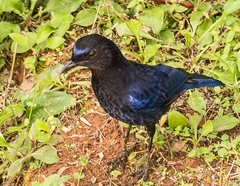
This is a monotypic taxon previously considered conspecific with Taiwan whistling thrush. It is a large thrush measuring about 25-30 cm and weighs about 101-130 g. The male has a blackish upper body with shiny metallic patches of blue on the forehead and shoulders, and glossy royal-blue scaling on back, scapulars and mid-breast to belly. The bill and legs are black. The female is very similar, but with weaker scaling below. Juveniles are black, with glossy blue shoulder patch and wing edgings. The blue becomes visible only in oblique lighting and is due to ultraviolet reflectance, a shared attribute with other whistling thrushes.

Malabar whistling thrushes are usually found in dark undergrowth in dense riverine forest. They typically... Wikipedia →

Sounds

Aberrant0:32

India · 2024

© Jairam Vijayan · XC875445 · CC BY-SA 4.0

Song0:24

India · 2022

© Uday Kiran · XC772172 · CC BY-NC-SA 4.0

Call0:05

India · 1998

© Jelle Scharringa · XC650886 · CC BY-NC-SA 4.0

Global Distribution

Parks Where Found

# Park Country Daily sighting probability
1 Periyar National Park 🇮🇳 India
~60%
2 Eravikulam National Park 🇮🇳 India
~50%
3 Mudumalai National Park 🇮🇳 India
~10%
4 Satpura National Park 🇮🇳 India
<5%
5 Bandipur National Park 🇮🇳 India
<5%
6 Nagarhole National Park 🇮🇳 India
<5%
7 Kanha National Park 🇮🇳 India
<5%
8 Bandhavgarh National Park 🇮🇳 India
<5%

Cities Where Found

# City Country Daily sighting probability
1 Kozhikode 🇮🇳 India
<5%
2 Mumbai 🇮🇳 India
<5%
3 Pune 🇮🇳 India
<5%
4 Bengaluru 🇮🇳 India
<5%

Before you go

What are the chances of seeing a Malabar Whistling-Thrush in Mudumalai National Park?

With luck

About 10% of wildlife watchers report a Malabar Whistling-Thrush sighting in Mudumalai National Park on a given day, based on 104 verified sightings from GBIF citizen-science data from 2019 to 2026. It is the 110th most-seen of the 233 birds we can rate there. Over three days the chance rises to about 30%, and over a week to about 60%, if each day is a fresh chance.

When is the best time to see a Malabar Whistling-Thrush in Mudumalai National Park?

January

In that month about 30% of wildlife watchers report a Malabar Whistling-Thrush in Mudumalai National Park on a given day, against under 5% in October and December, the lowest months. That is one of Mudumalai National Park's driest months, with about 25 mm of rain against 230 mm in July.

What time of day is best to see a Malabar Whistling-Thrush?

Between 3 and 6 am

Across all the parks we cover, that three-hour window holds the most Malabar Whistling-Thrush sightings with a recorded time, and about 6 in 10 of them come between 6 am and 6 pm: it is most active around dawn and dusk.

Is Mudumalai National Park the best place to see a Malabar Whistling-Thrush?

3rd of 8

Of the 8 parks where we can rate Malabar Whistling-Thrush sightings, Mudumalai National Park ranks 3rd at about 10%. The best odds are in Periyar National Park (India, about 60%) and Eravikulam National Park (India, about 50%).

Which relatives of the Malabar Whistling-Thrush live in Mudumalai National Park?

Same family: Muscicapidae

The closest relatives of the Malabar Whistling-Thrush that you can see in Mudumalai National Park (family Muscicapidae, Old World Flycatchers, Robins, and Chats) are Oriental Magpie-Robin (about 60%), Tickell's Blue Flycatcher (about 50%) and Pied Bushchat (about 40%), with each one's daily chance of a sighting.

Where does the Malabar Whistling-Thrush sighting chance come from?

GBIF citizen-science records

It is estimated from how often the Malabar Whistling-Thrush is recorded against all the birds logged in Mudumalai National Park (104 verified sightings from 2019 to 2026), calibrated against known sighting rates. Figures are rounded to the nearest 10% because citizen-science data supports honest approximations, not decimals, and months with records from fewer than five people show "—". How it works.

← Back to Mudumalai National Park