Nilgiri Thrush

Nilgiri Thrush

Zoothera neilgherriensis

Silhouette: Francesco "Architetto" Rollandin · PhyloPic

Endemic
Daily sighting probability <5% · Rare
at Mudumalai National Park

In 3 days ~10%

16 Verified sightings at Mudumalai National Park From 2019 to 2026
16 In 1 park
January Best month

About the Nilgiri Thrush

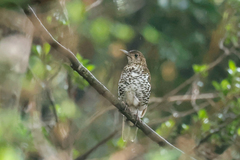
The Nilgiri thrush (Zoothera neilgherriensis) is a member of the thrush family. The Nilgiri thrush is endemic to the Western Ghats. It is largely restricted to the sholas, isolated cloud forests found in high altitudes that are separated by rolling montane grassland. It is also rarely found in roadways on rainy days. It feeds on insects and is an opportunistic insectivore. The thrush stays on the terrestrial lower canopy of the moist shola ecosystem. The scaled pattern of this species gives it a protective side of camouflage in terrestrial understory of the forest. Habitat extent is distributed throughout the moist shola forests in the region.

The sexes are similar, 27–31 cm long, with black scaling on a paler white or yellowish background. The most striking identification feature in flight is the black band on the white underwings, a feature shared with Siberian thrush. The male has a song which is a loud, far-carrying mechanical whistle, with 5-10 second pauses between each one second long phrase twee...tuuu....tuuu....tuuu.

It was previously considered a subspecies of the scaly thrush. Wikipedia →

Sounds

Recording0:17

India · 2022

© Panthera Tigris · XC714582 · CC BY-NC-SA 4.0

Global Distribution

Parks Where Found

# Park Country Daily sighting probability
1 Mudumalai National Park 🇮🇳 India
<5%

More parks will be added in future updates.

Before you go

What are the chances of seeing a Nilgiri Thrush in Mudumalai National Park?

Rare

Under 5% of wildlife watchers report a Nilgiri Thrush sighting in Mudumalai National Park on a given day, based on 16 verified sightings from GBIF citizen-science data from 2019 to 2026. It is the 200th most-seen of the 233 birds we can rate there. Over three days the chance rises to about 10%, if each day is a fresh chance.

When is the best time to see a Nilgiri Thrush in Mudumalai National Park?

January

In that month about 10% of wildlife watchers report a Nilgiri Thrush in Mudumalai National Park on a given day, against under 5% in February to December, the lowest months. That is one of Mudumalai National Park's driest months, with about 25 mm of rain against 230 mm in July.

Where else can you see a Nilgiri Thrush?

Only Mudumalai National Park, in our data

Mudumalai National Park is the only park on Wallace's Line with enough records to rate Nilgiri Thrush sightings: under 5% of wildlife watchers there report one on a given day.

Where does the Nilgiri Thrush sighting chance come from?

GBIF citizen-science records

It is estimated from how often the Nilgiri Thrush is recorded against all the birds logged in Mudumalai National Park (16 verified sightings from 2019 to 2026), calibrated against known sighting rates. Figures are rounded to the nearest 10% because citizen-science data supports honest approximations, not decimals, and months with records from fewer than five people show "—". How it works.

← Back to Mudumalai National Park