White-bellied Blue Flycatcher

White-bellied Blue Flycatcher

Cyornis pallidipes

Silhouette: L. Shyamal · PhyloPic

LCLeast ConcernNTVUENCR Endemic
Daily sighting probability <5% · Rare
at Mudumalai National Park

In 3 days ~10% in a week ~20%

22 Verified sightings at Mudumalai National Park From 2019 to 2026
400 In all 4 parks
July Best month
☀️ Diurnal When it's spotted

About the White-bellied Blue Flycatcher

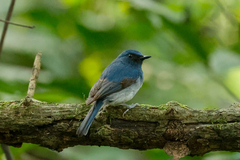
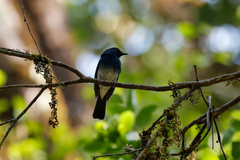
The white-bellied blue flycatcher (Cyornis pallidipes) is a small passerine bird in the flycatcher family Muscicapidae. It is endemic to the Western Ghats (including the Nilgiris) of southwest India. Males are dark blue with a lighter shade of blue on the brow and have a greyish white belly. Females have a rufous breast, a white face and olive grey above.

This flycatcher is about 13 centimetres (5.1 in) long and has a longish beak. It forages in the undergrowth in the shade of dense forest canopy where it makes aerial forays to capture insects. The male is indigo blue with ultramarine blue supercilium and forehead. The lores and face are dark grey. The belly is white and bordered by smoky grey wash. The female is olive brown above with whitish lores. The rufous throat and breast fades to white towards the belly. The female has a chestnut tail and can be told apart from other flycatchers like by the lack of the black and white tail pattern. In poor lighting and within the Palni Hills it can be confusable with the white-bellied blue robin, which however has longer legs and is more likely to be seen on the ground.

The white-bellied blue flycatcher... Wikipedia →

Sounds

Call0:09

India · 2011

© Rajgopal Patil · XC574741 · CC BY-NC-SA 4.0

Song0:20

India · 2014

© vir joshi · XC178279 · CC BY-NC-SA 4.0

Call0:20

India · 2016

© Pronoy Baidya · XC356248 · CC BY-NC-ND 4.0

Global Distribution

Parks Where Found

# Park Country Daily sighting probability
1 Periyar National Park 🇮🇳 India
~10%
2 Mudumalai National Park 🇮🇳 India
<5%
3 Nagarhole National Park 🇮🇳 India
<5%
4 Bandipur National Park 🇮🇳 India
<5%

Before you go

What are the chances of seeing a White-bellied Blue Flycatcher in Mudumalai National Park?

Rare

Under 5% of wildlife watchers report a White-bellied Blue Flycatcher sighting in Mudumalai National Park on a given day, based on 22 verified sightings from GBIF citizen-science data from 2019 to 2026. It is the 183rd most-seen of the 233 birds we can rate there. Over three days the chance rises to about 10%, and over a week to about 20%, if each day is a fresh chance.

When is the best time to see a White-bellied Blue Flycatcher in Mudumalai National Park?

May to July

In those months about 10% of wildlife watchers report a White-bellied Blue Flycatcher in Mudumalai National Park on a given day, against under 5% in August to April, the lowest months. Those are among Mudumalai National Park's wettest months, with about 190 mm of rain a month against 10 mm in February.

What time of day is best to see a White-bellied Blue Flycatcher?

Between 4 and 7 pm

Across all the parks we cover, that three-hour window holds the most White-bellied Blue Flycatcher sightings with a recorded time, and about 8 in 10 of them come between 6 am and 6 pm: it is a daytime animal.

Is Mudumalai National Park the best place to see a White-bellied Blue Flycatcher?

2nd of 4

Of the 4 parks where we can rate White-bellied Blue Flycatcher sightings, Mudumalai National Park ranks 2nd at under 5%. The best odds are in Periyar National Park (India, about 10%).

Where does the White-bellied Blue Flycatcher sighting chance come from?

GBIF citizen-science records

It is estimated from how often the White-bellied Blue Flycatcher is recorded against all the birds logged in Mudumalai National Park (22 verified sightings from 2019 to 2026), calibrated against known sighting rates. Figures are rounded to the nearest 10% because citizen-science data supports honest approximations, not decimals, and months with records from fewer than five people show "—". How it works.

← Back to Mudumalai National Park