About the Shoebill
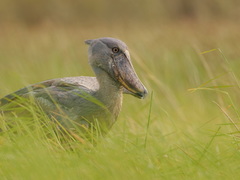
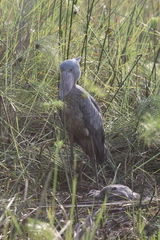
The shoebill (Balaeniceps rex), also known as the whale-headed stork, whalebill, and shoe-billed stork, is a large long-legged wading bird. It is named for its enormous, shoe-shaped bill. It has a somewhat stork-like overall form and was previously classified as a stork in the order Ciconiiformes, but genetic evidence has now placed it along with pelicans, herons, and its closest relative, the hamerkop, all in the order Pelecaniformes. Adults are mainly grey, while juveniles are browner. It lives in tropical East Africa in large swamps from South Sudan down to Zambia.
The shoebill may have been known to Ancient Egyptians, but was not classified by Europeans until the 19th century, after skins and eventually live specimens were brought to Europe. John Gould very briefly described it in 1850 from the skin of a specimen collected on the upper White Nile by English traveler Mansfield Parkyns. Gould provided a more detailed description in the following year. He placed the species in its own genus Balaeniceps and coined the binomial name Balaeniceps rex, from Latin balaena 'whale' and caput/ceps 'head'. Other common names are whalebill, shoe-billed stork, and whale-headed... Wikipedia →