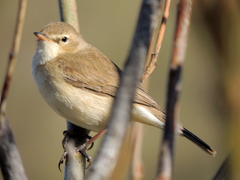
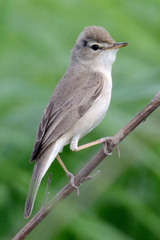
Booted Warbler

Booted Warbler

Iduna caligata

Silhouette: Sheatherius · PhyloPic

LCLeast ConcernNTVUENCR
Daily sighting probability <5% · Rare
at Nagarhole National Park

In 3 days ~10% in a week ~20%

65 Verified sightings at Nagarhole National Park From 2019 to 2026
284 In all 7 parks
January Best month
☀️ Diurnal When it's spotted

About the Booted Warbler

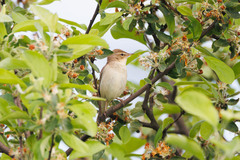
The booted warbler (Iduna caligata) is a species of passerine bird belonging to the family Acrocephalidae, the reed and tree warblers. This species breeds in Eastern Europe and western Asia, wintering in south Asia. it is a regular vagrant to Western Europe.

The booted warbler was first formally described as Sylvia caligata by the German physician, explorer, botanist and zoologist Martin Hinrich Carl Lichtenstein with its type locality given as the Ilek River, near Orenburg. This species is now classified in the genus Iduna, the tree warblers, within the family Acrocephalidae. All the "Old World warblers" were formerly classified within the wastebin taxon known as Sylviidae sensu lato, but in the late 20th Century, molecular studies resulted in this taxon being divided into a number of families.

It was formerly considered to be conspecific with Sykes's warbler, but the two are now usually both afforded species status. The booted warbler belongs to the genus Iduna which was proposed by Alexander Keyserling and Johann Heinrich Blasius in 1840, but they gave no explanation of the genus name, though in Norse mythology, Iðunn, or Iduna, is the goddess of spring... Wikipedia →

Sounds

Call0:25

Kazakhstan · 2025

© Frank Lambert · XC1030369 · CC BY-NC-ND 4.0

Song0:40

Sweden · 2024

© Lars Edenius · XC914170 · CC BY-NC-SA 4.0

Song1:09

Sweden · 2020

© Dag Österlund · XC913933 · CC BY-NC-SA 4.0

Global Distribution

Parks Where Found

# Park Country Daily sighting probability
1 Mudumalai National Park 🇮🇳 India
~10%
2 Bandipur National Park 🇮🇳 India
~10%
3 Nagarhole National Park 🇮🇳 India
<5%
4 Keoladeo National Park 🇮🇳 India
<5%
5 Bandhavgarh National Park 🇮🇳 India
<5%
6 Satpura National Park 🇮🇳 India
<5%
7 Kanha National Park 🇮🇳 India
<5%

Cities Where Found

# City Country Daily sighting probability
1 Coimbatore 🇮🇳 India
~20%
2 Vasai-Virar 🇮🇳 India
~20%
3 Novosibirsk 🇷🇺 Russia
~20%
4 Tiruppur 🇮🇳 India
~20%
5 Nashik 🇮🇳 India
~10%
6 Vijayawada 🇮🇳 India
~10%
7 Mysuru 🇮🇳 India
~10%
8 Bengaluru 🇮🇳 India
~10%
9 Raipur 🇮🇳 India
~10%
10 Surat 🇮🇳 India
~10%

Before you go

What are the chances of seeing a Booted Warbler in Nagarhole National Park?

Rare

Under 5% of wildlife watchers report a Booted Warbler sighting in Nagarhole National Park on a given day, based on 65 verified sightings from GBIF citizen-science data from 2019 to 2026. It is the 180th most-seen of the 272 birds we can rate there. Over three days the chance rises to about 10%, and over a week to about 20%, if each day is a fresh chance.

When is the best time to see a Booted Warbler in Nagarhole National Park?

January and February

In those months about 10% of wildlife watchers report a Booted Warbler in Nagarhole National Park on a given day, against under 5% in March to December, the lowest months. Those are among Nagarhole National Park's driest months, with about 10 mm of rain a month against 270 mm in July.

What time of day is best to see a Booted Warbler?

Between 11 am and 2 pm

Across all the parks we cover, that three-hour window holds the most Booted Warbler sightings with a recorded time, and about 9 in 10 of them come between 6 am and 6 pm: it is a daytime animal.

Is Nagarhole National Park the best place to see a Booted Warbler?

3rd of 7

Of the 7 parks where we can rate Booted Warbler sightings, Nagarhole National Park ranks 3rd at under 5%. The best odds are in Mudumalai National Park (India, about 10%) and Bandipur National Park (India, about 10%).

Where does the Booted Warbler sighting chance come from?

GBIF citizen-science records

It is estimated from how often the Booted Warbler is recorded against all the birds logged in Nagarhole National Park (65 verified sightings from 2019 to 2026), calibrated against known sighting rates. Figures are rounded to the nearest 10% because citizen-science data supports honest approximations, not decimals, and months with records from fewer than five people show "—". How it works.

← Back to Nagarhole National Park