Indian Yellow Tit

Indian Yellow Tit

Parus aplonotus

Silhouette: Ferran Sayol · PhyloPic

Daily sighting probability ~10% · With luck
at Nagarhole National Park

In 3 days ~20% in a week ~40%

193 Verified sightings at Nagarhole National Park From 2019 to 2026
1,095 In all 8 parks
October Best month
☀️ Diurnal When it's spotted

About the Indian Yellow Tit

The Indian black-lored tit, Indian tit, or Indian yellow tit (Grimmett et al., 2011) (Machlolophus aplonotus) is a passerine bird in the tit family Paridae. The yellow-cheeked tit is probably its closest relative, and both may be related to the yellow tit. These three tits almost certainly form a distinct lineage as evidenced by morphology, and mtDNA cytochrome b sequence analysis (Gill et al., 2005). The subgenus name Macholophus may apply for them.

This species is a resident breeder on the Indian subcontinent. It is a common bird in open tropical forests, but does not occur in Sri Lanka. It is an active and agile feeder, taking insects and spiders from the canopy, and sometimes fruit.

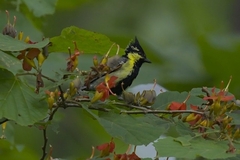
It is an easy tit to recognise in most of India, large in size at 13 cm, with a broad black line (broader in the male) down its otherwise yellow front. The large crest, neck, throat and head are black with yellow cheeks and supercilia. Upperparts are olive-green. It has two white or yellowish wingbars and white outer tail feathers.

Females and young birds are duller than males. The underpart colour becomes increasingly dull from north to south through this tit's range. It is, like other tits, a vocal bird, and has a large variety of calls, of which the most familiar is a si-si. The song is a sometimes nuthatch-like chi-chi-chi.

Woodpecker or barbet holes are used for a nest, and this species will also excavate its own hole or use man-made sites. The clutch is typically 3–5 white eggs, spotted red. The bird is a close sitter, hissing when disturbed.

The Indian black-lored tit was formerly one of the many species in the genus Parus but was moved to Machlolophus after a molecular phylogenetic analysis published in 2013 showed that the members of the new genus formed a distinct clade. Wikipedia →

Global Distribution

Parks Where Found

# Park Country Daily sighting probability
1 Satpura National Park 🇮🇳 India
~20%
2 Eravikulam National Park 🇮🇳 India
~10%
3 Nagarhole National Park 🇮🇳 India
~10%
4 Periyar National Park 🇮🇳 India
~10%
5 Kanha National Park 🇮🇳 India
<5%
6 Bandipur National Park 🇮🇳 India
<5%
7 Mudumalai National Park 🇮🇳 India
<5%
8 Bandhavgarh National Park 🇮🇳 India
<5%

Cities Where Found

# City Country Daily sighting probability
1 Jabalpur 🇮🇳 India
~30%
2 Ranchi 🇮🇳 India
~10%
3 Indore 🇮🇳 India
~10%
4 Bhopal 🇮🇳 India
<5%
5 Nagpur 🇮🇳 India
<5%
6 Pune 🇮🇳 India
<5%

Before you go

What are the chances of seeing an Indian Yellow Tit in Nagarhole National Park?

With luck

About 10% of wildlife watchers report an Indian Yellow Tit sighting in Nagarhole National Park on a given day, based on 193 verified sightings from GBIF citizen-science data from 2019 to 2026. It is the 129th most-seen of the 272 birds we can rate there. Over three days the chance rises to about 20%, and over a week to about 40%, if each day is a fresh chance.

When is the best time to see an Indian Yellow Tit in Nagarhole National Park?

February, July–August and October

In those months about 20% of wildlife watchers report an Indian Yellow Tit in Nagarhole National Park on a given day, against under 5% in March–May, September and November–December, the lowest months.

What time of day is best to see an Indian Yellow Tit?

Between 7 and 10 am

Across all the parks we cover, that three-hour window holds the most Indian Yellow Tit sightings with a recorded time, and about 9 in 10 of them come between 6 am and 6 pm: it is a daytime animal.

Is Nagarhole National Park the best place to see an Indian Yellow Tit?

3rd of 8

Of the 8 parks where we can rate Indian Yellow Tit sightings, Nagarhole National Park ranks 3rd at about 10%. The best odds are in Satpura National Park (India, about 20%) and Eravikulam National Park (India, about 10%).

Where does the Indian Yellow Tit sighting chance come from?

GBIF citizen-science records

It is estimated from how often the Indian Yellow Tit is recorded against all the birds logged in Nagarhole National Park (193 verified sightings from 2019 to 2026), calibrated against known sighting rates. Figures are rounded to the nearest 10% because citizen-science data supports honest approximations, not decimals, and months with records from fewer than five people show "—". How it works.

← Back to Nagarhole National Park