Malabar Trogon

Malabar Trogon

Harpactes fasciatus

Silhouette: Keith Murdock (photo), John E. McCormack, Michael G. Harvey, Brant C. Faircloth, Nicholas G. Crawford, Travis C. Glenn, Robb T. Brumfield & T. Michael Keesey · PhyloPic

LCLeast ConcernNTVUENCR
Daily sighting probability <5% · Rare
at Nagarhole National Park

In 3 days ~10% in a week ~20%

61 Verified sightings at Nagarhole National Park From 2019 to 2026
1,526 In all 5 parks
February Best month
🌅 Crepuscular When it's spotted

About the Malabar Trogon

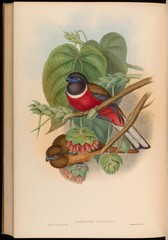
The Malabar trogon (Harpactes fasciatus) is a species of bird in the trogon family. It is found in the forests of India and Sri Lanka. In India, it is mainly found in the Western Ghats, hill forests of central India and in parts of the Eastern Ghats. They are insectivorous and although not migratory, may move seasonally in response to rain in hill forest regions. Like in other trogons, males and females vary in plumage. The birds utter low, guttural calls that can be heard only at close quarters, and perch still on a branch under the forest canopy, often facing away from the viewer, making them easy to miss despite their colourful plumage.

Like most other trogons, these birds are brightly coloured and sexually dimorphic. The male has a slaty-black head and breast, with a white border on the black bib separating it from the crimson on the underside. The back is olive-brown to chestnut. The wing coverts are black with fine white vermiculations. They have 12 tail feathers that are graduated. The central tail-feathers are chestnut with a black tip, with the second and third pairs from the middle having more black than chestnut. The outer three pairs have long white tips... Wikipedia →

Sounds

Call0:38

India · 2023

© Sathyan Meppayur · XC786590 · CC BY-NC-SA 4.0

Song0:24

India · 2023

© JISHNU KIZHAKKILLAM · XC775936 · CC BY-NC-SA 4.0

Recording0:19

India · 2013

© Sushant more · XC206370 · CC BY-NC-SA 4.0

Global Distribution

Parks Where Found

# Park Country Daily sighting probability
1 Sinharaja Forest Reserve 🇱🇰 Sri Lanka
~40%
2 Periyar National Park 🇮🇳 India
~30%
3 Nagarhole National Park 🇮🇳 India
<5%
4 Horton Plains National Park 🇱🇰 Sri Lanka
<5%
5 Bandipur National Park 🇮🇳 India
<5%

Before you go

What are the chances of seeing a Malabar Trogon in Nagarhole National Park?

Rare

Under 5% of wildlife watchers report a Malabar Trogon sighting in Nagarhole National Park on a given day, based on 61 verified sightings from GBIF citizen-science data from 2019 to 2026. It is the 170th most-seen of the 272 birds we can rate there. Over three days the chance rises to about 10%, and over a week to about 20%, if each day is a fresh chance.

When is the best time to see a Malabar Trogon in Nagarhole National Park?

February to April

In those months about 10% of wildlife watchers report a Malabar Trogon in Nagarhole National Park on a given day, against under 5% in May to January, the lowest months. Those are among Nagarhole National Park's driest months, with about 25 mm of rain a month against 270 mm in July.

What time of day is best to see a Malabar Trogon?

Between 5 and 8 am

Across all the parks we cover, that three-hour window holds the most Malabar Trogon sightings with a recorded time, and about 6 in 10 of them come between 6 am and 6 pm: it is most active around dawn and dusk.

Is Nagarhole National Park the best place to see a Malabar Trogon?

3rd of 5

Of the 5 parks where we can rate Malabar Trogon sightings, Nagarhole National Park ranks 3rd at under 5%. The best odds are in Sinharaja Forest Reserve (Sri Lanka, about 40%) and Periyar National Park (India, about 30%).

Where does the Malabar Trogon sighting chance come from?

GBIF citizen-science records

It is estimated from how often the Malabar Trogon is recorded against all the birds logged in Nagarhole National Park (61 verified sightings from 2019 to 2026), calibrated against known sighting rates. Figures are rounded to the nearest 10% because citizen-science data supports honest approximations, not decimals, and months with records from fewer than five people show "—". How it works.

← Back to Nagarhole National Park