Jackson's Chameleon

Jackson's Chameleon

Trioceros jacksonii

Silhouette: T. Michael Keesey (from a photograph by Frank Glaw, Jörn Köhler, Ted M. Townsend & Miguel Vences) · PhyloPic

LCLeast ConcernNTVUENCR
Daily sighting probability ~50% · Likely
at Nairobi National Park

In 3 days ~80% in a week >90%

88 Verified sightings at Nairobi National Park From 2019 to 2026
88 In 1 park
October Best month
☀️ Diurnal When it's spotted

About the Jackson's Chameleon

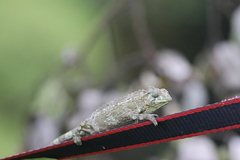
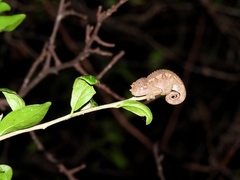
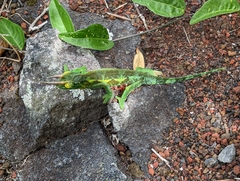
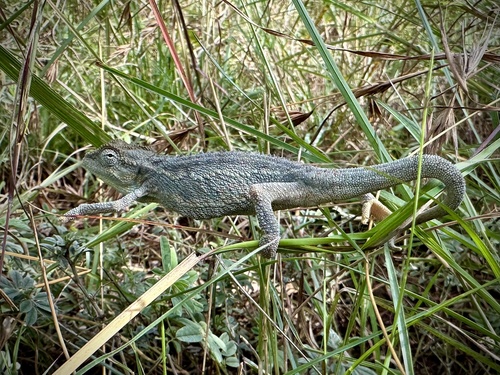
Jackson's chameleon (Trioceros jacksonii), also known commonly as Jackson's horned chameleon, the three-horned chameleon, and the Kikuyu three-horned chameleon, is a species of chameleon, a lizard in the family Chamaeleonidae. The species is native to East Africa, and introduced to Hawaii, Florida, and California. There are three recognized subspecies.

Jackson's chameleon was described by Belgian-British zoologist George Albert Boulenger in 1896. The generic name, Trioceros, is derived from the Greek τρί- (tri-) meaning "three" and κέρας (kéras) meaning "horns". This is in reference to the three horns found on the heads of males.

The specific name, jacksonii, is a Latinized form of the last name of English explorer and ornithologist Frederick John Jackson, who was serving as the first Governor of Kenya at the time of Boulenger's description. Wikipedia →

Global Distribution

Parks Where Found

# Park Country Daily sighting probability
1 Nairobi National Park 🇰🇪 Kenya
~50%

More parks will be added in future updates.

Cities Where Found

# City Country Daily sighting probability
1 Nairobi 🇰🇪 Kenya
~40%

Zoos & Centres Where Found

# Zoo / Centre Country
1 Toledo Zoo 🇺🇸 United States In captivity
2 Taronga Zoo 🇦🇺 Australia In captivity
3 Parc Zoologique et Botanique de Mulhouse 🇫🇷 France In captivity
4 Melbourne Zoo 🇦🇺 Australia In captivity
5 Schönbrunn Zoo 🇦🇹 Austria In captivity
6 Budapest Zoo & Botanical Garden 🇭🇺 Hungary In captivity
7 Akron Zoo 🇺🇸 United States In captivity
8 Santillana Zoo 🇪🇸 Spain In captivity
9 Zoo Boise 🇺🇸 United States In captivity
10 DMM Kariyushi Aquarium 🇯🇵 Japan In captivity

Before you go

What are the chances of seeing a Jackson's Chameleon in Nairobi National Park?

Likely

About 50% of wildlife watchers report a Jackson's Chameleon sighting in Nairobi National Park on a given day, based on 88 verified sightings from GBIF citizen-science data from 2019 to 2026. It is the 2nd most-seen of the 13 reptiles we can rate there. Over three days the chance rises to about 80%, and over a week to over 90%, if each day is a fresh chance.

When is the best time to see a Jackson's Chameleon in Nairobi National Park?

October

In that month about 70% of wildlife watchers report a Jackson's Chameleon in Nairobi National Park on a given day, against about 20% in August, the lowest month.

What time of day is best to see a Jackson's Chameleon?

Between 11 am and 2 pm

Across all the parks we cover, that three-hour window holds the most Jackson's Chameleon sightings with a recorded time, and about 8 in 10 of them come between 6 am and 6 pm: it is a daytime animal.

Where else can you see a Jackson's Chameleon?

Only Nairobi National Park, in our data

Nairobi National Park is the only park on Wallace's Line with enough records to rate Jackson's Chameleon sightings: about 50% of wildlife watchers there report one on a given day.

Which relatives of the Jackson's Chameleon live in Nairobi National Park?

Same genus: Trioceros

The closest relatives of the Jackson's Chameleon that you can see in Nairobi National Park (genus Trioceros, Equatorial Chameleons) are Helmeted Chameleon (about 30%) and Side-striped Chameleon (about 10%), with each one's daily chance of a sighting.

Where does the Jackson's Chameleon sighting chance come from?

GBIF citizen-science records

It is estimated from how often the Jackson's Chameleon is recorded against all the reptiles logged in Nairobi National Park (88 verified sightings from 2019 to 2026), calibrated against known sighting rates. Figures are rounded to the nearest 10% because citizen-science data supports honest approximations, not decimals, and months with records from fewer than five people show "—". How it works.

← Back to Nairobi National Park