Puff Adder

Puff Adder

Bitis arietans

Silhouette: Steven Traver · PhyloPic

LCLeast ConcernNTVUENCR
Daily sighting probability ~10% · With luck
at Nairobi National Park

In 3 days ~30% in a week ~60%

5 Verified sightings at Nairobi National Park From 2019 to 2026
805 In all 15 parks
September Best month
☀️ Diurnal When it's spotted

About the Puff Adder

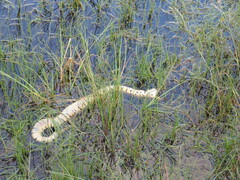
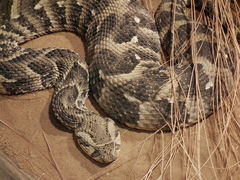
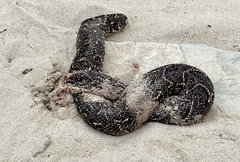
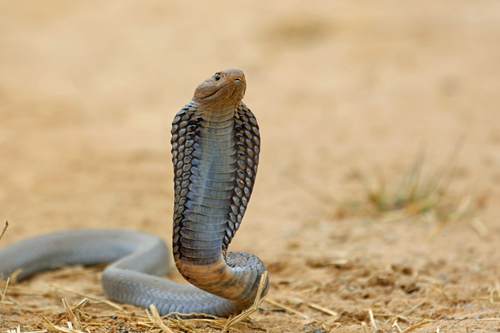
The puff adder (Bitis arietans) is a highly venomous viper species found in savannahs and grasslands from Morocco and western Arabia throughout Africa except for the Sahara and rainforest regions. It is responsible for causing the most snakebite fatalities in Africa owing to various factors, such as its wide distribution, frequent occurrence in highly populated regions, and aggressive disposition. Two subspecies are currently recognized, including the nominate subspecies described here.

The species is commonly known as the puff adder, African puff adder, or common puff adder. German naturalist Blasius Merrem described Bitis arietans in 1820. The specific name arietans means "striking violently" and is derived from the Latin arieto. The type locality given is "Promontorio bonae spei " (Cape of Good Hope), South Africa.

The puff adder's usual size is about 1.0 m (39.3 in) in total length (body and tail) and very stout. Large specimens of 190 cm (75 in) total length, weighing over 6.0 kg (13.2 lb) and with a girth of 40 cm (16 in) have been reported. Specimens from Saudi Arabia are not as large, usually no more than 80 cm (31 in) in total... Wikipedia →

Sounds

Recording0:11

Kenya · 2025

© Simon Musila · iNaturalist · CC BY-NC 4.0

Recording0:35

Angola · 2025

© Zilpa Miranda · iNaturalist · CC BY-NC 4.0

Recording0:08

South Africa · 2016

© Marion Maclean · iNaturalist · CC BY-NC 4.0

Global Distribution

Parks Where Found

# Park Country Daily sighting probability
1 West Coast National Park 🇿🇦 South Africa
~50%
2 De Hoop Nature Reserve 🇿🇦 South Africa
~40%
3 Tsavo East National Park 🇰🇪 Kenya
~30%
4 Garden Route National Park 🇿🇦 South Africa
~20%
5 Kgalagadi Transfrontier Park 🇿🇦 South Africa
~20%
6 uMkhuze Game Reserve 🇿🇦 South Africa
~20%
7 Table Mountain National Park 🇿🇦 South Africa
~20%
8 Kruger National Park 🇿🇦 South Africa
~20%
9 Addo Elephant National Park 🇿🇦 South Africa
~10%
10 Nairobi National Park 🇰🇪 Kenya
~10%
11 Serengeti National Park 🇹🇿 Tanzania
~10%
12 Pilanesberg National Park 🇿🇦 South Africa
~10%
13 Masai Mara National Reserve 🇰🇪 Kenya
~10%
14 Etosha National Park 🇳🇦 Namibia
~10%
15 iSimangaliso Wetland Park 🇿🇦 South Africa
~10%

Cities Where Found

# City Country Daily sighting probability
1 Cape Town 🇿🇦 South Africa
~10%

Zoos & Centres Where Found

# Zoo / Centre Country
1 San Diego Zoo 🇺🇸 United States In captivity
2 National Zoological Park 🇺🇸 United States In captivity
3 Denver Zoo 🇺🇸 United States In captivity
4 Cincinnati Zoo and Botanical Garden 🇺🇸 United States In captivity
5 Bronx Zoo 🇺🇸 United States In captivity
6 Omaha’s Henry Doorly Zoo and Aquarium 🇺🇸 United States In captivity
7 Johannesburg Zoo 🇿🇦 South Africa In captivity
8 National Zoological Garden of South Africa 🇿🇦 South Africa In captivity
9 Toledo Zoo 🇺🇸 United States In captivity
10 Oklahoma City Zoo and Botanical Garden 🇺🇸 United States In captivity
11 Saint Louis Zoo 🇺🇸 United States In captivity
12 Terra Natura Benidorm 🇪🇸 Spain In captivity
13 Zoo Knoxville 🇺🇸 United States In captivity
14 Houston Zoo 🇺🇸 United States In captivity
15 Cameron Park Zoo 🇺🇸 United States In captivity
16 London Zoo 🇬🇧 United Kingdom In captivity
17 Faunia 🇪🇸 Spain In captivity
18 Minsk Zoo 🇧🇾 Belarus In captivity
19 African Village 🇦🇪 United Arab Emirates In captivity
20 Crocworld Conservation Centre 🇿🇦 South Africa In captivity
21 Reptile Gardens 🇺🇸 United States In captivity
22 Chattanooga Zoo at Warner Park 🇺🇸 United States In captivity
23 Cherkasy Zoo 🇺🇦 Ukraine In captivity
24 Gambia Reptile Farm 🇬🇲 Gambia In captivity
25 Hartbeespoort Dam Snake and Animal Park 🇿🇦 South Africa In captivity
26 Riverbend Crocodile Farm 🇿🇦 South Africa In captivity
27 Lawnwood snake sanctuary 🇿🇦 South Africa In captivity
28 Terrariet 🇩🇰 Denmark In captivity
29 AgouaLand 🇧🇯 Benin In captivity
30 Città della Domenica 🇮🇹 Italy In captivity
31 Exotic Animal World 🇿🇦 South Africa In captivity
32 Falconry of Kenya 🇰🇪 Kenya In captivity
33 Maymont Farm 🇺🇸 United States In captivity
34 Reptilienzoo Nockalm 🇦🇹 Austria In captivity
35 Дэльфінарый 🇧🇾 Belarus In captivity

Closest Relatives at Nairobi National Park

No species of the same family or order lives in Nairobi National Park, so these are its closest relatives here: other reptiles.

Before you go

What are the chances of seeing a Puff Adder in Nairobi National Park?

With luck

About 10% of wildlife watchers report a Puff Adder sighting in Nairobi National Park on a given day, based on 5 verified sightings from GBIF citizen-science data from 2019 to 2026. It is the 13th most-seen of the 13 reptiles we can rate there. Over three days the chance rises to about 30%, and over a week to about 60%, if each day is a fresh chance.

When is the best time to see a Puff Adder in Nairobi National Park?

September

In that month about 40% of wildlife watchers report a Puff Adder in Nairobi National Park on a given day, against under 5% in August and October–May, the lowest months. That is one of Nairobi National Park's driest months, with about 30 mm of rain against 180 mm in April.

What time of day is best to see a Puff Adder?

Between 2 and 5 pm

Across all the parks we cover, that three-hour window holds the most Puff Adder sightings with a recorded time, and about 8 in 10 of them come between 6 am and 6 pm: it is a daytime animal.

Where does the Puff Adder sighting chance come from?

GBIF citizen-science records

It is estimated from how often the Puff Adder is recorded against all the reptiles logged in Nairobi National Park (5 verified sightings from 2019 to 2026), calibrated against known sighting rates. Figures are rounded to the nearest 10% because citizen-science data supports honest approximations, not decimals, and months with records from fewer than five people show "—". How it works.

← Back to Nairobi National Park