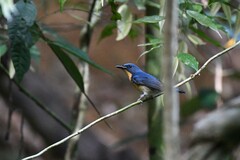
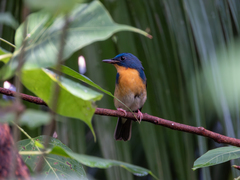
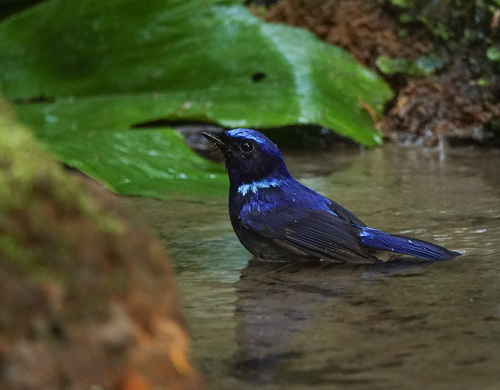
Large Blue-Flycatcher

Large Blue-Flycatcher

Cyornis magnirostris

Silhouette: L. Shyamal · PhyloPic

LCNTNear ThreatenedVUENCR
Daily sighting probability <5% · Rare
at Namdapha National Park

In 3 days <5%

6 Verified sightings at Namdapha National Park From 2019 to 2026
89 In all 2 parks
May Best month
☀️ Diurnal When it's spotted

About the Large Blue-Flycatcher

The large blue flycatcher (Cyornis magnirostris) is a medium-sized bird species characterized by distinctive sexual dimorphism along with most others of the Flycatcher family. This species of bird is in the family Muscicapidae. It is found in the eastern Himalayas, from Nepal to Bangladesh. It winters in the northern Malay Peninsula.

Adult male large blue flycatchers' exhibit striking features, including a cold, pale blue forehead. Their lores, cheeks, and some of the ear-coverts are jet black, contrasting with a deep blue cap on their head and dark blue feathers on the wings and tail with a subtle purplish tinge. Males display a vibrant orange-rufous throat and chin, which extends to the rear flanks and mid-belly, with the lower underparts being whitish. The bill is black, and the legs vary in color from pale flesh-pink to pale pinkish gray or light horn-brown. In stark contrast, the females are characterized by their grayish upperparts and crown, and strongly rufous-tinged rump, tail, and edges of the wing feathers. Their facial features include a pale buffish eyeing and lores, with dark brown cheeks and a pale rufous-tinged buff chin and throat. The remainder... Wikipedia →

Sounds

Song1:11

India · 2020

© Arka Sarkar · XC660240 · CC BY-NC-SA 4.0

Song1:23

Thailand · 2015

© Peter Ericsson · XC213505 · CC BY-NC-SA 4.0

Song0:19

India · 2017

© George Wagner · XC374338 · CC BY-NC-SA 4.0

Global Distribution

Parks Where Found

# Park Country Daily sighting probability
1 Khao Sok National Park 🇹🇭 Thailand
~10%
2 Namdapha National Park 🇮🇳 India
<5%

Cities Where Found

# City Country Daily sighting probability
1 Bangkok 🇹🇭 Thailand
<5%

Before you go

What are the chances of seeing a Large Blue-Flycatcher in Namdapha National Park?

Rare

Under 5% of wildlife watchers report a Large Blue-Flycatcher sighting in Namdapha National Park on a given day, based on 6 verified sightings from GBIF citizen-science data from 2019 to 2026. It is the 288th most-seen of the 298 birds we can rate there. Over three days the chance rises to under 5%, if each day is a fresh chance.

When is the best time to see a Large Blue-Flycatcher in Namdapha National Park?

May

In that month about 10% of wildlife watchers report a Large Blue-Flycatcher in Namdapha National Park on a given day, against under 5% in October to April, the lowest months. June to September have too few records to rate.

What time of day is best to see a Large Blue-Flycatcher?

Between 10 am and 1 pm

Across all the parks we cover, that three-hour window holds the most Large Blue-Flycatcher sightings with a recorded time, and about 9 in 10 of them come between 6 am and 6 pm: it is a daytime animal.

Is Namdapha National Park the best place to see a Large Blue-Flycatcher?

2nd of 2

Of the 2 parks where we can rate Large Blue-Flycatcher sightings, Namdapha National Park ranks 2nd at under 5%. The best odds are in Khao Sok National Park (Thailand, about 10%).

Which relatives of the Large Blue-Flycatcher live in Namdapha National Park?

Same genus: Cyornis

The closest relatives of the Large Blue-Flycatcher that you can see in Namdapha National Park (genus Cyornis, Blue Flycatchers and Jungle Flycatchers) are White-Tailed Blue-Flycatcher (about 30%) and Pale Blue-Flycatcher (about 10%), with each one's daily chance of a sighting.

Where does the Large Blue-Flycatcher sighting chance come from?

GBIF citizen-science records

It is estimated from how often the Large Blue-Flycatcher is recorded against all the birds logged in Namdapha National Park (6 verified sightings from 2019 to 2026), calibrated against known sighting rates. Figures are rounded to the nearest 10% because citizen-science data supports honest approximations, not decimals, and months with records from fewer than five people show "—". How it works.

← Back to Namdapha National Park