Slaty-backed Forktail

Slaty-backed Forktail

Enicurus schistaceus

Silhouette: Andy Wilson · PhyloPic

LCLeast ConcernNTVUENCR
Daily sighting probability ~50% · Likely
at Namdapha National Park

In 3 days ~90% in a week >90%

808 Verified sightings at Namdapha National Park From 2019 to 2026
1,948 In all 7 parks
December Best month
🌅 Crepuscular When it's spotted

About the Slaty-backed Forktail

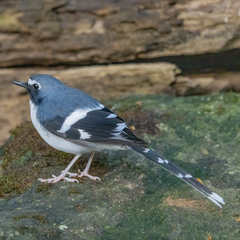
The slaty-backed forktail (Enicurus schistaceus) is a species of forktail in the family Muscicapidae. A slim, medium-sized forktail, it is distinguished from similar species by its slate grey forehead, crown, and mantle. It has a long and deeply forked tail banded in black and white, a white rump, and a white bar across its primary feathers; the rest of the plumage is predominantly white. The sexes look alike. The bird frequents the edges of fast-flowing streams and rivers, where it hunts small invertebrates by hopping among rocks or flying out over the water. It breeds between February and July, laying 3–4 pinkish, bluish, or white eggs; both sexes incubate the eggs.

The slaty-backed forktail is found near streams and rivers in tropical and subtropical regions, occasionally straying further from flowing water to the edges of roads and trails. Generally a solitary bird, it may occasionally be found in pairs, or in family groups in the breeding season. One of its calls has been described as similar to that of the Blyth's kingfisher, for which it has been mistaken. The forktail is found in the central and eastern Himalayas, the Indian Sub-continent, southern China and continental Southeast Asia. Its wide distribution and apparently stable population have led to it being classified as a species of least concern by the International Union for Conservation of Nature. Wikipedia →

Sounds

Call0:43

China · 2026

© Dave Guo · XC1187056 · CC BY-NC-SA 4.0

Call0:28

Malaysia · 2014

© Peter Boesman · XC290694 · CC BY-NC-ND 4.0

Call0:18

Malaysia · 2023

© David Boyle · XC923946 · CC BY-NC-SA 4.0

Global Distribution

Parks Where Found

# Park Country Daily sighting probability
1 Namdapha National Park 🇮🇳 India
~50%
2 Royal Manas National Park 🇧🇹 Bhutan
~30%
3 Doi Inthanon National Park 🇹🇭 Thailand
~20%
4 Khao Yai National Park 🇹🇭 Thailand
<5%
5 Manas National Park 🇮🇳 India
<5%
6 Jim Corbett National Park 🇮🇳 India
<5%
7 Kaeng Krachan National Park 🇹🇭 Thailand
<5%

Cities Where Found

# City Country Daily sighting probability
1 Hong Kong 🇨🇳 China
<5%
2 Kathmandu 🇳🇵 Nepal
<5%

Before you go

What are the chances of seeing a Slaty-backed Forktail in Namdapha National Park?

Likely

About 50% of wildlife watchers report a Slaty-backed Forktail sighting in Namdapha National Park on a given day, based on 808 verified sightings from GBIF citizen-science data from 2019 to 2026. It is the 5th most-seen of the 298 birds we can rate there. Over three days the chance rises to about 90%, and over a week to over 90%, if each day is a fresh chance.

When is the best time to see a Slaty-backed Forktail in Namdapha National Park?

February and November–December

In those months about 60% of wildlife watchers report a Slaty-backed Forktail in Namdapha National Park on a given day, against about 30% in March, the lowest month. Those are among Namdapha National Park's driest months, with about 50 mm of rain a month against 660 mm in July. June to September have too few records to rate.

What time of day is best to see a Slaty-backed Forktail?

Between 2 and 5 am

Across all the parks we cover, that three-hour window holds the most Slaty-backed Forktail sightings with a recorded time, and about half of them come between 6 am and 6 pm: it is most active around dawn and dusk.

Is Namdapha National Park the best place to see a Slaty-backed Forktail?

Yes

Of the 7 parks where we can rate Slaty-backed Forktail sightings, Namdapha National Park has the highest daily chance: about 50%. Next come Royal Manas National Park (Bhutan, about 30%) and Doi Inthanon National Park (Thailand, about 20%).

Which relatives of the Slaty-backed Forktail live in Namdapha National Park?

Same genus: Enicurus

The closest relatives of the Slaty-backed Forktail that you can see in Namdapha National Park (genus Enicurus, Forktails) are White-crowned Forktail (about 30%), Little Forktail (about 20%) and Black-backed Forktail (about 10%), with each one's daily chance of a sighting.

Where does the Slaty-backed Forktail sighting chance come from?

GBIF citizen-science records

It is estimated from how often the Slaty-backed Forktail is recorded against all the birds logged in Namdapha National Park (808 verified sightings from 2019 to 2026), calibrated against known sighting rates. Figures are rounded to the nearest 10% because citizen-science data supports honest approximations, not decimals, and months with records from fewer than five people show "—". How it works.

← Back to Namdapha National Park