Orange Oakleaf

Orange Oakleaf

Kallima inachus

Daily sighting probability ~40% · Likely
at Namdapha National Park

In 3 days ~80% in a week >90%

18 Verified sightings at Namdapha National Park From 2019 to 2026
56 In all 4 parks
October Best month
☀️ Diurnal When it's spotted

About the Orange Oakleaf

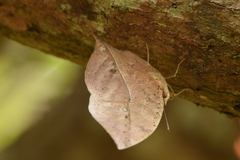
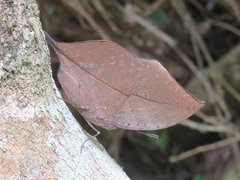
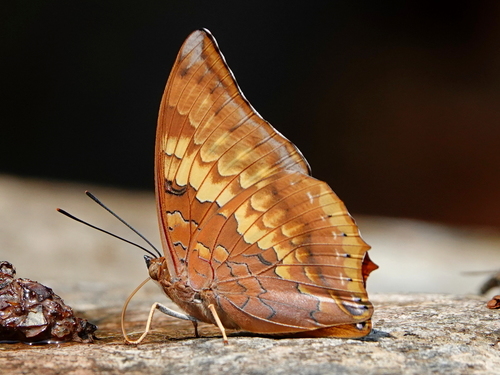
Kallima inachus, the orange oakleaf, Indian oakleaf or dead leaf, is a nymphalid butterfly found in Tropical Asia from Pakistan to Japan. With wings closed, it closely resembles a dry leaf with dark veins and is a commonly cited example of camouflage.

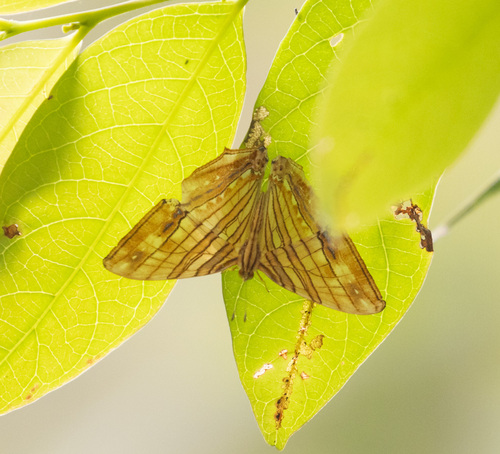
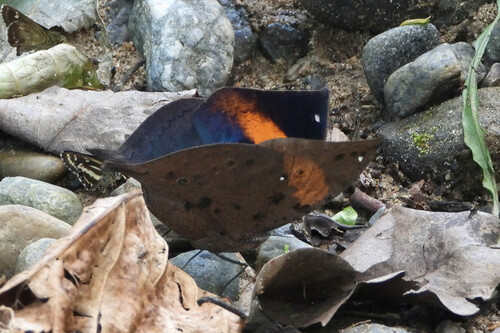
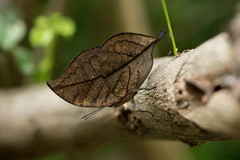
The butterfly wings are shaped like a leaf when in the closed position. When the wings are closed, only the cryptic underside markings are visible, which consists of irregular patterns and striations in many shades of biscuit, buff, browns, yellow, and black. The veins are darkened and resemble the veins of a leaf. The resemblance to a dried leaf, a masquerade, is extremely realistic and gives the genus its common names, the oakleaf or dead leaf.

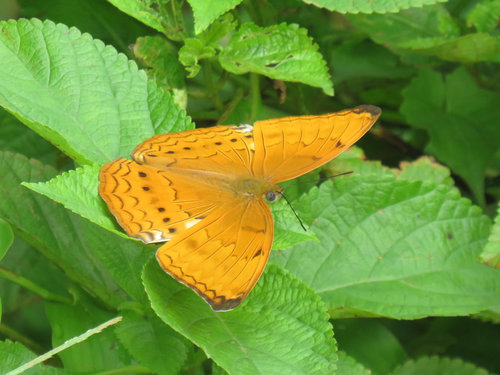
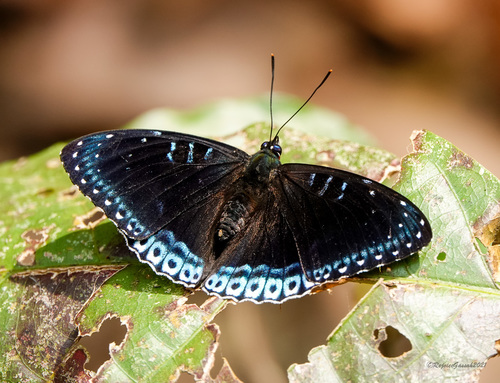
When the wings are open, the forewing exhibits a black apex, an orange discal band and a deep blue base. There are two white oculi, one along the margin of the apical black band, and the other bordering the orange and deep blue areas. The hindwing is more uniformly blue but diffused with brown patches along the termen.

Male and female butterflies are similar except that the female is generally larger and has the apex of the forewing protrude to form a longer point. Females also... Wikipedia →
Global Distribution

Parks Where Found

# Park Country Daily sighting probability
1 Namdapha National Park 🇮🇳 India
~40%
2 Royal Manas National Park 🇧🇹 Bhutan
~30%
3 Taroko National Park 🇹🇼 Taiwan
~20%
4 Kaeng Krachan National Park 🇹🇭 Thailand
~10%

Cities Where Found

# City Country Daily sighting probability
1 Dehradun 🇮🇳 India
~20%
2 Taipei 🇹🇼 Taiwan
~10%
3 Bangkok 🇹🇭 Thailand
<5%

Before you go

What are the chances of seeing an Orange Oakleaf in Namdapha National Park?

Likely

About 40% of wildlife watchers report an Orange Oakleaf sighting in Namdapha National Park on a given day, based on 18 verified sightings from GBIF citizen-science data from 2019 to 2026. It is the 31st most-seen of the 71 insects we can rate there. Over three days the chance rises to about 80%, and over a week to over 90%, if each day is a fresh chance.

When is the best time to see an Orange Oakleaf in Namdapha National Park?

October

In that month about 60% of wildlife watchers report an Orange Oakleaf in Namdapha National Park on a given day, against about 10% in January–February, May, September and November, the lowest months. June to August have too few records to rate.

What time of day is best to see an Orange Oakleaf?

Between 1 and 4 pm

Across all the parks we cover, that three-hour window holds the most Orange Oakleaf sightings with a recorded time, and about 9 in 10 of them come between 6 am and 6 pm: it is a daytime animal.

Is Namdapha National Park the best place to see an Orange Oakleaf?

Yes

Of the 4 parks where we can rate Orange Oakleaf sightings, Namdapha National Park has the highest daily chance: about 40%. Next come Royal Manas National Park (Bhutan, about 30%) and Taroko National Park (Taiwan, about 20%).

Which relatives of the Orange Oakleaf live in Namdapha National Park?

Same family: Nymphalidae

The closest relatives of the Orange Oakleaf that you can see in Namdapha National Park (family Nymphalidae, Brush-footed Butterflies) are Large Yeoman (about 60%), Indian Purple Emperor (about 60%) and Popinjay (about 50%), with each one's daily chance of a sighting.

Where does the Orange Oakleaf sighting chance come from?

GBIF citizen-science records

It is estimated from how often the Orange Oakleaf is recorded against all the insects logged in Namdapha National Park (18 verified sightings from 2019 to 2026), calibrated against known sighting rates. Figures are rounded to the nearest 10% because citizen-science data supports honest approximations, not decimals, and months with records from fewer than five people show "—". How it works.

← Back to Namdapha National Park