Red-billed Scimitar-Babbler

Red-billed Scimitar-Babbler

Pomatorhinus ochraceiceps

Silhouette: Sheatherius · PhyloPic

LCLeast ConcernNTVUENCR
Daily sighting probability ~10% · With luck
at Namdapha National Park

In 3 days ~40% in a week ~60%

161 Verified sightings at Namdapha National Park From 2019 to 2026
210 In all 3 parks
February Best month

About the Red-billed Scimitar-Babbler

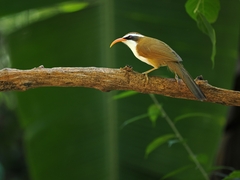
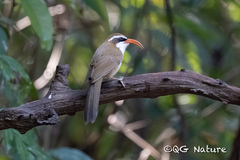
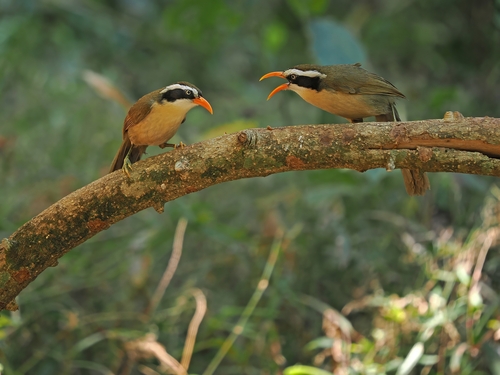
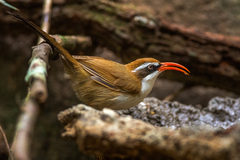
The red-billed scimitar-babbler (Pomatorhinus ochraceiceps) is a species of bird in the family Timaliidae. It is found in Northeast India, Southeast Asia and adjacent parts of southern China. It has a long reddish-orange decurved bill that is typical of scimitar-babblers, a rather long white supercilium, and brown upperparts and tail. Sexes are similar.

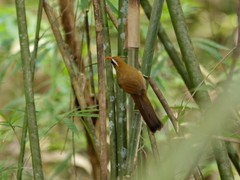
It is typically found between 300-2400m across its range and its natural habitats are subtropical or tropical moist lowland forest and subtropical or tropical moist montane forest, particularly favouring bamboo clumps and Fokienia-dominated forest. It feeds mainly on invertebrates but is also known to take nectar from flowers. It is a frequent participant of mixed-species bird flocks, often associating with the white-hooded babbler.

Collar, N. and C. Robson (2020). Red-billed Scimitar-Babbler (Pomatorhinus ochraceiceps), version 1.0. In Birds of the World (J. del Hoyo, A. Elliott, J. Sargatal, D. A. Christie, and E. de Juana, Editors). Cornell Lab of Ornithology, Ithaca, NY, USA. https://doi.org/10.2173/bow.rbsbab1.01 Wikipedia →

Sounds

Call0:23

Vietnam · 2026

© Tim Dinh / Annambirding · XC1162001 · CC BY-NC-SA 4.0

Song0:09

Vietnam · 2009

© Brian Cox · XC40944 · CC BY-NC-ND 2.5

Song0:18

Thailand · 2018

© Somkiat Pakapinyo (Chai) · XC403662 · CC BY-NC-SA 4.0

Global Distribution

Parks Where Found

# Park Country Daily sighting probability
1 Namdapha National Park 🇮🇳 India
~10%
2 Doi Inthanon National Park 🇹🇭 Thailand
<5%
3 Kaeng Krachan National Park 🇹🇭 Thailand
<5%

Before you go

What are the chances of seeing a Red-billed Scimitar-Babbler in Namdapha National Park?

With luck

About 10% of wildlife watchers report a Red-billed Scimitar-Babbler sighting in Namdapha National Park on a given day, based on 161 verified sightings from GBIF citizen-science data from 2019 to 2026. It is the 93rd most-seen of the 298 birds we can rate there. Over three days the chance rises to about 40%, and over a week to about 60%, if each day is a fresh chance.

When is the best time to see a Red-billed Scimitar-Babbler in Namdapha National Park?

February

In that month about 30% of wildlife watchers report a Red-billed Scimitar-Babbler in Namdapha National Park on a given day, against under 5% in October, the lowest month. That is one of Namdapha National Park's driest months, with about 100 mm of rain against 660 mm in July. June to September have too few records to rate.

Is Namdapha National Park the best place to see a Red-billed Scimitar-Babbler?

Yes

Of the 3 parks where we can rate Red-billed Scimitar-Babbler sightings, Namdapha National Park has the highest daily chance: about 10%. Next come Doi Inthanon National Park (Thailand, under 5%) and Kaeng Krachan National Park (Thailand, under 5%).

Which relatives of the Red-billed Scimitar-Babbler live in Namdapha National Park?

Same genus: Pomatorhinus

The closest relatives of the Red-billed Scimitar-Babbler that you can see in Namdapha National Park (genus Pomatorhinus, Eyebrowed Scimitar-Babblers) are Brown-crowned Scimitar-Babbler (about 20%) and Large Scimitar Babbler (about 10%), with each one's daily chance of a sighting.

Where does the Red-billed Scimitar-Babbler sighting chance come from?

GBIF citizen-science records

It is estimated from how often the Red-billed Scimitar-Babbler is recorded against all the birds logged in Namdapha National Park (161 verified sightings from 2019 to 2026), calibrated against known sighting rates. Figures are rounded to the nearest 10% because citizen-science data supports honest approximations, not decimals, and months with records from fewer than five people show "—". How it works.

← Back to Namdapha National Park