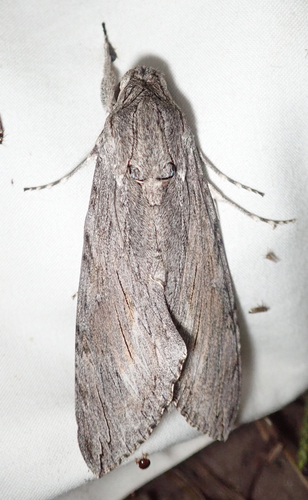
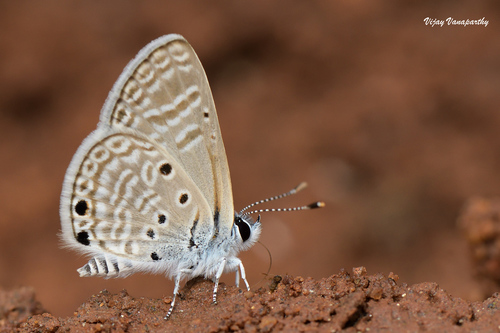
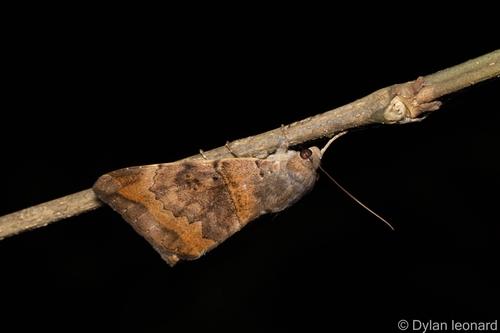
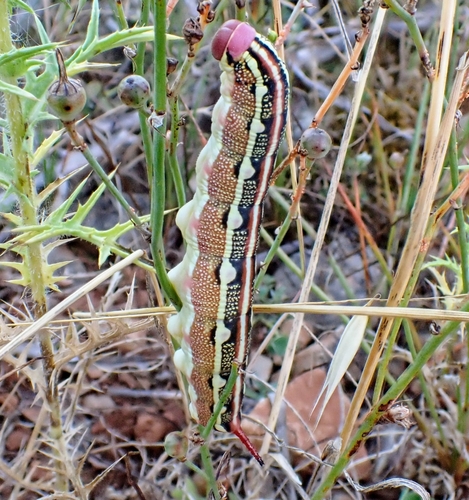
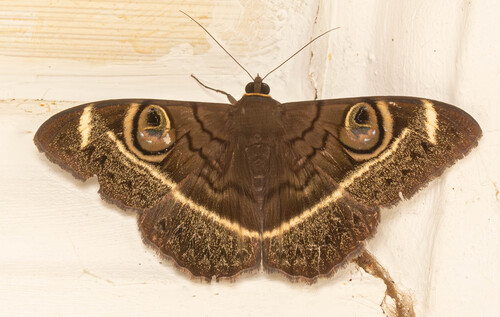
African Silk Moth

African Silk Moth

Gonometa postica

Daily sighting probability ~20% · Possible
at Namib-Naukluft National Park

In 3 days ~40% in a week ~70%

22 Verified sightings at Namib-Naukluft National Park From 2019 to 2026
22 In 1 park
December Best month
☀️ Diurnal When it's spotted

About the African Silk Moth

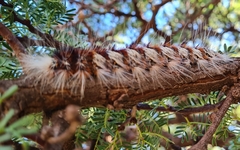
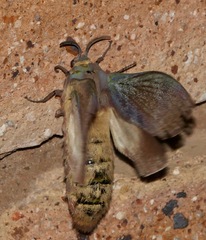
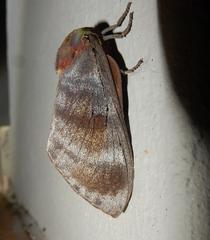
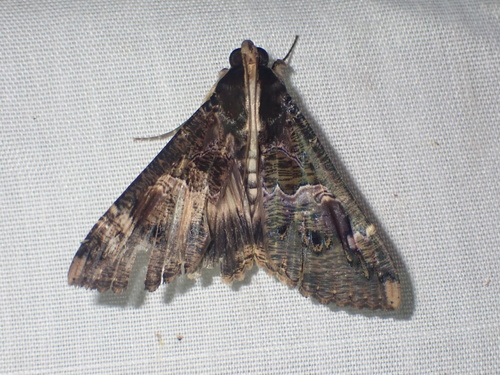
Gonometa postica (Walker, 1855), known commonly as the African wild silk moth, burn worm, and brandwurm, is a large species of African moth belonging to the family Lasiocampidae. The genus Gonometa boasts some very large moths and larvae; Gonometa sjostedti from Africa has a larva 16 centimeters long, for example. Most of the Lasiocampidae are highly sexually dimorphic. In G. postica the forewing of the male measures 21–25 mm and of the female 35–42 mm.

Gonometa postica and Argema mimosae cocoons are traditionally used as ankle rattles in southern Africa by San and Bantu tribes. They are filled with materials such as fine gravel, seeds, glass beads, broken sea shells, or pieces of ostrich eggshell.

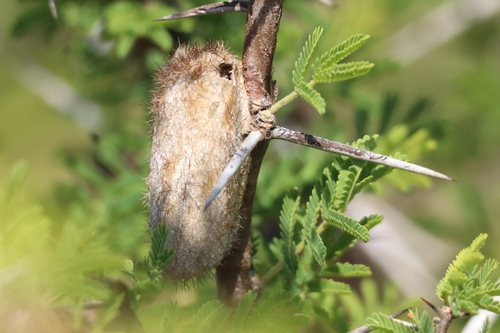
The species has become notable for producing a fine quality wild silk in its cocoon. The cocoons are harvested commercially in Namibia, Botswana, Kenya and South Africa, and the species also occurs in Zimbabwe and Mozambique. An Oxford University research team found that the cocoon surfaces are covered with calcium oxalate, hindering their commercial utilisation. They discovered and patented a method known as demineralizing using a warm solution of EDTA (ethylenediaminetetraacetic acid), softening the cocoons by dissolving the sericin, permitting the silk to be unravelled with no appreciable loss of strength. Cocoons are also sexually dimorphic, with those of females being roughly twice the size of those of males, thus yielding more silk. Sex ratios in natural populations will clearly play a large role in the harvesting of cocoons.

The larvae are quite variable in their patterning and, like many of the genus, are covered in irritating setae, or hairs. The larva is black with lateral tufts of white, yellow or orange. It has been recorded feeding on Acacia, Brachystegia, Elephantorrhiza, Pinus radiata, and Julbernardia. Another silk-producing member of the genus is Gonometa rufobrunnea (Aurivillius, 1927), which feeds almost exclusively on Colophospermum mopane. G. postica larvae and pupae are subject to parasitism by Diptera and Hymenoptera, the most common parasitoids being Palexorista species from the Tachinidae and Goryphus species from the Ichneumonidae.

The cocoons have long been known to cause the death of cattle, antelope and other ruminants in the Kalahari. During drought periods, the cocoons are eaten, probably because they resemble acacia pods. Wikipedia →
Global Distribution

Parks Where Found

# Park Country Daily sighting probability
1 Namib-Naukluft National Park 🇳🇦 Namibia
~20%

More parks will be added in future updates.

Cities Where Found

# City Country Daily sighting probability
1 Pretoria 🇿🇦 South Africa
~10%

Before you go

What are the chances of seeing an African Silk Moth in Namib-Naukluft National Park?

Possible

About 20% of wildlife watchers report an African Silk Moth sighting in Namib-Naukluft National Park on a given day, based on 22 verified sightings from GBIF citizen-science data from 2019 to 2026. It is the 11th most-seen of the 60 insects we can rate there. Over three days the chance rises to about 40%, and over a week to about 70%, if each day is a fresh chance.

When is the best time to see an African Silk Moth in Namib-Naukluft National Park?

December

In that month about 30% of wildlife watchers report an African Silk Moth in Namib-Naukluft National Park on a given day, against under 5% in June and July, the lowest months.

What time of day is best to see an African Silk Moth?

Between 10 am and 1 pm

Across all the parks we cover, that three-hour window holds the most African Silk Moth sightings with a recorded time, and about 9 in 10 of them come between 6 am and 6 pm: it is a daytime animal.

Where else can you see an African Silk Moth?

Only Namib-Naukluft National Park, in our data

Namib-Naukluft National Park is the only park on Wallace's Line with enough records to rate African Silk Moth sightings: about 20% of wildlife watchers there report one on a given day.

Which relatives of the African Silk Moth live in Namib-Naukluft National Park?

Same order: Lepidoptera

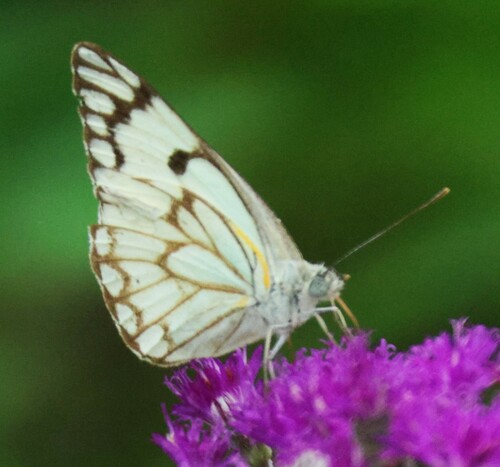
The closest relatives of the African Silk Moth that you can see in Namib-Naukluft National Park (order Lepidoptera, Butterflies and Moths) are Painted Lady (about 20%), Pioneer White (about 20%) and Crimson-Speckled Flunkey (about 10%), with each one's daily chance of a sighting.

Where does the African Silk Moth sighting chance come from?

GBIF citizen-science records

It is estimated from how often the African Silk Moth is recorded against all the insects logged in Namib-Naukluft National Park (22 verified sightings from 2019 to 2026), calibrated against known sighting rates. Figures are rounded to the nearest 10% because citizen-science data supports honest approximations, not decimals, and months with records from fewer than five people show "—". How it works.

← Back to Namib-Naukluft National Park