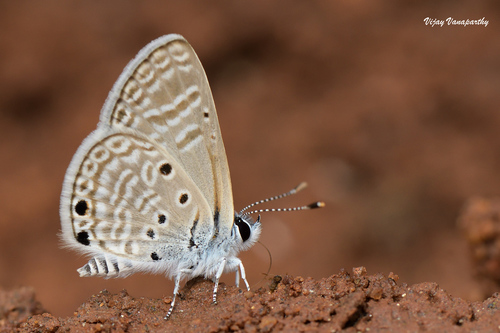
Bright Babul Blue

Bright Babul Blue

Azanus ubaldus

Daily sighting probability ~10% · With luck
at Namib-Naukluft National Park

In 3 days ~30% in a week ~60%

15 Verified sightings at Namib-Naukluft National Park From 2019 to 2026
26 In all 2 parks
December Best month
☀️ Diurnal When it's spotted

About the Bright Babul Blue

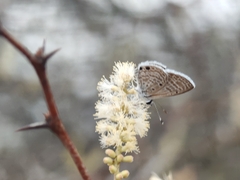
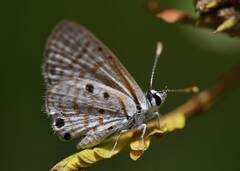
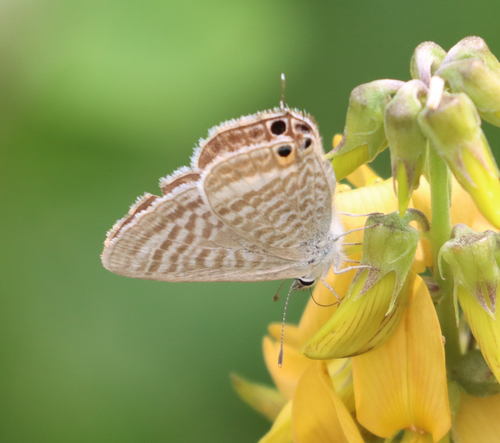
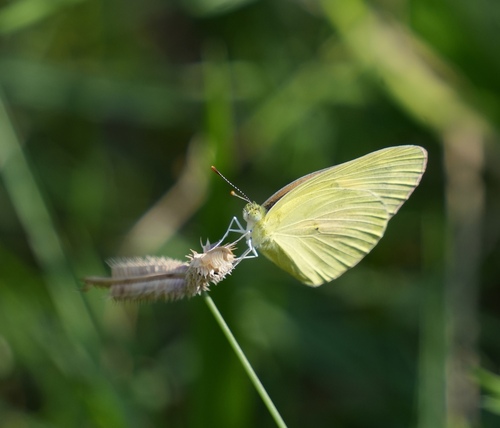
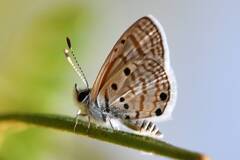
Azanus ubaldus, the bright babul blue, desert babul blue, or velvet-spotted blue, is a small butterfly found in India, the Middle East and Africa that belongs to the lycaenids or blues family. Male upperside brownish purple, dark blue at base of wings. Forewing: costa very narrow along its apical half, termen evenly and a little more broadly from apex to tornus, edged with brown; the area on the disc, in the cell and beyond it is covered with hair-like specialized scales and is distinctly darker. Hindwing: similar, the brown edging to the costa much broader; posteriorly in the tornal area there is a dark spot in interspace 1 and another more clearly defined similar spot in interspace 2, both spots merged more or less into the terminal brown edging. Cilia of both forewings and hindwings white, with their basal halves evenly dark brown. Underside: greyish brown. Forewing: two short white lines, one each side of the discocellulars; a minute black subcostal dot above apex of cell, another similar dot a little beyond it; two parallel, obliquely placed, transverse, upper discal white lines, followed by an inner and an outer obliquely placed, irregular, broken, subterminal... Wikipedia →
Global Distribution

Parks Where Found

# Park Country Daily sighting probability
1 Namib-Naukluft National Park 🇳🇦 Namibia
~10%
2 Kruger National Park 🇿🇦 South Africa
<5%

Cities Where Found

# City Country Daily sighting probability
1 Salem 🇮🇳 India
~20%
2 New Delhi 🇮🇳 India
~10%
3 Pune 🇮🇳 India
~10%
4 Hyderabad 🇮🇳 India
<5%
5 Johannesburg 🇿🇦 South Africa
<5%
6 Bengaluru 🇮🇳 India
<5%

Before you go

What are the chances of seeing a Bright Babul Blue in Namib-Naukluft National Park?

With luck

About 10% of wildlife watchers report a Bright Babul Blue sighting in Namib-Naukluft National Park on a given day, based on 15 verified sightings from GBIF citizen-science data from 2019 to 2026. It is the 21st most-seen of the 60 insects we can rate there. Over three days the chance rises to about 30%, and over a week to about 60%, if each day is a fresh chance.

When is the best time to see a Bright Babul Blue in Namib-Naukluft National Park?

February and December

In those months about 30% of wildlife watchers report a Bright Babul Blue in Namib-Naukluft National Park on a given day, against under 5% in March–April, June–September and November, the lowest months.

What time of day is best to see a Bright Babul Blue?

Between 9 am and noon

Across all the parks we cover, that three-hour window holds the most Bright Babul Blue sightings with a recorded time, and nearly all of them come between 6 am and 6 pm: it is a daytime animal.

Is Namib-Naukluft National Park the best place to see a Bright Babul Blue?

Yes

Of the 2 parks where we can rate Bright Babul Blue sightings, Namib-Naukluft National Park has the highest daily chance: about 10%. Next come Kruger National Park (South Africa, under 5%).

Which relatives of the Bright Babul Blue live in Namib-Naukluft National Park?

Same family: Lycaenidae

The closest relatives of the Bright Babul Blue that you can see in Namib-Naukluft National Park (family Lycaenidae, Gossamer-winged Butterflies) are Pea Blue (about 10%) and Brown Grass Jewel (about 10%), with each one's daily chance of a sighting.

Where does the Bright Babul Blue sighting chance come from?

GBIF citizen-science records

It is estimated from how often the Bright Babul Blue is recorded against all the insects logged in Namib-Naukluft National Park (15 verified sightings from 2019 to 2026), calibrated against known sighting rates. Figures are rounded to the nearest 10% because citizen-science data supports honest approximations, not decimals, and months with records from fewer than five people show "—". How it works.

← Back to Namib-Naukluft National Park