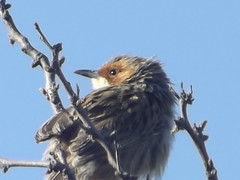
Rufous-eared Warbler

Rufous-eared Warbler

Malcorus pectoralis

Silhouette: Sheatherius · PhyloPic

LCLeast ConcernNTVUENCR
Daily sighting probability <5% · Rare
at Namib-Naukluft National Park

In 3 days <5% in a week ~10%

11 Verified sightings at Namib-Naukluft National Park From 2019 to 2026
119 In all 3 parks
August Best month
☀️ Diurnal When it's spotted

About the Rufous-eared Warbler

The rufous-eared warbler (Malcorus pectoralis) is a species of bird in the family Cisticolidae. It is found in Botswana, Namibia, and South Africa. It is the only species in the genus Malcorus. Its natural habitats are subtropical or tropical dry shrubland and subtropical or tropical dry lowland grassland.

The rufous-eared warbler was first described by Andrew Smith in 1829. It belongs to the genus Malcorus, a monotypic genus that occurs in the arid zones of western southern Africa. The taxonomy of the rufous-eared warbler has been debated, with it sometimes being grouped with crombecs, the grassbirds or the prinias. It has most recently been grouped within the family Cisticolidae. It had previously been placed in the genus Prinia, but has since been placed in its own genus due to morphological, behavioural and genetic differences. Its closest relatives are a group of other monotypic warblers, including the black-faced rufous warbler (Bathmocercus rufus), the Socotra warbler (Incana incana), the oriole warbler (Hypergerus atriceps), the grey-capped warbler (Eminia lepida), Winifred's warbler (also known as Mrs Moreau's warbler, Scepomycter winifredae... Wikipedia →

Sounds

Call1:03

South Africa · 2025

© Dawie de Swardt · XC974793 · CC BY-NC-SA 4.0

Song1:13

South Africa · 2022

© Tim Cockcroft · XC705469 · CC BY-NC-SA 4.0

Song0:27

South Africa · 2021

© Lynette Rudman · XC691414 · CC BY-NC-SA 4.0

Global Distribution

Parks Where Found

# Park Country Daily sighting probability
1 Etosha National Park 🇳🇦 Namibia
~10%
2 Kgalagadi Transfrontier Park 🇿🇦 South Africa
~10%
3 Namib-Naukluft National Park 🇳🇦 Namibia
<5%

Before you go

What are the chances of seeing a Rufous-eared Warbler in Namib-Naukluft National Park?

Rare

Under 5% of wildlife watchers report a Rufous-eared Warbler sighting in Namib-Naukluft National Park on a given day, based on 11 verified sightings from GBIF citizen-science data from 2019 to 2026. It is the 108th most-seen of the 108 birds we can rate there. Over three days the chance rises to under 5%, and over a week to about 10%, if each day is a fresh chance.

When is the best time to see a Rufous-eared Warbler in Namib-Naukluft National Park?

August

In that month about 10% of wildlife watchers report a Rufous-eared Warbler in Namib-Naukluft National Park on a given day, against under 5% in September to July, the lowest months.

What time of day is best to see a Rufous-eared Warbler?

Between 9 am and noon

Across all the parks we cover, that three-hour window holds the most Rufous-eared Warbler sightings with a recorded time, and about 9 in 10 of them come between 6 am and 6 pm: it is a daytime animal.

Is Namib-Naukluft National Park the best place to see a Rufous-eared Warbler?

3rd of 3

Of the 3 parks where we can rate Rufous-eared Warbler sightings, Namib-Naukluft National Park ranks 3rd at under 5%. The best odds are in Etosha National Park (Namibia, about 10%) and Kgalagadi Transfrontier Park (South Africa, about 10%).

Which relatives of the Rufous-eared Warbler live in Namib-Naukluft National Park?

Same family: Cisticolidae

The closest relatives of the Rufous-eared Warbler that you can see in Namib-Naukluft National Park (family Cisticolidae, Cisticolas and Allies) are Black-chested Prinia (about 30%) and Yellow-bellied Eremomela (about 20%), with each one's daily chance of a sighting.

Where does the Rufous-eared Warbler sighting chance come from?

GBIF citizen-science records

It is estimated from how often the Rufous-eared Warbler is recorded against all the birds logged in Namib-Naukluft National Park (11 verified sightings from 2019 to 2026), calibrated against known sighting rates. Figures are rounded to the nearest 10% because citizen-science data supports honest approximations, not decimals, and months with records from fewer than five people show "—". How it works.

← Back to Namib-Naukluft National Park

