Short Blind Dart Skink

Short Blind Dart Skink

Typhlacontias brevipes

Silhouette: David Orr · PhyloPic

LCLeast ConcernNTVUENCR Endemic
Daily sighting probability ~10% · With luck
at Namib-Naukluft National Park

In 3 days ~30% in a week ~60%

10 Verified sightings at Namib-Naukluft National Park From 2019 to 2026
10 In 1 park
January Best month
☀️ Diurnal When it's spotted

About the Short Blind Dart Skink

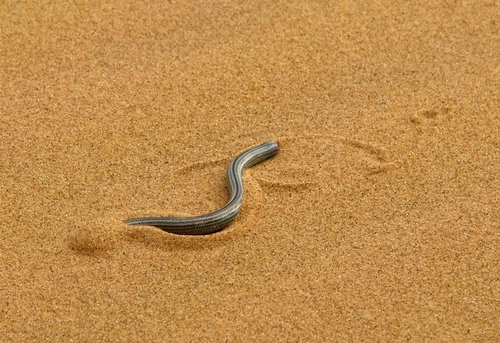
Typhlacontias brevipes, also known as FitzSimon's [sic] burrowing skink or short blind dart skink, is a species of skink endemic to the Namib Desert (Namibia). It was described by Vivian FitzSimons in 1938. The species name is derived from the Latin words brevis, -e = short and pes, pedis = foot.

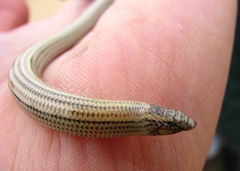
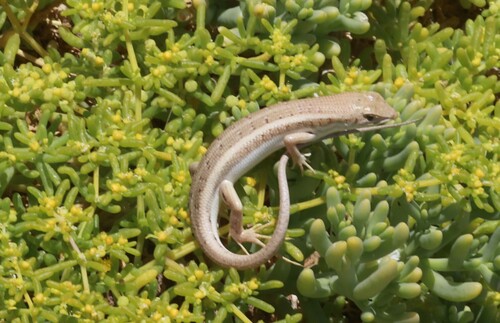
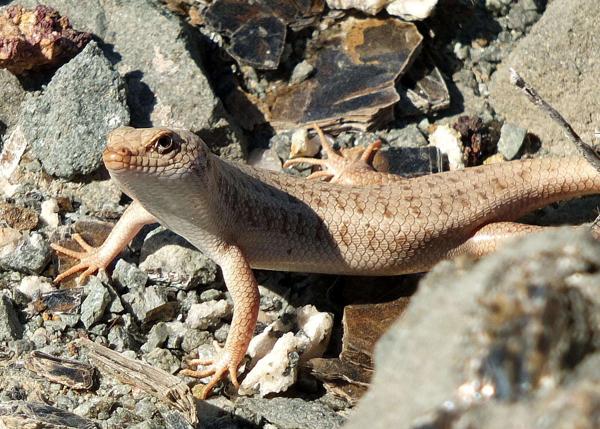
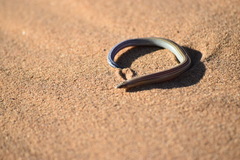
These slender skinks have small eyes with no eyelids and no external ear openings. The hindlimb rudiments are visible on either side of cloaca. The body coloration varies from light buff to sulphur yellow. Vague stripes, formed by the scales, can occur along the back and upper flanks. The tail is blue-grey. They can reach a snout–vent length of 113 mm (4.4 in).

Females are viviparous and give birth to up to three young. Typhlacontias brevipes typically occur on the leeward side of dunes in the roots of grass tufts found in semi-stable sand. They are active at night and in the cooler hours of the day when they forage for small insects like ants, termites, antlions, and beetles.

Photographs available at: Observations in the Genus: Typhlacontias Specimen from Swakopmund Wikipedia →
Global Distribution

Parks Where Found

# Park Country Daily sighting probability
1 Namib-Naukluft National Park 🇳🇦 Namibia
~10%

More parks will be added in future updates.

Before you go

What are the chances of seeing a Short Blind Dart Skink in Namib-Naukluft National Park?

With luck

About 10% of wildlife watchers report a Short Blind Dart Skink sighting in Namib-Naukluft National Park on a given day, based on 10 verified sightings from GBIF citizen-science data from 2019 to 2026. It is the 29th most-seen of the 39 reptiles we can rate there. Over three days the chance rises to about 30%, and over a week to about 60%, if each day is a fresh chance.

When is the best time to see a Short Blind Dart Skink in Namib-Naukluft National Park?

January, May and September

In those months about 20% of wildlife watchers report a Short Blind Dart Skink in Namib-Naukluft National Park on a given day, against under 5% in February–March, August and October–November, the lowest months.

What time of day is best to see a Short Blind Dart Skink?

Between 8 and 11 am

Across all the parks we cover, that three-hour window holds the most Short Blind Dart Skink sightings with a recorded time, and about 9 in 10 of them come between 6 am and 6 pm: it is a daytime animal.

Where else can you see a Short Blind Dart Skink?

Only Namib-Naukluft National Park, in our data

Namib-Naukluft National Park is the only park on Wallace's Line with enough records to rate Short Blind Dart Skink sightings: about 10% of wildlife watchers there report one on a given day.

Which relatives of the Short Blind Dart Skink live in Namib-Naukluft National Park?

Same family: Scincidae

The closest relatives of the Short Blind Dart Skink that you can see in Namib-Naukluft National Park (family Scincidae, Skinks) are Kalahari Tree Skink (about 30%), Variegated Skink (about 20%) and Western three-striped skink (about 20%), with each one's daily chance of a sighting.

Where does the Short Blind Dart Skink sighting chance come from?

GBIF citizen-science records

It is estimated from how often the Short Blind Dart Skink is recorded against all the reptiles logged in Namib-Naukluft National Park (10 verified sightings from 2019 to 2026), calibrated against known sighting rates. Figures are rounded to the nearest 10% because citizen-science data supports honest approximations, not decimals, and months with records from fewer than five people show "—". How it works.

← Back to Namib-Naukluft National Park