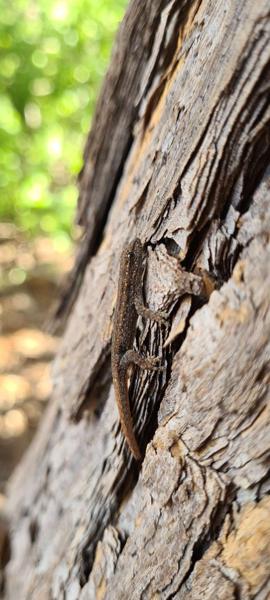
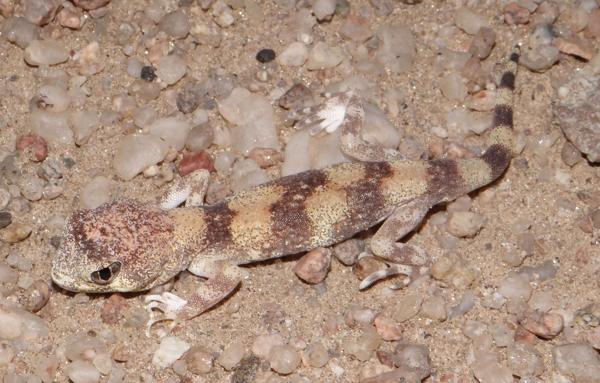
Namib Sand Gecko

Namib Sand Gecko

Pachydactylus rangei

Silhouette: Emmanuel Jimenez · PhyloPic

LCLeast ConcernNTVUENCR
Daily sighting probability ~40% · Likely
at Namib-Naukluft National Park

In 3 days ~70% in a week >90%

80 Verified sightings at Namib-Naukluft National Park From 2019 to 2026
80 In 1 park
January Best month
☀️🌙 Day & Night When it's spotted

About the Namib Sand Gecko

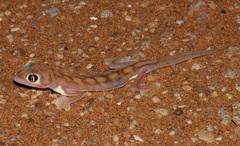
Pachydactylus rangei, the Namib sand gecko or Namib web-footed gecko, is a species of small lizard in the family Gekkonidae. It inhabits the arid areas of Angola, Namibia, and South Africa, and was first described in 1908 by Swedish zoologist Lars Gabriel Andersson, who named it after its finder, German geologist Dr. Paul Range.

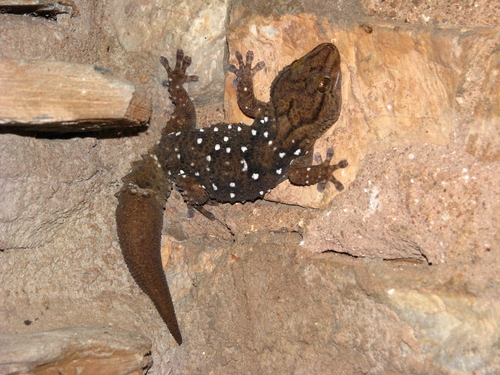
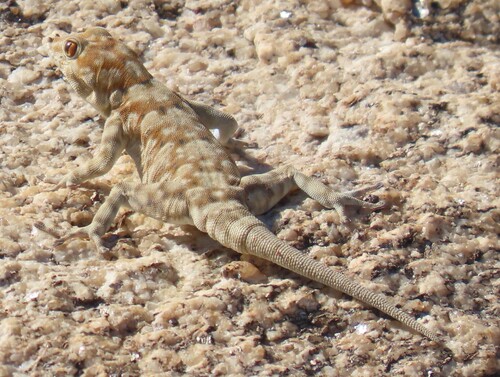
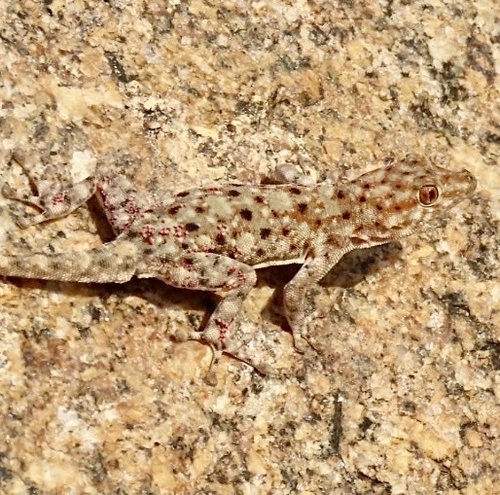
Pachydactylus rangei grows to a length of about 13 cm (5 in) including a 6-centimetre (2.4 in) tail. The head is quite distinct from the slender body and both are flattened dorsally. The eyes are large, dark-coloured and protuberant and have vertical pupils. The web-footed gecko is very pale, nearly translucent. It has a salmon-colored undertone and some have light brown stripes or patterns. Their skin coloration allows for very good camouflage among the sand of the Namib Desert. The skin is covered in fine, smooth scales and is translucent, and some of the internal organs can be seen through it. The legs are thin but the feet are broad, with fully webbed toes, enabling this gecko to burrow easily and to run on loose sand. The gecko developed the webbed feet as an adaptation to help them stay on top of the Namib Desert sand or bury underneath... Wikipedia →

Global Distribution

Parks Where Found

# Park Country Daily sighting probability
1 Namib-Naukluft National Park 🇳🇦 Namibia
~40%

More parks will be added in future updates.

Closest Relatives at Namib-Naukluft National Park

Before you go

What are the chances of seeing a Namib Sand Gecko in Namib-Naukluft National Park?

Likely

About 40% of wildlife watchers report a Namib Sand Gecko sighting in Namib-Naukluft National Park on a given day, based on 80 verified sightings from GBIF citizen-science data from 2019 to 2026. It is the 5th most-seen of the 39 reptiles we can rate there. Over three days the chance rises to about 70%, and over a week to over 90%, if each day is a fresh chance.

When is the best time to see a Namib Sand Gecko in Namib-Naukluft National Park?

January

In that month about 50% of wildlife watchers report a Namib Sand Gecko in Namib-Naukluft National Park on a given day, against about 30% in May–July, September and November–December, the lowest months.

What time of day is best to see a Namib Sand Gecko?

Between 8 and 11 am

Across all the parks we cover, that three-hour window holds the most Namib Sand Gecko sightings with a recorded time, and about 6 in 10 of them come between 6 am and 6 pm: it is seen both by day and at night.

Where else can you see a Namib Sand Gecko?

Only Namib-Naukluft National Park, in our data

Namib-Naukluft National Park is the only park on Wallace's Line with enough records to rate Namib Sand Gecko sightings: about 40% of wildlife watchers there report one on a given day.

Which relatives of the Namib Sand Gecko live in Namib-Naukluft National Park?

Same genus: Pachydactylus

The closest relatives of the Namib Sand Gecko that you can see in Namib-Naukluft National Park (genus Pachydactylus, Typical Thick-toed Geckos) are Pointed Thick-toed Gecko (about 20%) and Cape Cross Thick-toed Gecko (about 10%), with each one's daily chance of a sighting.

Where does the Namib Sand Gecko sighting chance come from?

GBIF citizen-science records

It is estimated from how often the Namib Sand Gecko is recorded against all the reptiles logged in Namib-Naukluft National Park (80 verified sightings from 2019 to 2026), calibrated against known sighting rates. Figures are rounded to the nearest 10% because citizen-science data supports honest approximations, not decimals, and months with records from fewer than five people show "—". How it works.

← Back to Namib-Naukluft National Park