Social Weaver

Social Weaver

Philetairus socius

Silhouette: Sheatherius · PhyloPic

LCLeast ConcernNTVUENCR
Daily sighting probability ~30% · Possible
at Namib-Naukluft National Park

In 3 days ~70% in a week ~90%

240 Verified sightings at Namib-Naukluft National Park From 2019 to 2026
1,102 In all 3 parks
November Best month
☀️ Diurnal When it's spotted

About the Social Weaver

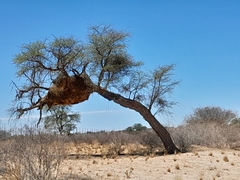
The sociable weaver (Philetairus socius) is a species of bird in the weaver family, endemic to Southern Africa. It is the only species in its genus Philetairus. It is found in South Africa, Namibia, and Botswana, but its range is centered within the Northern Cape Province of South Africa. The species builds large, compound, community nests, a rarity among birds. These nests are perhaps the most spectacular structure built by any bird.

The sociable weaver was first described by ornithologist John Latham in 1790. Alternative names include the common social weaver, common social-weaver, and social weaver. Formerly, four subspecies were recognised, but the species is now considered monotypic. The sociable weaver is the only extant species in the genus Philetairus.

Based on a 2017 DNA-analysis, P. socius belongs to the group of sparrow weavers (subfamily Plocepasserinae) and is most related to the genus Pseudonigrita. These two genera are the sister group of the genus Plocepasser. The most basic genus of the subfamily is Sporopipes. Provided that genera are correct clades, the following tree expresses current insights.

Measuring... Wikipedia →

Sounds

Call0:14

Namibia · 2023

© Ehren Eksteen · XC793359 · CC BY-NC-SA 4.0

Flight call0:44

South Africa · 2022

© Dawie de Swardt · XC757683 · CC BY-NC-SA 4.0

Alarm call0:51

South Africa · 1996

© Rick Nuttall · XC662436 · CC BY-NC-SA 4.0

Global Distribution

Parks Where Found

# Park Country Daily sighting probability
1 Kgalagadi Transfrontier Park 🇿🇦 South Africa
~70%
2 Namib-Naukluft National Park 🇳🇦 Namibia
~30%
3 Etosha National Park 🇳🇦 Namibia
~20%

Zoos & Centres Where Found

# Zoo / Centre Country
1 San Diego Zoo 🇺🇸 United States In captivity
2 Basel Zoo 🇨🇭 Switzerland In captivity

Before you go

What are the chances of seeing a Social Weaver in Namib-Naukluft National Park?

Possible

About 30% of wildlife watchers report a Social Weaver sighting in Namib-Naukluft National Park on a given day, based on 240 verified sightings from GBIF citizen-science data from 2019 to 2026. It is the 18th most-seen of the 108 birds we can rate there. Over three days the chance rises to about 70%, and over a week to about 90%, if each day is a fresh chance.

When is the best time to see a Social Weaver in Namib-Naukluft National Park?

November

In that month about 60% of wildlife watchers report a Social Weaver in Namib-Naukluft National Park on a given day, against about 20% in January–February and July–August, the lowest months.

What time of day is best to see a Social Weaver?

Between 8 and 11 am

Across all the parks we cover, that three-hour window holds the most Social Weaver sightings with a recorded time, and nearly all of them come between 6 am and 6 pm: it is a daytime animal.

Is Namib-Naukluft National Park the best place to see a Social Weaver?

2nd of 3

Of the 3 parks where we can rate Social Weaver sightings, Namib-Naukluft National Park ranks 2nd at about 30%. The best odds are in Kgalagadi Transfrontier Park (South Africa, about 70%).

Which relatives of the Social Weaver live in Namib-Naukluft National Park?

Same family: Passeridae

The closest relatives of the Social Weaver that you can see in Namib-Naukluft National Park (family Passeridae, Old World Sparrows) are Cape Sparrow (about 80%) and Southern Gray-headed Sparrow (about 10%), with each one's daily chance of a sighting.

Where does the Social Weaver sighting chance come from?

GBIF citizen-science records

It is estimated from how often the Social Weaver is recorded against all the birds logged in Namib-Naukluft National Park (240 verified sightings from 2019 to 2026), calibrated against known sighting rates. Figures are rounded to the nearest 10% because citizen-science data supports honest approximations, not decimals, and months with records from fewer than five people show "—". How it works.

← Back to Namib-Naukluft National Park