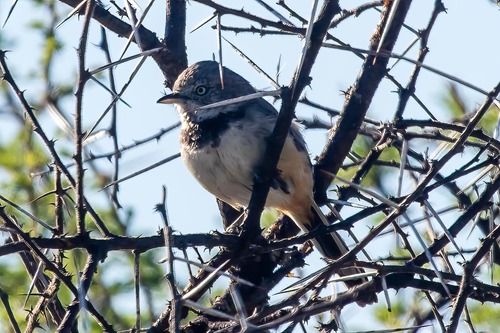
Banded Warbler

Banded Warbler

Sylvia boehmi

Silhouette: Martin Bulla, based on John Cox's illustration · PhyloPic

Daily sighting probability ~10% · With luck
at Ngorongoro Conservation Area

In 3 days ~30% in a week ~60%

321 Verified sightings at Ngorongoro Conservation Area From 2019 to 2026
1,630 In all 11 parks
April Best month
☀️ Diurnal When it's spotted

About the Banded Warbler

The banded parisoma (Curruca boehmi), banded tit warbler or banded warbler, is a species of Old World warbler in the family Sylviidae. It is found in Ethiopia, Kenya, Somalia, and Tanzania. Its natural habitat is dry savanna.

Measuring 4.75 in (12.1 cm) in length, this bird is identified as gray on top, white below, with a dark chest band. The bird has variable spotting on the throat, white patches on his wing and outer tail, and buff coloring on the belly and undertail.

Three subspecies are recognised: Curruca boehmi somalica (Friedmann, 1928) – Ethiopia, northwest Somalia and northeast Kenya Curruca boehmi marsabit (Van Someren, 1931) – central north Kenya Curruca boehmi boehmi (Reichenow, 1882) – south Kenya and Tanzania

Banded parisoma, Tanzania Birds Parisoma boehmi, ZipCodeZoo Wikipedia →

Global Distribution

Parks Where Found

# Park Country Daily sighting probability
1 Samburu National Reserve 🇰🇪 Kenya
~20%
2 Tarangire National Park 🇹🇿 Tanzania
~20%
3 Serengeti National Park 🇹🇿 Tanzania
~20%
4 Ruaha National Park 🇹🇿 Tanzania
~10%
5 Ngorongoro Conservation Area 🇹🇿 Tanzania
~10%
6 Tsavo West National Park 🇰🇪 Kenya
~10%
7 Amboseli National Park 🇰🇪 Kenya
~10%
8 Lake Manyara National Park 🇹🇿 Tanzania
~10%
9 Nairobi National Park 🇰🇪 Kenya
~10%
10 Mkomazi National Park 🇹🇿 Tanzania
<5%
11 Masai Mara National Reserve 🇰🇪 Kenya
<5%

Before you go

What are the chances of seeing a Banded Warbler in Ngorongoro Conservation Area?

With luck

About 10% of wildlife watchers report a Banded Warbler sighting in Ngorongoro Conservation Area on a given day, based on 321 verified sightings from GBIF citizen-science data from 2019 to 2026. It is the 152nd most-seen of the 519 birds we can rate there. Over three days the chance rises to about 30%, and over a week to about 60%, if each day is a fresh chance.

When is the best time to see a Banded Warbler in Ngorongoro Conservation Area?

February to April

In those months about 20% of wildlife watchers report a Banded Warbler in Ngorongoro Conservation Area on a given day, against under 5% in June–August and October, the lowest months.

What time of day is best to see a Banded Warbler?

Between 7 and 10 am

Across all the parks we cover, that three-hour window holds the most Banded Warbler sightings with a recorded time, and about 8 in 10 of them come between 6 am and 6 pm: it is a daytime animal.

Is Ngorongoro Conservation Area the best place to see a Banded Warbler?

5th of 11

Of the 11 parks where we can rate Banded Warbler sightings, Ngorongoro Conservation Area ranks 5th at about 10%. The best odds are in Samburu National Reserve (Kenya, about 20%), Tarangire National Park (Tanzania, about 20%) and Serengeti National Park (Tanzania, about 20%).

Where does the Banded Warbler sighting chance come from?

GBIF citizen-science records

It is estimated from how often the Banded Warbler is recorded against all the birds logged in Ngorongoro Conservation Area (321 verified sightings from 2019 to 2026), calibrated against known sighting rates. Figures are rounded to the nearest 10% because citizen-science data supports honest approximations, not decimals, and months with records from fewer than five people show "—". How it works.

← Back to Ngorongoro Conservation Area