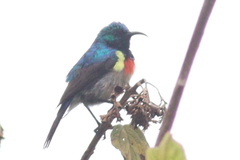
Eastern Double-collared Sunbird

Eastern Double-collared Sunbird

Cinnyris mediocris

Silhouette: Sheatherius · PhyloPic

LCLeast ConcernNTVUENCR
Daily sighting probability ~20% · Possible
at Ngorongoro Conservation Area

In 3 days ~50% in a week ~80%

561 Verified sightings at Ngorongoro Conservation Area From 2019 to 2026
880 In all 4 parks
April Best month
☀️ Diurnal When it's spotted

About the Eastern Double-collared Sunbird

The eastern double-collared sunbird (Cinnyris mediocris) is a species of bird in the family Nectariniidae. It is found in upland areas of Kenya and northern Tanzania. The eastern double-collared sunbird is a small species. The adult male has upper parts a metallic green, dark wings and tail, and a red breast band and olive belly. The beak is strongly curved and used to sip nectar from flowers. The adult female is olive above, with brown on the wings and yellowish-green underparts.

The eastern double-collared sunbird is native to mountainous regions of Kenya and northern Tanzania. It is found in forests, upland pasture, heathland and bamboo, at altitudes of between 600 and 1,500 m (2,000 and 4,900 ft). It descends to lower altitudes after the breeding season.

The eastern double-collared sunbird feeds alone or in pairs, or may join small flocks of mixed species, which are often led by the white-headed wood hoopoe (Phoeniculus bollei). It feeds on nectar, insects, spiders and small molluscs; the insects include flies, neuropterans and hymenopterans. Flying ants may be caught on the wing, prey invertebrates are picked off... Wikipedia →

Sounds

Song0:08

Kenya · 2026

© Ding Li Yong · XC1179395 · CC BY-NC-ND 4.0

Call0:14

Tanzania · 2024

© isaac kilusu · XC902623 · CC BY-NC-SA 4.0

Alarm call0:09

Kenya · 2022

© Lars Lachmann · XC749271 · CC BY-NC-SA 4.0

Global Distribution

Parks Where Found

# Park Country Daily sighting probability
1 Aberdare National Park 🇰🇪 Kenya
~60%
2 Ngorongoro Conservation Area 🇹🇿 Tanzania
~20%
3 Arusha National Park 🇹🇿 Tanzania
<5%
4 Serengeti National Park 🇹🇿 Tanzania
<5%

Before you go

What are the chances of seeing an Eastern Double-collared Sunbird in Ngorongoro Conservation Area?

Possible

About 20% of wildlife watchers report an Eastern Double-collared Sunbird sighting in Ngorongoro Conservation Area on a given day, based on 561 verified sightings from GBIF citizen-science data from 2019 to 2026. It is the 66th most-seen of the 519 birds we can rate there. Over three days the chance rises to about 50%, and over a week to about 80%, if each day is a fresh chance.

When is the best time to see an Eastern Double-collared Sunbird in Ngorongoro Conservation Area?

April and November

In those months about 40% of wildlife watchers report an Eastern Double-collared Sunbird in Ngorongoro Conservation Area on a given day, against about 10% in February and June, the lowest months. Those are among Ngorongoro Conservation Area's wettest months, with about 180 mm of rain a month against almost none in July.

What time of day is best to see an Eastern Double-collared Sunbird?

Between 9 am and noon

Across all the parks we cover, that three-hour window holds the most Eastern Double-collared Sunbird sightings with a recorded time, and about 8 in 10 of them come between 6 am and 6 pm: it is a daytime animal.

Is Ngorongoro Conservation Area the best place to see an Eastern Double-collared Sunbird?

2nd of 4

Of the 4 parks where we can rate Eastern Double-collared Sunbird sightings, Ngorongoro Conservation Area ranks 2nd at about 20%. The best odds are in Aberdare National Park (Kenya, about 60%).

Which relatives of the Eastern Double-collared Sunbird live in Ngorongoro Conservation Area?

Same genus: Cinnyris

The closest relatives of the Eastern Double-collared Sunbird that you can see in Ngorongoro Conservation Area (genus Cinnyris, Cinnyris Sunbirds) are Variable Sunbird (about 30%) and Beautiful Sunbird (about 20%), with each one's daily chance of a sighting.

Where does the Eastern Double-collared Sunbird sighting chance come from?

GBIF citizen-science records

It is estimated from how often the Eastern Double-collared Sunbird is recorded against all the birds logged in Ngorongoro Conservation Area (561 verified sightings from 2019 to 2026), calibrated against known sighting rates. Figures are rounded to the nearest 10% because citizen-science data supports honest approximations, not decimals, and months with records from fewer than five people show "—". How it works.

← Back to Ngorongoro Conservation Area