Little Rock-Thrush

Little Rock-Thrush

Monticola rufocinereus

Silhouette: Martin Bulla, based on François Desbordes' illustration · PhyloPic

LCLeast ConcernNTVUENCR
Daily sighting probability <5% · Rare
at Ngorongoro Conservation Area

In 3 days <5%

10 Verified sightings at Ngorongoro Conservation Area From 2019 to 2026
159 In all 3 parks
January Best month
☀️ Diurnal When it's spotted

About the Little Rock-Thrush

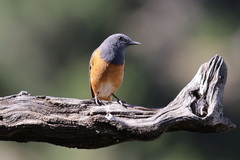
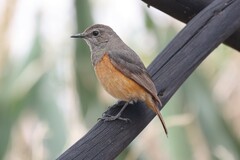
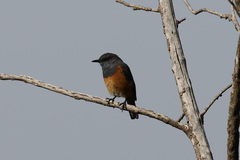
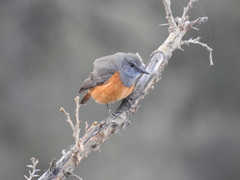
The little rock thrush (Monticola rufocinereus) is a species of passerine bird in the family Muscicapidae. It is found in Eritrea, Ethiopia, Kenya, Oman, Saudi Arabia, Somalia, South Sudan, Tanzania, Uganda, and Yemen. It is found in rocky (inland cliffs and mountain peaks) areas with some trees, and sometimes near settlements. At 15 to 16 centimetres (5.9 to 6.3 in) this is the smallest of the Muscicapidae. The male has the head, throat and upper mantle blue-grey, the underparts orange-red, except for the center blackish center tail and tips which form an inverted T shape. The female is duller and paler. It is readily mistaken for a redstart because of its habit of trembling its tail.

Sinclair, Ian; Ryan, Peter (2003). Birds of Africa south of the Sahara. Cape Town: Struik. Stevenson, Terry; Fanshawe, John (2002). A Field Guide to the Birds of East Africa. Wikipedia →

Sounds

Song0:26

Saudi Arabia · 2023

© Abdulrahman Alenezi · XC861634 · CC BY-NC-SA 4.0

Call0:11

Saudi Arabia · 2022

© David Darrell-Lambert · XC746201 · CC BY-NC-SA 4.0

Song0:21

Tanzania · 2021

© isaac kilusu · XC718375 · CC BY-NC-SA 4.0

Global Distribution

Parks Where Found

# Park Country Daily sighting probability
1 Lake Nakuru National Park 🇰🇪 Kenya
~10%
2 Arusha National Park 🇹🇿 Tanzania
<5%
3 Ngorongoro Conservation Area 🇹🇿 Tanzania
<5%

Before you go

What are the chances of seeing a Little Rock-Thrush in Ngorongoro Conservation Area?

Rare

Under 5% of wildlife watchers report a Little Rock-Thrush sighting in Ngorongoro Conservation Area on a given day, based on 10 verified sightings from GBIF citizen-science data from 2019 to 2026. It is the 464th most-seen of the 519 birds we can rate there. Over three days the chance rises to under 5%, if each day is a fresh chance.

When is the best time to see a Little Rock-Thrush in Ngorongoro Conservation Area?

Any time of year

In every month with enough records, under 5% of wildlife watchers report a Little Rock-Thrush in Ngorongoro Conservation Area on a given day, so our monthly data shows no clear season.

What time of day is best to see a Little Rock-Thrush?

Between 7 and 10 am

Across all the parks we cover, that three-hour window holds the most Little Rock-Thrush sightings with a recorded time, and about 8 in 10 of them come between 6 am and 6 pm: it is a daytime animal.

Is Ngorongoro Conservation Area the best place to see a Little Rock-Thrush?

3rd of 3

Of the 3 parks where we can rate Little Rock-Thrush sightings, Ngorongoro Conservation Area ranks 3rd at under 5%. The best odds are in Lake Nakuru National Park (Kenya, about 10%) and Arusha National Park (Tanzania, under 5%).

Where does the Little Rock-Thrush sighting chance come from?

GBIF citizen-science records

It is estimated from how often the Little Rock-Thrush is recorded against all the birds logged in Ngorongoro Conservation Area (10 verified sightings from 2019 to 2026), calibrated against known sighting rates. Figures are rounded to the nearest 10% because citizen-science data supports honest approximations, not decimals, and months with records from fewer than five people show "—". How it works.

← Back to Ngorongoro Conservation Area