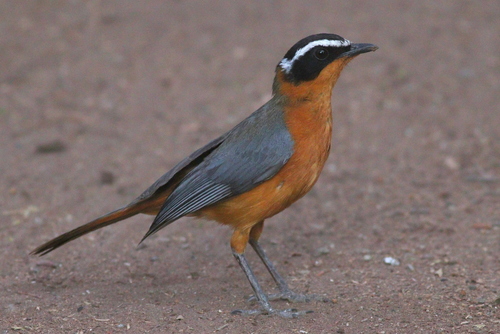
Moorland Chat

Moorland Chat

Pinarochroa sordida

Silhouette: Martin Bulla, based on François Desbordes' illustration · PhyloPic

LCLeast ConcernNTVUENCR
Daily sighting probability <5% · Rare
at Ngorongoro Conservation Area

In 3 days <5%

11 Verified sightings at Ngorongoro Conservation Area From 2019 to 2026
570 In all 3 parks
September Best month
☀️ Diurnal When it's spotted

About the Moorland Chat

The moorland chat (Pinarochroa sordida), also known as the alpine chat or hill chat, is a species of songbird in the Old World flycatcher family. It is endemic to the eastern Afromontane. It lives at high altitudes on moors and grassland, usually above 3,400 m (11,100 ft), but can live as low as 2,100 m (6,900 ft). It has a short tail and long legs. It is bold and will approach people.

The moorland chat was formally described in 1837 by the German naturalist Eduard Rüppell from a specimen collected in the Simien Mountains of northern Ethiopia. Rüppell coined the binomial name Saxicola sordica. The chat was discovered on Mount Elgon on the Uganda-Kenya border by Frederick Jackson. The English geographer Halford Mackinder brought back the same bird from Mount Kenya in 1899. He presented a paper on the first ascent to the Royal Geographical Society in 1900. The scientific results of his expedition were discussed in detail afterwards.

A very curious little bird was found by Mr Jackson on Mount Elgon at a height of 11,000 feet, and I remember saying to Mr. Mackinder that he was bound to find the same sort of little chat on Mount Kenya, at a height of 11,000 feet. This... Wikipedia →

Sounds

Call0:08

Ethiopia · 2014

© Andrew Spencer · XC210016 · CC BY-NC-SA 4.0

Call0:08

Kenya · 2026

© Ding Li Yong · XC1179727 · CC BY-NC-ND 4.0

Call0:43

Kenya · 2018

© Frank Lambert · XC455656 · CC BY-NC-ND 4.0

Global Distribution

Parks Where Found

# Park Country Daily sighting probability
1 Bale Mountains National Park 🇪🇹 Ethiopia
~80%
2 Aberdare National Park 🇰🇪 Kenya
~50%
3 Ngorongoro Conservation Area 🇹🇿 Tanzania
<5%

Cities Where Found

# City Country Daily sighting probability
1 Addis Ababa 🇪🇹 Ethiopia
~10%

Before you go

What are the chances of seeing a Moorland Chat in Ngorongoro Conservation Area?

Rare

Under 5% of wildlife watchers report a Moorland Chat sighting in Ngorongoro Conservation Area on a given day, based on 11 verified sightings from GBIF citizen-science data from 2019 to 2026. It is the 490th most-seen of the 519 birds we can rate there. Over three days the chance rises to under 5%, if each day is a fresh chance.

When is the best time to see a Moorland Chat in Ngorongoro Conservation Area?

Any time of year

In every month with enough records, under 5% of wildlife watchers report a Moorland Chat in Ngorongoro Conservation Area on a given day, so our monthly data shows no clear season.

What time of day is best to see a Moorland Chat?

Between 11 am and 2 pm

Across all the parks we cover, that three-hour window holds the most Moorland Chat sightings with a recorded time, and about 9 in 10 of them come between 6 am and 6 pm: it is a daytime animal.

Is Ngorongoro Conservation Area the best place to see a Moorland Chat?

3rd of 3

Of the 3 parks where we can rate Moorland Chat sightings, Ngorongoro Conservation Area ranks 3rd at under 5%. The best odds are in Bale Mountains National Park (Ethiopia, about 80%) and Aberdare National Park (Kenya, about 50%).

Which relatives of the Moorland Chat live in Ngorongoro Conservation Area?

Same family: Muscicapidae

The closest relatives of the Moorland Chat that you can see in Ngorongoro Conservation Area (family Muscicapidae, Old World Flycatchers, Robins, and Chats) are Capped Wheatear (about 30%), Northern Anteater-Chat (about 30%) and White-eyed Slaty Flycatcher (about 30%), with each one's daily chance of a sighting.

Where does the Moorland Chat sighting chance come from?

GBIF citizen-science records

It is estimated from how often the Moorland Chat is recorded against all the birds logged in Ngorongoro Conservation Area (11 verified sightings from 2019 to 2026), calibrated against known sighting rates. Figures are rounded to the nearest 10% because citizen-science data supports honest approximations, not decimals, and months with records from fewer than five people show "—". How it works.

← Back to Ngorongoro Conservation Area