Slender-tailed Nightjar

Slender-tailed Nightjar

Caprimulgus clarus

Silhouette: Ferran Sayol · PhyloPic

LCLeast ConcernNTVUENCR
Daily sighting probability <5% · Rare
at Ngorongoro Conservation Area

In 3 days <5%

15 Verified sightings at Ngorongoro Conservation Area From 2019 to 2026
425 In all 10 parks
April Best month
☀️🌙 Day & Night When it's spotted

About the Slender-tailed Nightjar

The slender-tailed nightjar (Caprimulgus clarus) is a species of nightjar in the family Caprimulgidae. It is found in parts of eastern and central Africa, including the Democratic Republic of the Congo, Ethiopia, Kenya, Somalia, South Sudan, Tanzania, and Uganda.

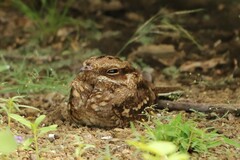
The slender-tailed nightjar is a medium-sized nightjar, measuring approximately 25–28 cm in length. It has cryptically patterned brown, grey, and black plumage, providing effective camouflage against dry ground and leaf litter. The head is relatively large and flattened, with a small bill and a very wide gape adapted for catching insects in flight. The tail is long and tapered, with the central feathers extending beyond the others, giving rise to the species’ common name.

Sexes are similar in appearance, though males may show slightly more prominent pale patches on the wings. No subspecies are currently recognized. The species is distributed across eastern and parts of central Africa. It inhabits dry, open environments including savanna, dry woodland, bushland, open scrub, rocky areas, and sparsely vegetated grassland. It is often associated with semi-arid regions and may occur... Wikipedia →

Sounds

Song0:43

Ethiopia · 2024

© Marcin Sołowiej · XC962780 · CC BY-NC-SA 4.0

Flight call0:16

Kenya · 2017

© isaac kilusu · XC390809 · CC BY-NC-SA 4.0

Song1:02

Ethiopia · 2015

© Peter Boesman · XC300078 · CC BY-NC-ND 4.0

Global Distribution

Parks Where Found

# Park Country Daily sighting probability
1 Samburu National Reserve 🇰🇪 Kenya
~10%
2 Tsavo West National Park 🇰🇪 Kenya
~10%
3 Amboseli National Park 🇰🇪 Kenya
~10%
4 Lake Mburo National Park 🇺🇬 Uganda
<5%
5 Tarangire National Park 🇹🇿 Tanzania
<5%
6 Kidepo Valley National Park 🇺🇬 Uganda
<5%
7 Murchison Falls National Park 🇺🇬 Uganda
<5%
8 Tsavo East National Park 🇰🇪 Kenya
<5%
9 Serengeti National Park 🇹🇿 Tanzania
<5%
10 Ngorongoro Conservation Area 🇹🇿 Tanzania
<5%

Cities Where Found

# City Country Daily sighting probability
1 Mombasa 🇰🇪 Kenya
~10%

Before you go

What are the chances of seeing a Slender-tailed Nightjar in Ngorongoro Conservation Area?

Rare

Under 5% of wildlife watchers report a Slender-tailed Nightjar sighting in Ngorongoro Conservation Area on a given day, based on 15 verified sightings from GBIF citizen-science data from 2019 to 2026. It is the 453rd most-seen of the 519 birds we can rate there. Over three days the chance rises to under 5%, if each day is a fresh chance.

When is the best time to see a Slender-tailed Nightjar in Ngorongoro Conservation Area?

Any time of year

In every month with enough records, under 5% of wildlife watchers report a Slender-tailed Nightjar in Ngorongoro Conservation Area on a given day, so our monthly data shows no clear season.

What time of day is best to see a Slender-tailed Nightjar?

Between 5 and 8 pm

Across all the parks we cover, that three-hour window holds the most Slender-tailed Nightjar sightings with a recorded time, and about half of them come between 6 am and 6 pm: it is seen both by day and at night.

Is Ngorongoro Conservation Area the best place to see a Slender-tailed Nightjar?

10th of 10

Of the 10 parks where we can rate Slender-tailed Nightjar sightings, Ngorongoro Conservation Area ranks 10th at under 5%. The best odds are in Samburu National Reserve (Kenya, about 10%), Tsavo West National Park (Kenya, about 10%) and Amboseli National Park (Kenya, about 10%).

Where does the Slender-tailed Nightjar sighting chance come from?

GBIF citizen-science records

It is estimated from how often the Slender-tailed Nightjar is recorded against all the birds logged in Ngorongoro Conservation Area (15 verified sightings from 2019 to 2026), calibrated against known sighting rates. Figures are rounded to the nearest 10% because citizen-science data supports honest approximations, not decimals, and months with records from fewer than five people show "—". How it works.

← Back to Ngorongoro Conservation Area