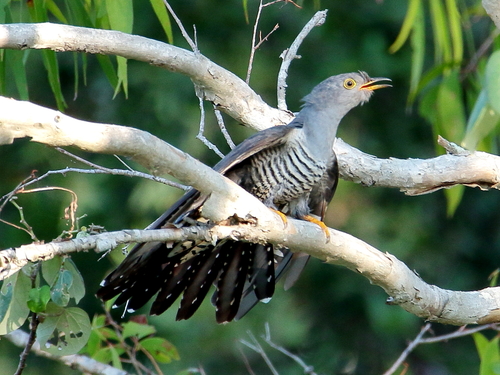
Northern Hawk-Cuckoo

Northern Hawk-Cuckoo

Cuculus hyperythrus

LCLeast ConcernNTVUENCR
Daily sighting probability <5% · Rare
at Nikko National Park

In 3 days ~10% in a week ~20%

10 Verified sightings at Nikko National Park From 2019 to 2026
10 In 1 park
May Best month
☀️ Diurnal When it's spotted

About the Northern Hawk-Cuckoo

The northern hawk-cuckoo or rufous hawk-cuckoo (Hierococcyx hyperythrus) is a species of cuckoo found in eastern China, North and South Korea, far eastern Russia, and Japan. Northern populations migrate to overwinter in Borneo. This elusive species is considered rare over most of its range and many of its life history traits remain understudied. It is known to perch in the crowns of tall trees, making direct observation difficult.

The northern hawk-cuckoo, along with the Malaysian hawk-cuckoo (Hierococcyx fugax) and the Hodgson’s hawk-cuckoo (Hierococcyx nisicolor), were all once considered the same species, H. fugax. All three were recently split into their own monotypic species.

The genus Hierococcyx are called hawk-cuckoos due to their broad, rounded wings and plumage which lend them great resemblance to Japanese and Chinese sparrowhawks. They are similar enough that in the field hawk-cuckoos are often mistaken for an Accipiter.

The northern hawk-cuckoo is one of the smallest in the genus Hierococcyx at 28-30 cm in length, a weight between 99.0-147.8 g, and an average wing length of 20.2 cm, although measurements can vary slightly between sexes.

Both sexes sport... Wikipedia →

Sounds

Song0:49

Russian Federation · 1994

© Vadim Ivushkin · XC805631 · CC BY-NC-SA 4.0

Call0:17

Russian Federation · 2015

© Albert Lastukhin · XC268798 · CC BY-NC-SA 4.0

Song0:42

Japan · 2015

© Peter Boesman · XC285794 · CC BY-NC-ND 4.0

Global Distribution

Parks Where Found

# Park Country Daily sighting probability
1 Nikko National Park 🇯🇵 Japan
<5%

More parks will be added in future updates.

Cities Where Found

# City Country Daily sighting probability
1 Shanghai 🇨🇳 China
~10%
2 Beijing 🇨🇳 China
<5%
3 Nanjing 🇨🇳 China
<5%
4 Hangzhou 🇨🇳 China
<5%

Before you go

What are the chances of seeing a Northern Hawk-Cuckoo in Nikko National Park?

Rare

Under 5% of wildlife watchers report a Northern Hawk-Cuckoo sighting in Nikko National Park on a given day, based on 10 verified sightings from GBIF citizen-science data from 2019 to 2026. It is the 85th most-seen of the 102 birds we can rate there. Over three days the chance rises to about 10%, and over a week to about 20%, if each day is a fresh chance.

When is the best time to see a Northern Hawk-Cuckoo in Nikko National Park?

May

In that month about 10% of wildlife watchers report a Northern Hawk-Cuckoo in Nikko National Park on a given day, against under 5% in June to April, the lowest months.

What time of day is best to see a Northern Hawk-Cuckoo?

Between 8 and 11 am

Across all the parks we cover, that three-hour window holds the most Northern Hawk-Cuckoo sightings with a recorded time, and about 9 in 10 of them come between 6 am and 6 pm: it is a daytime animal.

Where else can you see a Northern Hawk-Cuckoo?

Only Nikko National Park, in our data

Nikko National Park is the only park on Wallace's Line with enough records to rate Northern Hawk-Cuckoo sightings: under 5% of wildlife watchers there report one on a given day.

Which relatives of the Northern Hawk-Cuckoo live in Nikko National Park?

Same genus: Cuculus

The closest relatives of the Northern Hawk-Cuckoo that you can see in Nikko National Park (genus Cuculus, Typical Old World Cuckoos) are Common Cuckoo (about 30%), Lesser Cuckoo (about 20%) and Oriental Cuckoo (about 10%), with each one's daily chance of a sighting.

Where does the Northern Hawk-Cuckoo sighting chance come from?

GBIF citizen-science records

It is estimated from how often the Northern Hawk-Cuckoo is recorded against all the birds logged in Nikko National Park (10 verified sightings from 2019 to 2026), calibrated against known sighting rates. Figures are rounded to the nearest 10% because citizen-science data supports honest approximations, not decimals, and months with records from fewer than five people show "—". How it works.

← Back to Nikko National Park