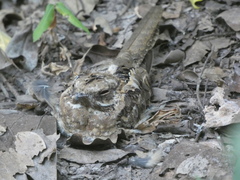
Long-tailed Nightjar

Long-tailed Nightjar

Caprimulgus climacurus

Silhouette: Ferran Sayol · PhyloPic

LCLeast ConcernNTVUENCR
Daily sighting probability ~10% · With luck
at Niokolo-Koba National Park

In 3 days ~30% in a week ~50%

31 Verified sightings at Niokolo-Koba National Park From 2019 to 2026
62 In all 2 parks
December Best month
☀️🌙 Day & Night When it's spotted

About the Long-tailed Nightjar

The long-tailed nightjar (Caprimulgus climacurus) is one of 98 species of nightjar in the family Caprimulgidae, the "true nightjars". It is a nocturnal, insectivorous bird characterized by its distinctive long tail. It is found throughout mainland Africa in open areas, arid semi-deserts, and savannas, with common sightings alongside roadways.

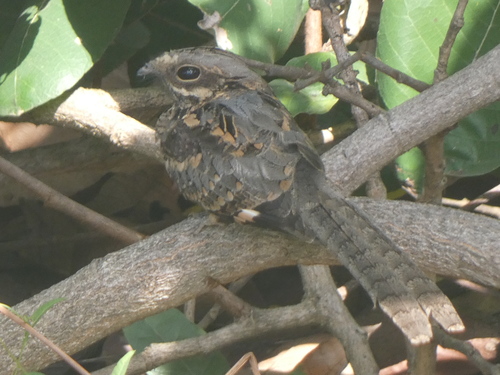
The long-tailed nightjar ranges from about 29–43 cm in size and is sexually dimorphic. It has a long, graduated tail, with its size ranging from 200-304 mm in males and 156-256 mm in females. Its plumage is primarily rufous-brown to gray-brown in colour, but has pale bands (white in males, buff in females) across the forewing, as well as along the trailing edge of the flight feathers. The males can also have a white throat patch and brown bills, legs and feet. A sexually immature Long-tailed Nightjar looks more similar to a female, however its plumage tends to be paler.

The identification characteristics of the Long-tailed Nightjar are similar to those of the slender-tailed nightjar (Caprimulgus clarus) and the square-tailed nightjar (Caprimulgus fossii). Specifically, when the long-tailed Nightjar is non-breeding or moulting... Wikipedia →
Sounds

Song1:17

Nigeria · 2022

© Dickson Anoibi Matthew · XC757075 · CC BY-NC-SA 4.0

Call0:38

Senegal · 2016

© Bram Piot · XC343538 · CC BY-NC-SA 4.0

Song1:14

Ghana · 2022

© Peter Boesman · XC718940 · CC BY-NC-ND 4.0

Global Distribution

Parks Where Found

# Park Country Daily sighting probability
1 Niokolo-Koba National Park 🇸🇳 Senegal
~10%
2 Murchison Falls National Park 🇺🇬 Uganda
<5%

Cities Where Found

# City Country Daily sighting probability
1 Accra 🇬🇭 Ghana
<5%
2 Serrekunda 🇬🇲 Gambia
<5%

Before you go

What are the chances of seeing a Long-tailed Nightjar in Niokolo-Koba National Park?

With luck

About 10% of wildlife watchers report a Long-tailed Nightjar sighting in Niokolo-Koba National Park on a given day, based on 31 verified sightings from GBIF citizen-science data from 2019 to 2026. It is the 132nd most-seen of the 215 birds we can rate there. Over three days the chance rises to about 30%, and over a week to about 50%, if each day is a fresh chance.

When is the best time to see a Long-tailed Nightjar in Niokolo-Koba National Park?

December

In that month about 20% of wildlife watchers report a Long-tailed Nightjar in Niokolo-Koba National Park on a given day, against under 5% in February and April, the lowest months. That is one of Niokolo-Koba National Park's driest months, with almost no rain against 300 mm in August. May–July and October have too few records to rate.

What time of day is best to see a Long-tailed Nightjar?

Between 7 and 10 pm

Across all the parks we cover, that three-hour window holds the most Long-tailed Nightjar sightings with a recorded time, and about half of them come between 6 am and 6 pm: it is seen both by day and at night.

Is Niokolo-Koba National Park the best place to see a Long-tailed Nightjar?

Yes

Of the 2 parks where we can rate Long-tailed Nightjar sightings, Niokolo-Koba National Park has the highest daily chance: about 10%. Next come Murchison Falls National Park (Uganda, under 5%).

Where does the Long-tailed Nightjar sighting chance come from?

GBIF citizen-science records

It is estimated from how often the Long-tailed Nightjar is recorded against all the birds logged in Niokolo-Koba National Park (31 verified sightings from 2019 to 2026), calibrated against known sighting rates. Figures are rounded to the nearest 10% because citizen-science data supports honest approximations, not decimals, and months with records from fewer than five people show "—". How it works.

← Back to Niokolo-Koba National Park