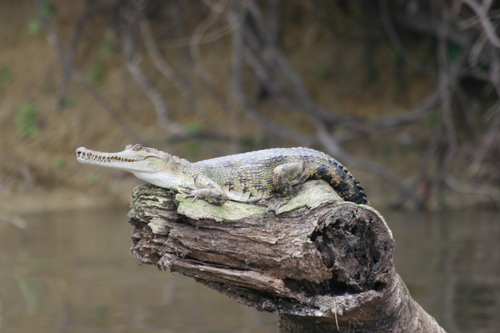
Central African slender-snouted crocodile

Central African slender-snouted crocodile

Mecistops leptorhynchus

Daily sighting probability ~30% · Possible
at Odzala-Kokoua National Park

In 3 days ~70% in a week ~90%

17 Verified sightings at Odzala-Kokoua National Park From 2019 to 2026
17 In 1 park
May Best month
☀️ Diurnal When it's spotted

About the Central African slender-snouted crocodile

The Central African slender-snouted crocodile (Mecistops leptorhynchus) is one of two species of crocodiles in the genus Mecistops. It was once thought to be a population of the West African slender-snouted crocodile (Mecistops cataphractus) but was elevated to a species after two detailed studies, one in 2014 and the other in 2018.

The species was described in 1835 on the basis of a specimen that had died at the London Zoo and had been claimed to have been collected in the Fernando Po. Studies of specimens and their molecular sequences established that there were two different species which occurred in distinct hydrological zones. M. leptorhynchus is easily differentiated morphologically from M. cataphractus by the absence of a round tubercle or boss on the squamosal scale at the back of the head in the former and present in the latter.

The genus name Mecistops is most probably derived from the Ancient Greek words μήκιστ (mēkist), meaning "longest", and ὄψ (óps) meaning "face". The specific epithet leptorhynchus is derived from the Ancient Greek words λεπτός (leptós), meaning "thin", and ῥύγχος (rhúnkhos), meaning "snout". Bennett (1835) may have named the species so... Wikipedia →
Sounds

Recording2:09

Gabon · 2022

© bureaubenjamin · iNaturalist · CC BY-NC 4.0

Global Distribution

Parks Where Found

# Park Country Daily sighting probability
1 Odzala-Kokoua National Park 🇨🇬 Republic of the Congo
~30%

More parks will be added in future updates.

Zoos & Centres Where Found

# Zoo / Centre Country
1 Kansas City Zoo 🇺🇸 United States In captivity
2 Oregon Zoo 🇺🇸 United States In captivity
3 La Ferme aux crocodiles 🇫🇷 France In captivity
4 L'Oceanogràfic 🇪🇸 Spain In captivity
5 Kalimba Reptile Park 🇿🇲 Zambia In captivity
6 Sobela Ocean Aquarium 🇺🇸 United States In captivity

Before you go

What are the chances of seeing a Central African slender-snouted crocodile in Odzala-Kokoua National Park?

Possible

About 30% of wildlife watchers report a Central African slender-snouted crocodile sighting in Odzala-Kokoua National Park on a given day, based on 17 verified sightings from GBIF citizen-science data from 2019 to 2026. It is the most-seen of the 8 reptiles we can rate there. Over three days the chance rises to about 70%, and over a week to about 90%, if each day is a fresh chance.

When is the best time to see a Central African slender-snouted crocodile in Odzala-Kokoua National Park?

May and August

In those months about 50% of wildlife watchers report a Central African slender-snouted crocodile in Odzala-Kokoua National Park on a given day, against under 5% in January, March, June, September and November, the lowest months.

What time of day is best to see a Central African slender-snouted crocodile?

Between 10 am and 1 pm

Across all the parks we cover, that three-hour window holds the most Central African slender-snouted crocodile sightings with a recorded time, and nearly all of them come between 6 am and 6 pm: it is a daytime animal.

Where else can you see a Central African slender-snouted crocodile?

Only Odzala-Kokoua National Park, in our data

Odzala-Kokoua National Park is the only park on Wallace's Line with enough records to rate Central African slender-snouted crocodile sightings: about 30% of wildlife watchers there report one on a given day.

Where does the Central African slender-snouted crocodile sighting chance come from?

GBIF citizen-science records

It is estimated from how often the Central African slender-snouted crocodile is recorded against all the reptiles logged in Odzala-Kokoua National Park (17 verified sightings from 2019 to 2026), calibrated against known sighting rates. Figures are rounded to the nearest 10% because citizen-science data supports honest approximations, not decimals, and months with records from fewer than five people show "—". How it works.

← Back to Odzala-Kokoua National Park